
Why Does Printed Paper Crack Along a Fold? Causes and Prevention
Why Does Printed Paper Crack Along a Fold? Causes and Prevention
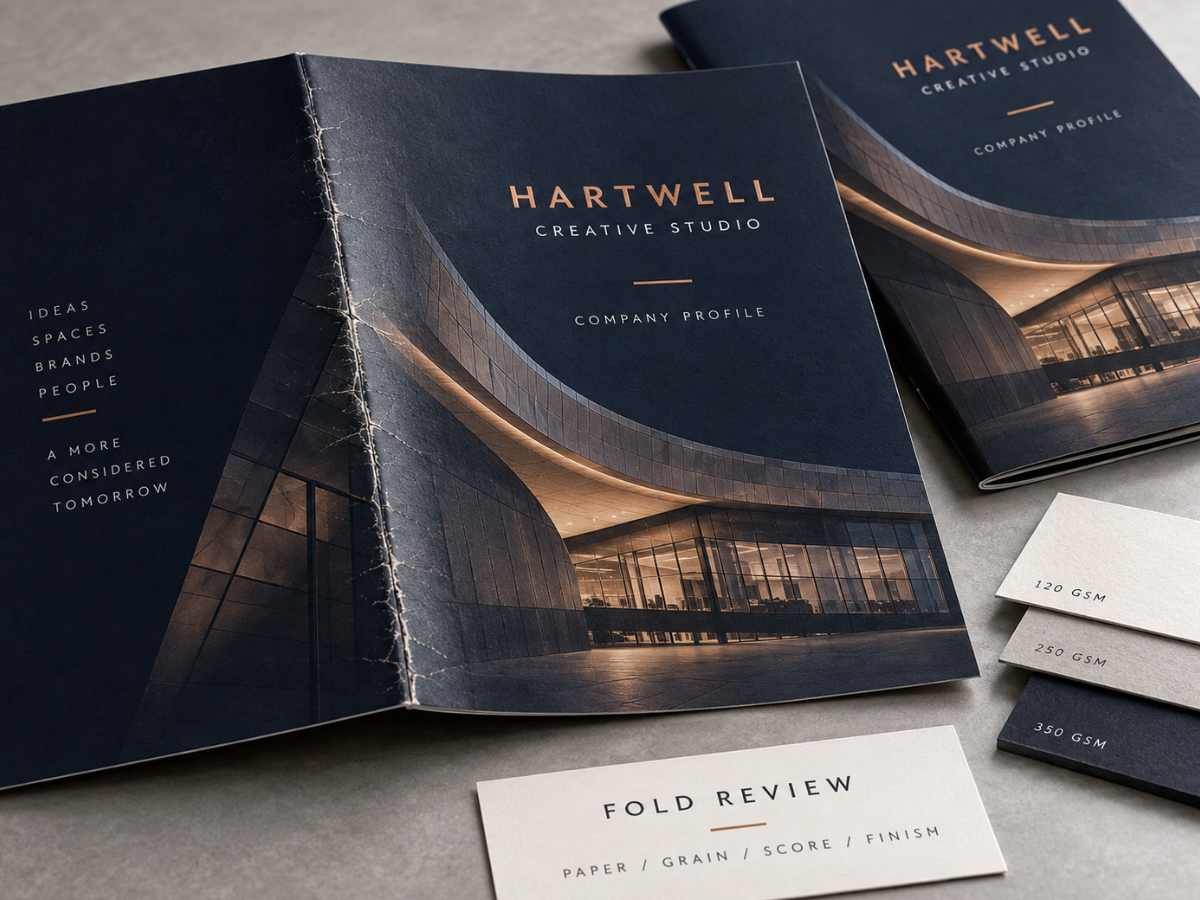
Printed paper can crack along a fold when the paper fibres, surface coating or printed layer cannot accommodate the stress of bending. Heavier stocks, dense ink coverage, paper grain direction and the folding process can all contribute. Appropriate stock selection, scoring and production planning can reduce the risk, although no single technique guarantees a completely invisible fold on every material.
A brochure can look excellent while it is lying flat on a table. The photographs are sharp, the colours are rich and the finished stock feels substantial. Then someone opens it, and a thin white line appears along the crease.
On a pale background, the line might be barely noticeable. Across a dark blue, black or burgundy panel, it can become one of the most visible parts of the design.
This is commonly called fold cracking. It is a physical problem involving the paper or printed surface, not necessarily an error in the artwork or colour reproduction.
Understanding why it happens is useful when ordering brochures, greeting cards, folded business cards and other print products that must bend along a defined line.
Some risk factors are established before the artwork reaches production. Others relate to the chosen stock or finishing method. The earlier those decisions are considered, the easier it is to avoid a disappointing result.
1. What Actually Cracks When Printed Paper Is Folded?
Paper is made from fibres that form a sheet with a particular thickness and structure. Many printing papers also have a surface coating, while the printing process adds ink, toner or another image-forming layer.
When the sheet is folded, the outside of the bend must stretch around a larger radius than the inside.
If the material cannot accommodate that movement, the surface may fracture. Depending on the paper and printing process, the visible line may involve the coating, printed image, paper fibres or a combination of these layers.
On a dark printed background, a crack may expose the lighter paper or coating beneath. That contrast makes the defect more obvious.
This is why a crack can appear white even when there is nothing wrong with the original dark artwork.
2. Why Are Cracks More Noticeable on Dark Colours?
Dark backgrounds do not necessarily mean that a fold will fail. They make surface damage easier to see.
Imagine two otherwise identical brochures. One has a white background running through the centre fold. The other has a solid dark navy panel extending across it.
Both pieces experience mechanical stress when folded. If the surface develops a fine fracture, the lighter underlying material will stand out much more strongly against the navy.
Heavy printed coverage can also affect the behaviour of the surface, depending on the ink, toner, coating and production process.
That does not mean businesses should avoid dark designs. It means dark areas crossing a prominent fold deserve more careful consideration during artwork and production planning.
3. Does Thicker Paper Crack More Easily?
Heavier or thicker paper can present additional folding challenges, but paper weight alone does not determine whether a crack will appear.
A thicker sheet generally needs to accommodate more deformation as it bends. Its construction, stiffness and surface characteristics also influence how it behaves.
Two stocks described using similar weight values may fold differently because they are not constructed in the same way.
For example, a heavily coated cover stock may behave differently from a more flexible uncoated sheet.
If a brochure must open and close repeatedly, selecting the heaviest available paper is not automatically the best decision.
Pryntco's Paper Weight Guide explains the differences between text stock, cover stock and cardstock when choosing materials for print projects.
4. Why Paper Grain Direction Matters
Paper fibres tend to align predominantly in one direction during manufacturing. This is known as the paper's grain direction.
Grain direction influences how the sheet bends, folds and responds to changes in its environment.
In many conventional folding applications, positioning the main fold parallel to the paper grain produces a more cooperative bend than folding against it.
Folding across the grain can create additional resistance and may increase the likelihood of visible cracking, especially on thicker or coated materials.
However, grain direction is only one part of the problem. A correctly oriented sheet can still develop cracks if its surface, printing method or finishing setup is unsuitable.
Paper grain may also be constrained by the available stock, sheet layout and production method. Businesses should discuss unusual folding requirements before assuming a particular grain arrangement can be provided.
5. What Is Scoring, and How Does It Help?
Scoring is a finishing process that creates a controlled line in a sheet before it is folded.
The score helps the material bend in a more predictable location and can reduce the stress that would otherwise be concentrated along an uncontrolled crease.
This is especially useful for many heavier printed stocks.
However, scoring is not the same as cutting through the paper. The intention is to prepare the fold while preserving the integrity of the finished piece.
The correct scoring method depends on the stock, thickness, coating, grain and folding equipment.
An unsuitable score can still produce poor results. In some cases, an incorrectly prepared crease can damage the surface rather than improve it.
Scoring should therefore be treated as a production specification, not as a universal repair for every cracking problem.
6. Does Every Folded Brochure Need Scoring?
No.
The need depends on the selected product configuration and production process.
A lightweight brochure stock may fold cleanly under suitable production conditions without the same preparation required by a heavier card.
Other materials may benefit substantially from scoring.
The important step is to select a product designed for the intended finished format rather than ordering an unrelated flat print and assuming it can be folded afterward without issues.
Pryntco offers Custom Brochures in half-fold, tri-fold, Z-fold and accordion configurations.
The folding and finishing requirements should follow the selected product rather than an assumption that all brochure stocks behave identically.
7. How Can Coatings and Laminates Affect a Fold?
Coated paper and laminated print introduce additional surface characteristics that influence folding behaviour.
Depending on the product, the coating or laminate may be less flexible than the underlying sheet. A pronounced bend can create stress in those layers.
This is particularly relevant when a design uses broad areas of solid colour that extend through the crease.
A smooth, premium finish can look excellent when flat but still require suitable folding preparation.
Don't assume a laminate will automatically prevent cracking. The complete construction must be appropriate for the intended fold.
When choosing between finishes, consider both the visual result and how the printed piece will be used.
8. Is Cracking More Common With Digital Printing?
Some digitally printed materials can be susceptible to visible fold cracking, particularly when heavy toner coverage or other surface characteristics are involved.
However, the words "digital printing" and "offset printing" are too broad to predict the final result by themselves.
Equipment, inks, toner, stock, finishing and environmental conditions all matter.
Commercial print production uses several methods, each with its own material compatibility and limitations.
The most useful question is not whether one printing method is universally better, but whether the complete proposed production process is appropriate for the intended folded piece.
9. Can You Prevent Cracking by Keeping Ink Away From the Fold?
Artwork can sometimes be adjusted to make cracking less conspicuous, but design changes should support the visual concept rather than undermine it.
For example, a solid dark background passing directly through the fold may make a pale crack obvious.
A designer might instead use a lighter background near the fold, adjust the photographic composition or position a natural visual transition along the crease.
These decisions are easier when the folding structure is known before the artwork is finalized.
However, leaving a white strip through the middle of an otherwise continuous design is not always appropriate or necessary.
Artwork changes can reduce visual exposure to a crack. They do not remove the physical stress involved in folding.
10. What About Photographs That Cross a Fold?
A photograph spanning two panels can create an attractive continuous image, but it needs to work both when the piece is open and when it is folded.
Important faces, product details, small lettering and other critical elements should generally not depend on perfect reproduction directly across a crease.
Minor folding variation can affect alignment, and visible cracking can interrupt a dark or detailed part of the image.
One practical approach is to position the most important photographic subject away from the fold while allowing less critical background areas to cross it.
This is particularly useful for company brochures and folded promotional materials with large hero images.
11. Does the Folding Style Change the Risk?
Different folded products contain different numbers of creases and may fold in different directions.
A half-fold brochure has one main fold. A tri-fold and Z-fold contain two, while an accordion design may contain several alternating folds.
Each crease is a point where the sheet must bend.
That doesn't mean an accordion brochure is inherently unsuitable for coated stock. It means the artwork, paper and finishing need to be planned for the actual folding structure.
Pryntco's Brochure Folding Guide
Use the exact artwork template for the chosen format and identify all significant fold locations before approving the final design.
12. Can Folded Business Cards and Greeting Cards Crack?
Yes. The same underlying mechanical considerations apply to other printed products that bend along a crease.
Folded business cards may use thicker stock than a typical brochure. Greeting cards also need to open cleanly without showing an unattractive fracture through the design.
For either product, a heavy dark background crossing the fold may make cracking more noticeable.
Choose a product configuration intended for folding, and confirm any unusual material or finishing requirements rather than attempting to fold a heavy flat card yourself.
Pryntco offers Greeting Cards with selectable paper and finishing options.
13. What Should You Check Before Approving a Folded Print Order?
Begin with the intended finished object.
For a brochure, determine how it will be folded, where the visible creases will fall and how frequently readers will open it.
Then review the material and artwork together.
- Confirm the exact product and folding configuration.
- Review the available paper stocks rather than choosing by thickness alone.
- Identify dark backgrounds and photographs crossing fold lines.
- Keep important text and detailed graphics away from vulnerable crease areas.
- Use the correct final-size artwork template.
- Discuss grain direction or scoring when relevant to the project.
- Confirm any special coatings or finishing requirements.
- Review a representative physical sample when the fold appearance is especially important.
Not every project requires additional sampling. The purpose is to identify material uncertainties before committing to a substantial order.
14. Can a Physical Sample Reveal Problems Before Production?
A properly selected sample or prototype can be useful when the behaviour of the fold is important.
There is a difference between a basic paper dummy and a production-representative printed sample.
A paper dummy can show how the panels close and whether the layout works. It cannot establish how the actual chosen coated stock and printed surface will behave.
A more representative sample may provide better information about the intended construction, depending on how it is produced.
Ask the printer what kind of sample is available and what it is intended to demonstrate. Sample availability, additional cost and production conditions should be confirmed before ordering.
15. What If Your Printed Brochures Have Already Cracked?
First, examine where the damage appears.
Does it follow the entire fold, or is it most obvious across a dark background? Is the printed surface breaking while the paper underneath remains intact? Is the crease positioned correctly?
Compare several copies, including examples that have been opened only once and those that have been handled repeatedly.
Take clear photographs under ordinary lighting and keep representative samples.
When discussing the issue with the printer, provide the original order details and describe the problem precisely.
For example:
"The dark background on the front cover has developed a pale line along the centre fold after opening. We would like to review the stock and folding options before reordering."
That gives the production team useful information for evaluating the issue.
Don't assume that pressing the fold flatter or applying an improvised coating afterward will restore the original printed surface.
16. How to Reduce Fold Cracking on Your Next Order
The best approach is to consider the fold before choosing the final stock and approving the design.
A heavy, coated brochure with dark graphics across several creases has different production requirements from a lightweight informational leaflet.
Begin with the intended use. Choose a suitable folded product, confirm the available paper and finishing options, and prepare the artwork around the actual crease positions.
If the appearance of the fold is particularly important, discuss the requirement before production and ask whether an appropriate physical sample is available.
Fold cracking is not always completely avoidable, but informed stock selection, artwork planning and finishing decisions can reduce the risk of an unpleasant surprise.
For a new project, explore Pryntco's Brochure Printing options. If the project has unusual paper, colour coverage or folding requirements, request a custom quote from Pryntco and describe the intended construction before finalizing the order.

