How to Track Print Marketing Results: QR Codes, Promo Codes, Landing Pages and Campaign Attribution
How to Track Print Marketing Results: QR Codes, Promo Codes, Landing Pages and Campaign Attribution
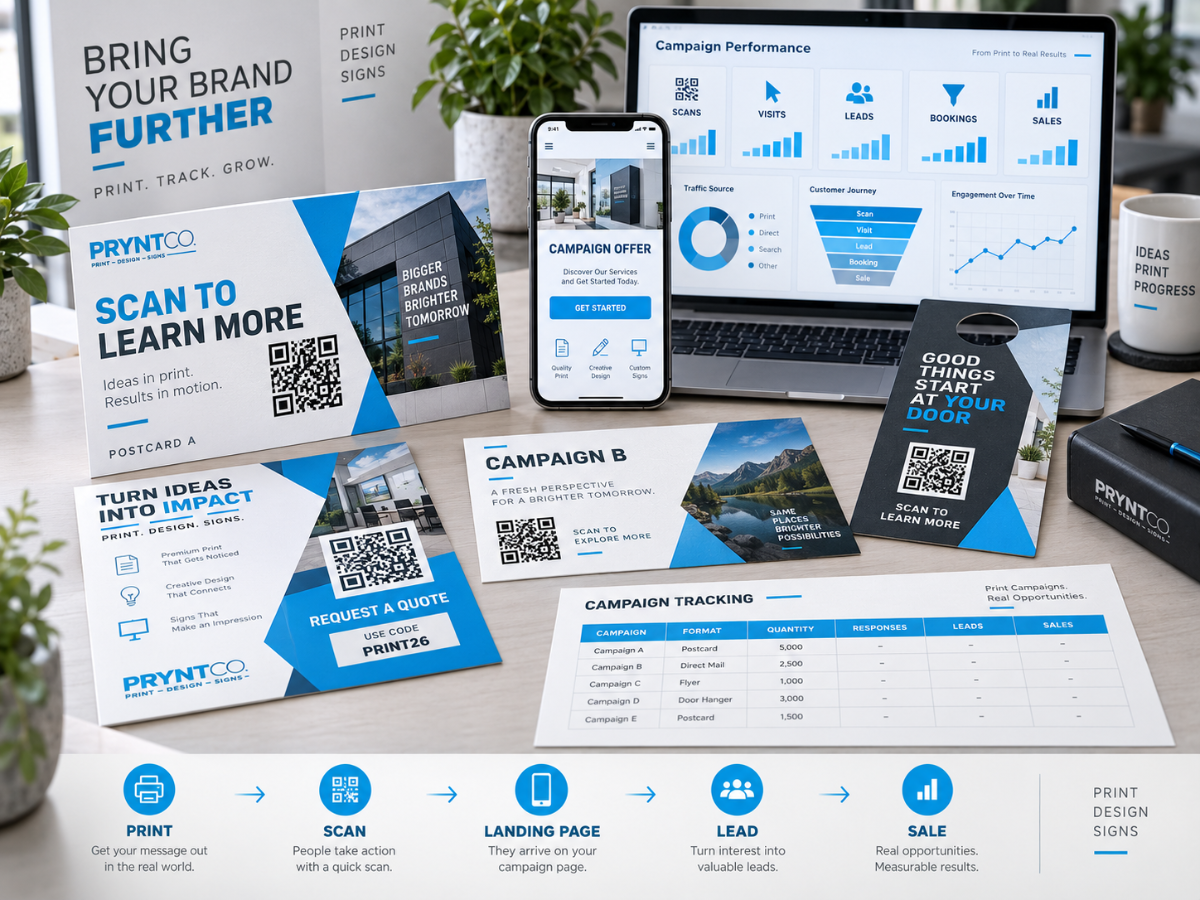
Print marketing becomes easier to improve when every campaign has a measurable next step. A QR scan, promo-code redemption or landing-page visit can show engagement, but the most useful measurement connects that activity to the real business result: a lead, booking, purchase, quote request or another outcome the campaign was designed to create.
Businesses often know exactly how many flyers, postcards or door hangers they distributed.
They know how much the printing cost.
They know when the campaign launched.
Then someone asks:
“Did it work?”
And the answer becomes much harder.
Printed marketing does not automatically produce the same built-in click data as digital advertising.
But that does not mean print cannot be measured.
A well-planned campaign can connect physical materials with trackable actions such as:
- QR-code scans
- Promo-code redemptions
- Dedicated landing-page visits
- Calls
- Quote requests
- Bookings
- Purchases
The key is deciding what to measure before the artwork is printed.
1. Can Print Marketing Actually Be Tracked?
Yes.
Print can be connected to measurable customer actions using:
- QR codes
- Campaign URLs
- Promo codes
- Phone tracking
- Lead-source questions
- Dedicated forms
No single tracking method is perfect, so choose the method that matches the campaign objective.
2. Why Should Print Marketing Be Tracked?
Tracking helps businesses answer questions such as:
- Which campaign generated inquiries?
- Which neighbourhood responded?
- Which offer performed better?
- Which format should be repeated?
Without measurement, future print decisions depend largely on assumptions.
3. What Should You Measure First?
Start with the business objective.
Examples include:
- Generate phone calls
- Generate quote requests
- Drive store visits
- Book appointments
- Sell a product
- Register event attendees
The tracking method should support that objective.
4. What Is a Print Marketing Conversion?
A conversion is the action the campaign is designed to create.
Depending on the campaign, that may be:
- Purchase
- Booking
- Phone call
- Quote request
- Registration
Define the conversion before measuring campaign success.
5. What Is the Difference Between Engagement and Conversion?
| Engagement | Conversion |
|---|---|
| QR scan | Appointment booked |
| Landing-page visit | Quote requested |
| Coupon viewed | Coupon redeemed |
Engagement can be useful, but it is not always the final business result.
6. How Do QR Codes Track Print Campaigns?
A QR code connects printed material to a digital destination.
That destination may be:
- Landing page
- Booking page
- Quote form
- Product page
- Event registration
Analytics on the destination can help identify traffic generated by the campaign.
7. Should Every Print Campaign Have a QR Code?
No.
A QR code is useful when:
- The customer is likely to use a phone.
- The next action is digital.
- The destination provides additional value.
If the main action is a phone call or physical store visit, another tracking method may be more appropriate.
8. Where Should a QR Code Be Placed?
Place it where the customer can:
- See it
- Understand it
- Scan it comfortably
Keep it away from:
- Trim
- Folds
- Perforations
- Busy backgrounds
9. What Should the QR Code Label Say?
Explain what happens after scanning.
Examples include:
- SCAN TO BOOK
- SCAN FOR A QUOTE
- SCAN TO VIEW THE OFFER
- SCAN TO REGISTER
A naked QR code gives the customer less reason to interact.
10. Should Different Campaigns Use Different QR Codes?
Yes when the business wants to separate performance.
For example:
- Postcard campaign QR
- Flyer campaign QR
- Door hanger QR
This makes it easier to compare traffic sources.
11. Should Different Locations Use Different QR Codes?
They can.
A multi-location business may want separate codes for:
- Hamilton
- Toronto
- Specific stores
Each code can direct customers to the correct local page while supporting separate analysis.
12. What Is a Campaign Landing Page?
A campaign landing page is a webpage created specifically for the print promotion.
It can repeat:
- Headline
- Offer
- Campaign image
- Call to action
This creates continuity between print and digital.
13. Why Not Send Every QR Code to the Homepage?
A homepage often contains too many choices.
A customer who scans a flyer advertising one specific service should not have to search the website to find it again.
Use the most relevant destination possible.
14. What Is a Campaign URL?
A campaign URL is a web address created or selected for a specific promotion.
It may be used alongside or instead of a QR code.
Keep printed URLs:
- Short
- Readable
- Easy to type
15. What Are UTM Parameters?
UTM parameters are tracking tags added to a URL so analytics systems can identify information such as:
- Campaign
- Source
- Medium
A QR code can point to a tagged URL without printing the long tracking string visibly.
16. Should Printed URLs Contain Long Tracking Codes?
No.
Long tracking parameters are difficult to type and make the design look cluttered.
Use a short visible URL or QR code that redirects appropriately.
17. What Is a Promo Code?
A promo code is a campaign-specific word or code entered during a purchase, booking or inquiry.
Examples could be:
- SPRING26
- WELCOME
- LOCAL
Codes should remain short and easy to read.
18. How Do Promo Codes Track Print?
If a code appears only on a specific printed campaign, redemptions can be associated with that campaign.
For example:
500 postcards mailed → 18 campaign-code redemptions.
The business can then evaluate the downstream results.
19. Should Different Print Formats Use Different Promo Codes?
Yes when comparison matters.
For example:
- POSTCARD26
- FLYER26
- DOOR26
Do not create multiple codes unless staff and systems can track them accurately.
20. Can Phone Calls Be Tracked?
Yes.
Possible approaches include:
- Dedicated campaign phone number
- Dedicated extension
- Staff asking how the caller heard about the business
Follow applicable privacy and telecommunications requirements for any call-tracking system used.
21. Is “How Did You Hear About Us?” Useful?
Yes, particularly when customers may respond through several channels.
Staff can record answers such as:
- Postcard
- Flyer
- Referral
Self-reported attribution is imperfect but can still provide useful context.
22. Can Store Visits Be Tracked?
They can when the campaign includes a redeemable action.
Examples include:
- Bring this card
- Show this code
- Present the printed offer
Staff need a consistent method for recording the response.
23. Can Coupons Be Used to Track Print Marketing?
Yes.
A physical coupon can create direct attribution when it is redeemed.
Include:
- Offer
- Conditions
- Expiry where applicable
- Campaign code
Only advertise offers the business can honour.
24. How Do You Track Direct Mail?
Direct-mail campaigns can combine:
- QR code
- Promo code
- Unique landing page
- Call source
Pryntco’s Direct Mail Marketing Guide covers broader campaign planning.
25. How Do You Track Flyers?
A flyer can use:
- QR code
- Coupon
- Short campaign URL
- Promo code
If flyers are distributed in several locations, use different identifiers when geographic performance matters.
26. How Do You Track Door Hangers?
Neighbourhood door-hanger campaigns can use:
- Neighbourhood-specific promo code
- QR code
- Dedicated landing page
This can help compare one distribution area with another.
27. How Do You Track Posters and Signs?
Posters and signs can use:
- Short memorable URL
- Large readable QR code where appropriate
- Campaign phrase
Remember that viewing distance affects how much information can be used.
28. How Do You Track Event Print?
Event materials can track:
- Registrations
- QR scans
- Giveaway entries
- Post-event inquiries
Use a code or page that clearly identifies the event.
29. What Is Response Rate?
Response rate measures the percentage of recipients who completed a defined response action.
A simplified formula is:
Responses ÷ Pieces Distributed × 100
There is no universal “good” response rate because campaigns, audiences and actions vary substantially.
30. What Is Conversion Rate?
Conversion rate measures how many people who entered the campaign journey completed the intended business action.
For example:
Landing-page visitors → bookings
or:
QR scans → purchases.
31. What Is Cost Per Response?
A simple campaign-level calculation is:
Total campaign cost ÷ number of responses
This can help compare campaigns that used different quantities or formats.
32. What Is Cost Per Lead?
Cost per lead focuses on qualified inquiries rather than every response.
A QR scan may not be a lead.
A completed quote request may be.
Define what counts as a lead before calculating the metric.
33. How Should Revenue Be Attributed?
When possible, connect the campaign identifier to the customer record or transaction.
For example:
Promo code → order
or:
Campaign landing page → quote → sale.
Not every transaction can be attributed perfectly, so avoid overstating precision.
34. Should You Test Two Print Campaigns at Once?
You can test variations, but change one major variable at a time when possible.
For example:
- Headline A vs Headline B
- Offer A vs Offer B
- Neighbourhood A vs Neighbourhood B
If every element changes, it becomes difficult to identify what caused the difference.
35. Should Print Campaign Results Be Compared Over Time?
Yes.
Track campaigns in a simple record containing:
- Date
- Audience
- Quantity
- Format
- Offer
- Response method
- Leads
- Sales where available
This creates a useful history for future planning.
36. What Should Be Tested Before Printing?
Before production:
- Scan every QR code.
- Test the landing page on mobile.
- Test promo codes.
- Confirm phone numbers.
- Confirm URLs.
- Check campaign tracking.
Do not wait until thousands of printed pieces have been distributed to discover that a QR code leads to the wrong page.
37. What Are the Most Common Print Marketing Tracking Mistakes?
Common problems include:
- Deciding how to track after printing.
- Sending every QR code to the homepage.
- Using one promo code across every campaign.
- Counting every QR scan as a customer.
- Failing to track phone inquiries.
- Changing several campaign variables at once.
- Using broken or untested links.
- Measuring engagement but ignoring sales outcomes.
38. How Should You Track a Print Marketing Campaign From Start to Finish?
Start by defining the outcome.
Decide whether the campaign is designed to create a purchase, booking, quote request, event registration or another specific action.
Then choose the tracking method before designing the print.
A postcard may use a QR code linked to a dedicated landing page. A flyer may use a promo code. A local door-hanger campaign may use a neighbourhood-specific code. A customer-reactivation campaign may use both a QR code and CRM campaign source.
Make sure each identifier is unique enough to distinguish the campaign.
Test the full customer journey before production. Scan the QR code from the actual-size proof. Open the page on a phone. Submit the form. Test the promo code. Call the number.
After launch, separate engagement from business results.
QR scans and webpage visits indicate interest. Leads, bookings and purchases indicate stronger outcomes.
Record the campaign results alongside quantity, audience, offer and distribution date so future campaigns can be compared over time.
Do not chase universal print-marketing benchmarks. A specialized B2B mailing and a broad local restaurant flyer campaign can have completely different goals and economics.
Pryntco’s existing campaign resources include the B2B Direct Mail Guide, Real Estate Direct Mail Guide, Customer Reactivation Guide and New Mover Direct Mail Guide.
For a custom printed campaign, use Pryntco’s custom quote request or contact Pryntco.