
What Should Go Inside the Box? Thank-You Cards, Care Cards and Warranty Inserts Compared
What Should Go Inside the Box? Thank-You Cards, Care Cards and Warranty Inserts Compared
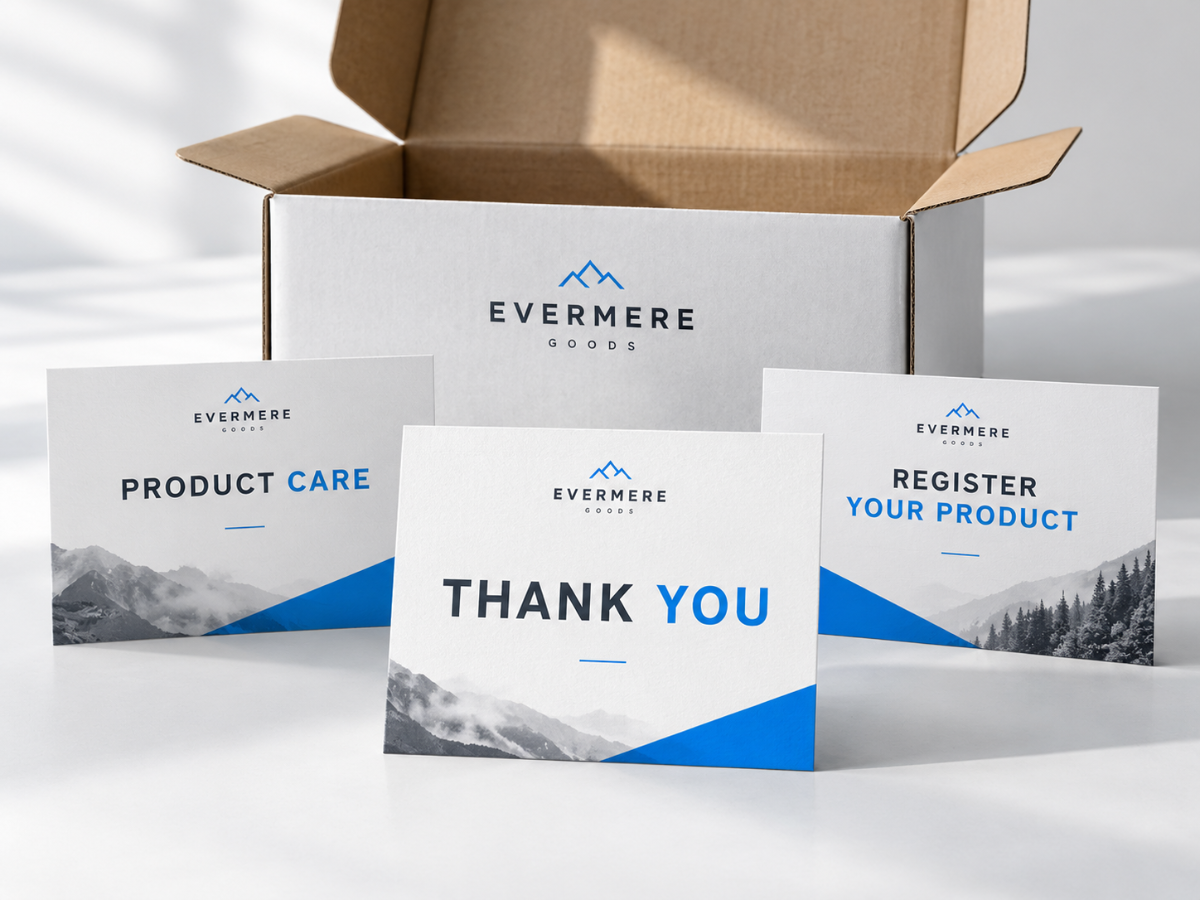
The best package insert is the one the customer actually needs. A thank-you card builds the relationship, a care card helps the customer use the product properly and a warranty or registration card connects the purchase to support. Do not force all three jobs onto one crowded piece unless the information genuinely fits.
Opening a customer order creates a useful moment for printed communication.
The question is what belongs inside the package.
Should the customer receive a thank-you card?
Do they need product-care instructions?
Should there be warranty or registration information?
Does the business need several cards, or can one well-designed insert handle the essential information?
Pryntco already has dedicated guides covering Thank-You Cards for Orders, Product Care Cards, Warranty & Product Registration Cards and broader Ecommerce Packaging Inserts.
This guide focuses on the decision between those insert types so a business can avoid putting unnecessary paper into every order.
1. What Is a Package Insert?
A package insert is a printed piece placed inside a product order, shipment, retail package or gift box.
Its job may be to:
- Thank the customer
- Explain product care
- Provide instructions
- Direct customers to warranty information
- Support product registration
2. What Is the Difference Between a Thank-You Card, Care Card and Warranty Card?
| Insert | Primary Purpose |
|---|---|
| Thank-You Card | Customer appreciation and relationship |
| Care Card | Help customer care for or use the product |
| Warranty / Registration Card | Connect product to support, warranty or registration process |
3. Does Every Order Need a Printed Insert?
No.
An insert should solve a real communication problem.
If the package is already clear and the customer does not need additional information, adding another card may simply create clutter.
4. When Should You Use a Thank-You Card?
Use a thank-you card when appreciation is the main purpose.
It works well for:
- Ecommerce orders
- Retail purchases
- Handmade products
- Client projects
- Premium orders
The message should feel like appreciation before it becomes another promotion.
5. What Should a Thank-You Card Say?
Keep the message simple.
Examples include:
- THANK YOU FOR YOUR ORDER
- THANK YOU FOR CHOOSING US
- WE APPRECIATE YOUR SUPPORT
Then add one short sentence that reflects the actual customer relationship.
6. Should a Thank-You Card Include a Promotion?
It can, but the promotion should remain secondary.
If almost the entire card is a discount advertisement, the customer may no longer experience it as a genuine thank-you message.
7. When Should You Use a Product Care Card?
Use a care card when the customer needs practical information after purchase.
This can apply to:
- Apparel
- Jewellery
- Home décor
- Leather products
- Plants
- Specialty products
8. What Should a Product Care Card Include?
Include only the care information the customer genuinely needs.
That may include:
- Cleaning
- Washing
- Storage
- Routine maintenance
- Customer support
The responsible business or manufacturer should provide the instructions.
9. When Is a Care Card More Important Than a Thank-You Card?
When incorrect care could create customer confusion or damage the product.
Functional information should take priority over promotional messaging.
A short “thank you” line can still appear, but care instructions should remain the main purpose.
10. When Should You Use a Warranty Card?
Use a warranty card when customers need a clear path to actual warranty information or support.
It may include:
- Product name
- Model number
- Serial number
- Warranty website
- Support contact
11. When Should You Use a Product Registration Card?
Use one when the business has a genuine registration process.
The card can tell customers how to:
- Register online
- Scan a QR code
- Record a serial number
- Access support
Do not imply registration is required unless that is actually true.
12. Can Warranty and Registration Information Share One Card?
Yes when the process remains easy to understand.
For example:
REGISTER YOUR PRODUCT
followed by a QR code and a separate line directing the customer to complete warranty terms can work clearly on one card.
13. Can Thank-You and Care Information Share One Card?
Yes.
A useful structure is:
- Front: thank-you message
- Back: care instructions
This works particularly well when the care information is short.
14. Can Care and Warranty Information Share One Card?
Sometimes.
It works best when both sections are concise.
If care instructions are extensive or warranty information requires several fields, use separate pieces or direct the customer to a complete digital resource.
15. Should All Three Be Combined on One Card?
Usually not.
Three different purposes can create:
- Too much text
- Multiple QR codes
- Competing calls to action
- Tiny instructions
One strong insert is better than one overloaded insert.
16. How Many Inserts Should Go in a Package?
Use the fewest pieces that adequately support the customer.
A package may legitimately need:
- One care card
- One warranty card
But it probably does not need six separate promotional cards unless each performs a necessary function.
17. Which Insert Is Most Important for Apparel?
Usually the care card if special care information matters.
A thank-you message can be combined with it when space allows.
Warranty information is usually only appropriate when the business has an actual warranty or product-support process.
18. Which Insert Is Most Important for Handmade Products?
It depends on the product.
A handmade business may use:
- Thank-you card for appreciation
- Care card for cleaning or storage
Do not copy generic care instructions from another seller.
19. Which Insert Is Most Important for Technical Products?
Technical products may require:
- Setup information
- Registration
- Warranty direction
- Support contact
A promotional thank-you message should not overshadow essential product information.
20. Which Insert Is Most Important for Gifts?
A thank-you or presentation card may be the most natural choice.
Care information can be added separately when the product needs it.
A warranty card should only be included when the product genuinely has an applicable warranty process.
21. Which Insert Is Best for Repeat-Purchase Businesses?
A thank-you card can support the relationship and include a simple reorder path.
For consumable products, a QR code can direct the customer to:
- Reorder page
- Subscription information
- Product page
Keep the main purpose clear.
22. Should a Package Insert Ask for a Review?
It can, but avoid turning every customer insert into a review request.
A dedicated review card may be stronger when feedback is the main objective.
Keep requests neutral and do not offer incentives for a positive rating.
23. Should a Package Insert Include a Referral Program?
Only when a real referral program exists.
If referrals are important, a dedicated referral card can keep the offer clearer than adding another small section to a care or warranty card.
24. How Many QR Codes Should Be on One Insert?
Prefer one primary QR code whenever possible.
Several codes can force the customer to choose between:
- Care guide
- Warranty
- Review page
- Social account
A single clear destination usually creates less friction.
25. Where Should a Care-Card QR Code Lead?
Possible destinations include:
- Complete care guide
- Instruction video
- Product support page
Label the code clearly so the customer knows what will open.
26. Where Should a Warranty QR Code Lead?
It may lead to:
- Warranty terms
- Registration page
- Customer-support portal
Do not use a temporary or campaign-specific URL for information customers may need years later.
27. Should a Thank-You Card Use a QR Code?
Only when there is one useful next step.
Examples include:
- Reorder
- Customer account
- Product page
The code should not dominate the appreciation message.
28. What Size Should an Insert Be?
The size depends on:
- Amount of information
- Package size
- Need for handwriting
- Number of sections
Pryntco’s existing package-insert guidance notes that compact business-card-style formats can suit very short messages, while 4" × 6" and 5" × 7" postcard-style layouts provide more room.
29. When Is a Small Card Enough?
A small card can work for:
- Simple thank-you message
- Three short care instructions
- Single QR action
- Basic registration direction
Do not reduce essential text just to force it onto a smaller card.
30. When Is a Larger Insert Better?
Use more space when customers need:
- Several care steps
- Diagrams
- Support instructions
- Multiple product fields
Readability should determine the format.
31. Should an Insert Be Writable?
Yes when staff or customers need to add:
- Purchase date
- Serial number
- Personal note
- Dealer information
Choose a surface that supports the intended pen, pencil or stamp.
32. Should Inserts Match the Packaging?
Yes.
Coordinate:
- Logo
- Colours
- Typography
- Tone
The insert should feel like part of the same customer experience.
33. Should Every Product Receive the Same Insert?
No.
Different products may require different information.
For example:
- Apparel → care card
- Technical equipment → registration card
- Simple gift item → thank-you card
Segment only when fulfilment staff can manage the versions reliably.
34. How Should Businesses Manage Insert Versions?
Use clear file names.
For example:
ProductA_CareCard_2026_FINAL.pdf
is clearer than:
insert-new-final3.pdf
Remove outdated files and physical stock when instructions or policies change.
35. What Information Should Never Be Invented?
Do not invent:
- Warranty duration
- Coverage terms
- Care instructions
- Safety warnings
- Registration requirements
- Product claims
The responsible business or manufacturer must provide or approve that information.
36. What Should Be Checked Before Printing Package Inserts?
Confirm:
- Correct product
- Correct instructions
- Correct warranty information
- Current URL
- Working QR code
- Readable type
- Physical fit inside the package
Place a physical proof into the actual box or mailer before producing the full quantity.
37. What Are the Most Common Package Insert Mistakes?
Common problems include:
- Putting too many calls to action on one card.
- Making care instructions too small.
- Using several QR codes without clear labels.
- Printing outdated warranty wording.
- Sending the wrong insert with the wrong product.
- Choosing a card larger than the package.
- Using promotional copy where functional information should come first.
38. Which Insert Should Go Inside Your Customer Order?
Start with what the customer needs after opening the box.
If the main goal is appreciation, use a thank-you card.
If the customer needs cleaning, storage or maintenance instructions, use a product care card.
If the product has a genuine warranty, registration or support process, use a warranty or registration insert.
Combine functions only when the information remains easy to understand.
A two-sided thank-you and care card can work well. A registration card can also direct customers to complete warranty terms online.
What usually does not work is squeezing appreciation, care, warranty, review requests, referrals, social media and discounts onto one tiny piece.
Give the insert one clear job.
For deeper guidance, review Pryntco’s Thank-You Card Guide, Product Care Card Guide, Warranty & Registration Card Guide and Ecommerce Packaging Insert Guide.
For a custom insert format or print project, request a custom quote or contact Pryntco.

