Straight or Curved Media Wall? Choosing a Trade Show Backdrop
Straight or Curved Media Wall? Choosing a Trade Show Backdrop
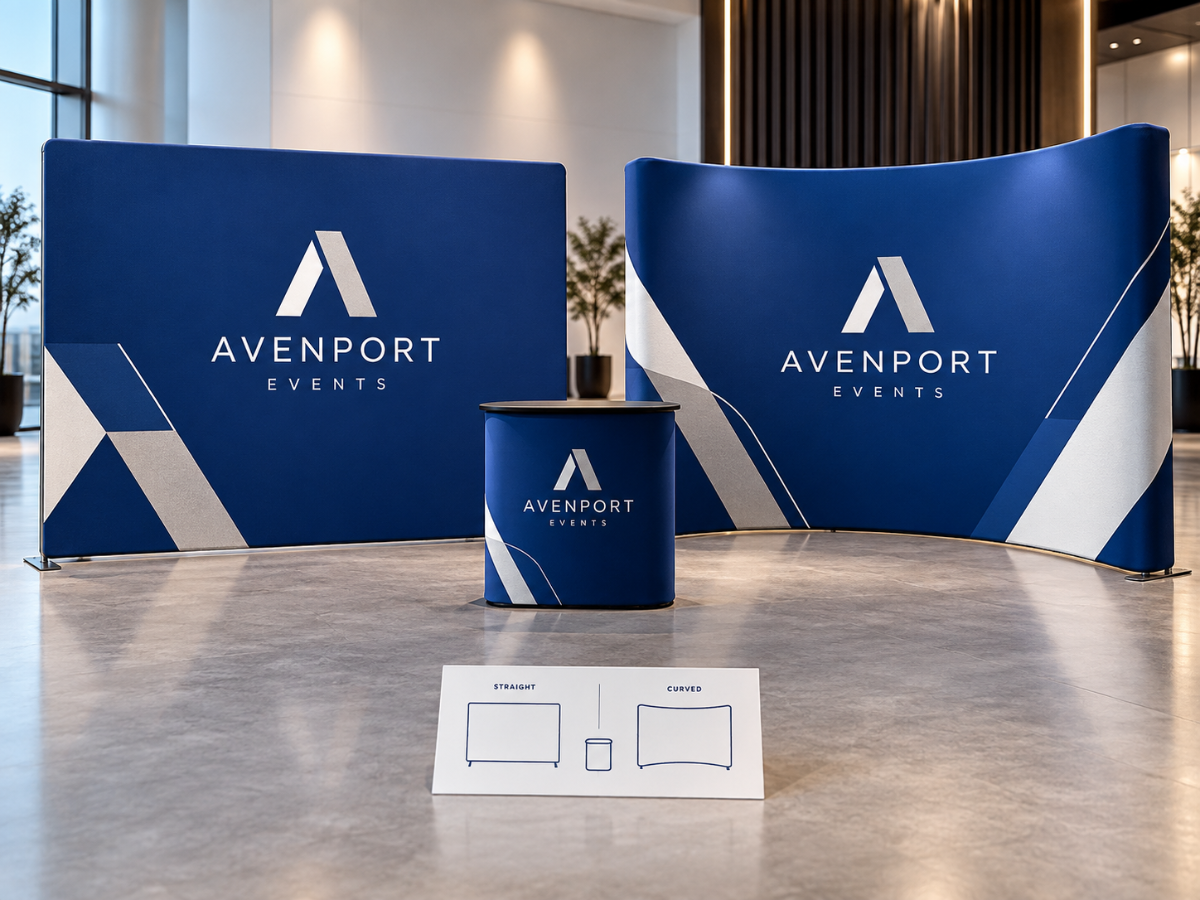
A straight and curved media wall can carry the same brand, but they shape the booth differently. A straight wall creates a broad, flat visual plane. A curved wall wraps the backdrop into the space. Choose the frame around the booth, photography and viewing angles rather than choosing the shape simply because one looks more dramatic.
A large event backdrop can become the visual anchor of a trade show booth.
It may sit behind a reception table, define a branded photo area, frame a product display or simply give an otherwise temporary space a finished background.
Once a business decides it wants a fitted fabric media wall, another decision appears:
straight or curved?
Pryntco currently offers both a straight Fabric Pillow Case Media Wall and an 8' Curved Fabric Pillow Case Media Wall.
Both use fitted fabric graphics over tube-style frames, but their shape changes the way the display interacts with the room.
1. What Is the Main Difference Between a Straight and Curved Media Wall?
The difference is the frame geometry.
A straight media wall creates a flat backdrop.
A curved media wall bends across the viewing area.
That affects:
- Booth footprint
- Viewing angles
- Photography
- Artwork composition
- How surrounding display pieces are arranged
2. What Does a Straight Media Wall Look Like in a Booth?
A straight wall creates a clean horizontal plane behind the booth.
It can work naturally behind:
- Registration tables
- Product displays
- Interview areas
- Photo areas
- Presentation spaces
The flat surface also makes alignment with other straight booth elements visually simple.
3. What Does a Curved Media Wall Change Visually?
A curved wall wraps the graphic slightly into the surrounding space.
That can create a more enclosed or dimensional backdrop than a completely flat wall.
The curve itself becomes part of the booth design, so the artwork should be prepared for that shape rather than treated as though it will be seen only straight-on.
4. Which One Uses More Visual Width?
For Pryntco’s current products, the straight wall is the larger listed display at 120" × 120", while the curved wall is listed at 96" × 96".
Those are different products rather than two shapes of the same exact dimensions.
Always plan around the actual current frame size instead of assuming a straight and curved option occupy identical space.
5. Which One Needs More Floor-Plan Planning?
The curved wall deserves extra attention because the frame does not sit on one simple flat plane.
Before ordering, consider:
- Booth width
- Booth depth
- Table position
- Walking space
- Neighbouring displays
Confirm the current product footprint when space is tight.
6. Which One Works Better Against a Physical Wall?
A straight media wall is usually the more obvious fit when the backdrop will sit close to an existing straight wall.
Its shape follows the architecture naturally.
A curved display may need more room to preserve its intended shape.
7. Which One Works Better in an Open Booth?
Either can work.
A straight backdrop can create a strong visual rear boundary.
A curved wall can make the display feel more self-contained within an open event space.
The better choice depends on the rest of the booth.
8. Which One Works Better as a Photo Backdrop?
Both can work well.
A straight wall provides a predictable flat background for:
- Group photos
- Interviews
- Step-and-repeat artwork
A curved wall can create a more immersive background around one or several guests.
The camera position and number of people being photographed matter more than shape alone.
9. Which One Is Better for Step-and-Repeat Logos?
A straight wall is the simpler surface for a traditional repeating-logo pattern because the artwork is viewed across a flat plane.
A curved wall can also use repeating logos, but the design should allow for the outer areas turning away from the centre viewing angle.
Pryntco’s Photo Backdrop Display Guide covers step-and-repeat spacing in more detail.
10. Should Logos Be Smaller on a Curved Backdrop?
Not automatically.
The more important issue is placement.
Important logos should remain clear from the expected camera and visitor positions.
Avoid placing critical branding only on the far edges where the curve changes the viewing angle.
11. Where Should the Main Logo Go on a Straight Wall?
Usually in a prominent central or upper-central area where people, tables or products are less likely to cover it.
Consider what will sit in front of the wall before finalizing the artwork.
A beautiful centred logo is less useful if the booth counter hides half of it.
12. Where Should the Main Logo Go on a Curved Wall?
Keep the most important identity closer to the central viewing area.
The sides can support:
- Secondary patterns
- Brand colour
- Supporting graphics
without carrying the only essential logo or message.
13. Should a Media Wall Contain a Full Service List?
Usually not.
The backdrop should help someone recognize the business quickly.
A stronger wall often contains:
- Logo
- Short positioning line
- Large image or visual system
Detailed services belong on brochures, flyers or other booth materials.
14. Should a Website Be Printed on the Backdrop?
It can be when the address is short and readable.
Do not place a long URL in small type along the bottom of a ten-foot display where nobody can comfortably read it.
The brand name itself may already make the website easy to find.
15. Should a QR Code Go on a Media Wall?
Only when the code can be large enough and positioned where visitors can actually scan it.
A QR code several feet behind a table may be impractical.
A tabletop sign, brochure or card often provides a better scanning distance.
16. Which One Works Better Behind a Trade Show Table?
A straight wall naturally aligns with a straight table and can create a clean layered booth:
media wall → table → visitor.
A curved wall can also work, but the table placement should respect the curve rather than hiding its shape.
17. Which One Works Better Without a Table?
A curved wall can become particularly noticeable when it stands on its own as the main physical feature.
A straight wall can also work well with:
- Product pedestals
- Interview chairs
- Open photo space
The surrounding furniture should support the backdrop rather than compete with it.
18. Can Either Media Wall Be Printed Double-Sided?
Pryntco’s current straight and curved fabric media-wall products both list single-sided and double-sided printing options.
Double-sided printing can be useful when the rear of the display remains visible to visitors.
It is unnecessary when the wall will sit directly against another wall or booth boundary.
19. When Is Double-Sided Printing Worth Considering?
Consider it when the display is:
- Freestanding
- Visible from an aisle behind the booth
- Used in the centre of an event space
- Reused in multiple layouts
Design the reverse intentionally rather than automatically duplicating the front.
20. Should the Back Side Use the Same Artwork?
Not necessarily.
The reverse may need a simpler treatment if visitors see it from a different distance or direction.
For example:
- Front → full brand message
- Back → logo and simple colour field
21. How Does Fabric Affect the Appearance?
Both current Pryntco media walls use fitted pillow-case-style fabric graphics.
The graphic stretches over the frame, creating a continuous branded surface without the loose hanging appearance of a conventional banner.
Artwork should be prepared specifically for the actual template.
22. Should Artwork Be Designed Before Choosing Straight or Curved?
No.
Choose the display first.
Then design for:
- Exact dimensions
- Shape
- Safe areas
- Expected viewing angle
Trying to force one finished artwork file onto two different frame shapes can weaken both versions.
23. Can the Same Brand Concept Be Adapted to Both?
Yes.
Keep the same:
- Logo
- Colour system
- Photography style
- Typography
while changing the composition to fit the actual frame.
24. How Large Should Backdrop Text Be?
Large enough to read from the expected event distance.
A media wall is not a brochure.
If visitors need to walk right up to the fabric to read the headline, the message is probably too small.
25. Should the Bottom of the Wall Carry Important Information?
Usually not.
The lower area may be blocked by:
- Tables
- Guests
- Products
- Furniture
Keep the main brand recognition higher in the composition.
26. Should People Be Considered During the Design?
Yes.
If the wall will be used for photos, picture the actual people standing in front of it.
Logos placed only at head height may disappear behind guests.
A repeated pattern or strategically elevated identity can remain visible more consistently.
27. Which Shape Works Better for Group Photos?
A straight wall offers predictable width across the entire frame.
That can make larger group composition easier to judge.
A curved wall can frame a smaller group attractively, but confirm that the available visible width suits the expected number of guests.
28. Which Shape Works Better for Interviews or Video?
Either can work.
A straight wall creates a simple controlled plane behind the speaker.
A curve can add depth to the background.
Test where the camera will sit and ensure logos are not distorted or pushed outside the frame.
29. Can Lighting Change the Choice?
Yes.
The curve changes the angle of the surface relative to event lighting.
Before an important media setup, test:
- Front lighting
- Side lighting
- Camera angle
Do not rely on the backdrop alone to solve poor event lighting.
30. Should a Media Wall Match the Table Cover?
They should feel coordinated.
The table cover may use a simple logo while the backdrop carries the broader visual system.
Pryntco’s Table Covers can support that kind of coordinated booth.
31. Should It Match Retractable Banners or Flags?
Yes, but avoid duplicating the exact same design everywhere.
A useful system might be:
- Media wall → brand identity
- Retractable banner → service or offer
- Flag → visibility from distance
Each piece can belong to the same brand while doing a different job.
32. How Should a Small Booth Avoid Looking Overcrowded?
Choose one dominant display.
If a media wall already fills the rear of the booth, you may not need several additional tall banners standing in front of it.
Pryntco’s Trade Show Printing Checklist emphasizes building a clear display system rather than using every product available.
33. Can a Media Wall Be Used Outside Trade Shows?
Yes.
Current Pryntco media walls are positioned for:
- Conferences
- Photo areas
- Events
- Branded presentation spaces
The same display can work wherever a large controlled background is useful.
34. Should Event-Specific Dates Be Printed on the Fabric?
Only when the display is truly intended for one event.
If the frame and graphic are meant to be reused, keep the main design more evergreen.
Temporary dates can live on another sign or printed piece.
35. What Should Be Checked Before Ordering?
Confirm:
- Straight or curved frame
- Current dimensions
- Single- or double-sided printing
- Booth footprint
- Artwork template
- Table and furniture position
- Photography requirements
36. What Are the Most Common Straight Media-Wall Mistakes?
Common problems include:
- Putting the main logo too low behind a table.
- Treating the wall like a giant brochure.
- Using small contact information nobody can read.
- Ignoring how people will stand in front of it.
- Adding too many other large displays to the same booth.
37. What Are the Most Common Curved Media-Wall Mistakes?
Common problems include:
- Using straight-wall artwork without adapting it.
- Putting essential content on the far curved edges.
- Ignoring booth depth and footprint.
- Choosing the curve without considering camera angles.
- Assuming the current curved and straight products are the same size.
38. Should You Choose a Straight or Curved Media Wall?
Choose a straight media wall when you want a broad, flat branded surface that aligns naturally with tables, existing walls and conventional booth layouts.
It is especially easy to plan for group photography, step-and-repeat patterns and structured trade-show setups.
Choose a curved media wall when the shape itself helps create the space.
The curve can make a freestanding backdrop feel more dimensional and can work especially well for smaller photo areas, branded activations and booths where the background should visually wrap around the central area.
Do not choose by shape alone.
Compare the current dimensions, booth footprint, furniture, camera position and the way visitors will approach the space.
Then build the artwork specifically for the selected template.
Pryntco currently offers a straight Fabric Pillow Case Media Wall and an 8' Curved Fabric Pillow Case Media Wall for trade shows, conferences, photo areas and branded event spaces.
For help planning a complete booth or backdrop setup, contact Pryntco or submit a custom quote request.