
How to Keep Staff Uniforms Consistent Across T-Shirts, Polos, Hoodies and Hats
How to Keep Staff Uniforms Consistent Across T-Shirts, Polos, Hoodies and Hats
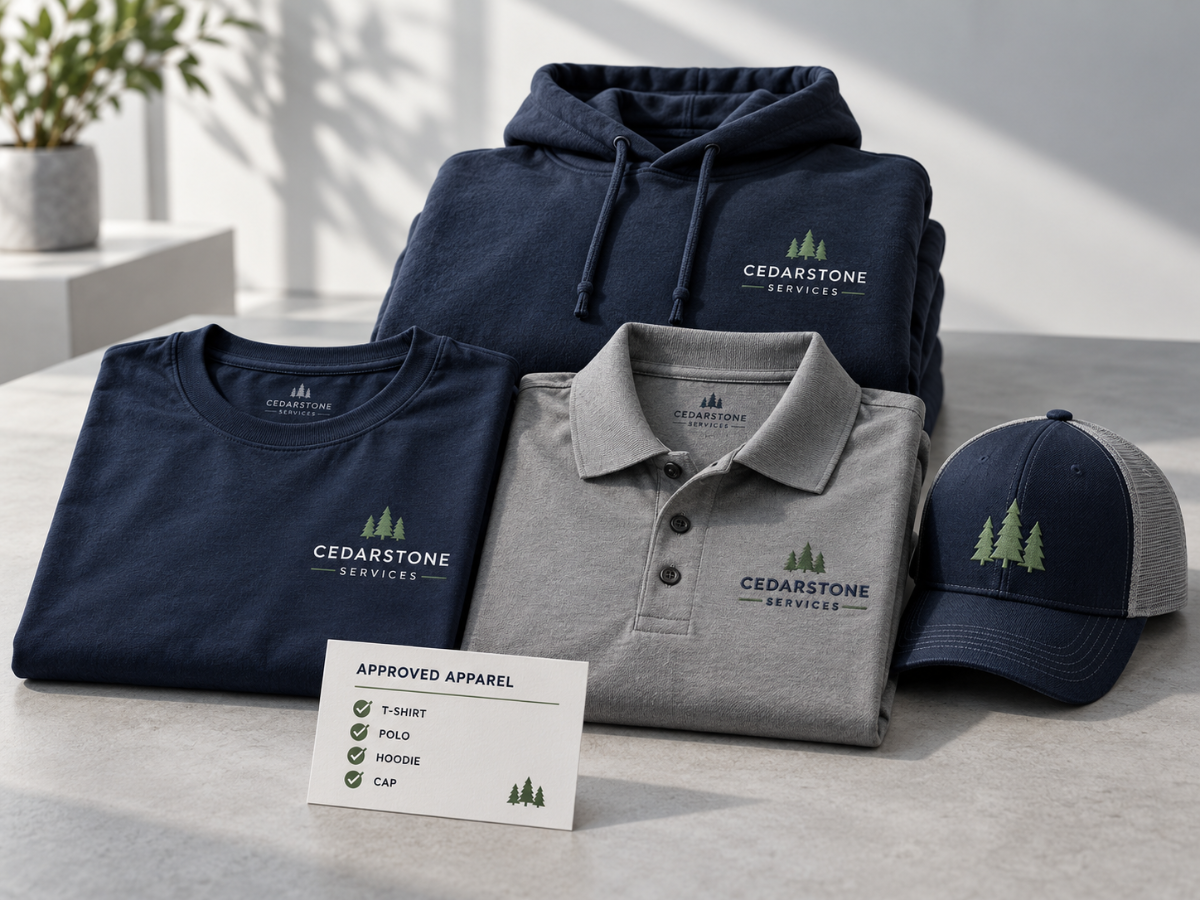
A consistent staff uniform does not mean every employee has to wear the exact same garment. T-shirts, polos, hoodies and hats can all belong to one uniform system when the logo, colour palette, decoration style and role of each garment are controlled from the beginning.
A growing company rarely stays with one staff shirt forever.
The original team may begin with a simple branded T-shirt.
Then customer-facing staff need polos.
Outdoor employees need hoodies.
Someone orders caps for summer.
A second location opens.
New employees are hired.
Before long, the company technically has branded apparel, but the team no longer looks like one team.
One shirt uses a large logo.
Another has a small chest mark.
The polo uses a different blue.
The hoodie has an old logo.
The cap was embroidered from a different artwork file.
None of those individual decisions may seem serious, but together they create visual inconsistency.
Pryntco’s current Apparel catalogue includes T-shirts, long sleeves, polos, sweatshirts, hoodies, tanks and headwear for staff, teams and branded programs.
The goal is not to make every garment identical.
It is to build rules strong enough that several garments can still look like one uniform.
1. What Makes a Staff Uniform Look Consistent?
Consistency usually comes from repeating a controlled set of decisions.
Those decisions include:
- Logo version
- Brand colours
- Garment colours
- Decoration method
- Logo position
- Approved garment styles
The employee does not need to wear the same garment every day for those elements to create a recognizable system.
2. Does Every Employee Need the Same Shirt?
No.
Different roles can justify different garments.
For example:
- Production staff → T-shirt
- Front-of-house staff → polo
- Outdoor staff → hoodie or approved headwear
- Event team → T-shirt or polo depending on the event
The garments can differ while the branding stays controlled.
3. Why Should Roles Be Defined Before Apparel Is Ordered?
Because the uniform should support the work.
A company that orders one garment for everybody may later discover that it does not suit:
- Customer-facing employees
- Outdoor work
- Seasonal conditions
- Trade shows
Start with the job rather than the catalogue.
4. What Should Be the Core Staff Garment?
Choose one garment that covers the broadest everyday use.
For many businesses, that may be a T-shirt.
For others, a polo may make more sense.
The core garment becomes the visual reference for the rest of the apparel program.
5. When Should a Polo Be Added?
A polo can provide a more structured option for:
- Front-of-house staff
- Sales teams
- Managers
- Client meetings
- Trade shows
Pryntco’s current Men’s Polos are positioned for uniforms, customer-facing teams, trade shows and corporate programs.
6. When Should a Hoodie Be Added?
A hoodie can provide an approved branded layer for cooler conditions or casual work environments.
It may be useful for:
- Warehouse teams
- Outdoor staff
- Event crews
- Casual workplace uniforms
The hoodie should complement the shirt underneath rather than introduce a separate visual identity.
7. When Should Headwear Be Part of the Uniform?
Use headwear when the role or environment gives employees a practical reason to wear it.
Pryntco’s Custom Hat, Cap and Beanie Guide identifies staff, teams, events and outdoor businesses among common uses for branded headwear.
Do not add a hat merely because there is another place to put the logo.
8. Does Every Uniform Piece Need the Same Logo Size?
No.
A chest logo on a polo should not automatically be enlarged to the same visual scale as a full-front T-shirt graphic.
A cap requires another adaptation again.
Keep the same approved identity while adjusting the mark to the available decoration area.
9. Should the Same Logo Version Be Used Everywhere?
Use the same core brand identity, but approved alternate versions may be necessary.
A brand system might include:
- Primary horizontal logo
- Compact stacked logo
- Icon
- One-colour version
These should be approved variations rather than improvised versions created for individual garments.
10. Why Is a One-Colour Logo Version Useful?
A one-colour logo can simplify decoration when:
- The garment colour already carries the brand
- The decoration area is small
- Embroidery requires a cleaner treatment
- The full-colour logo becomes visually busy
The simplified version should still be part of the official identity.
11. Should T-Shirts and Polos Use the Same Logo Position?
They can use a similar general position, such as the left chest, but the placement should be checked on each garment.
Necklines, plackets and garment proportions differ.
Do not transfer coordinates blindly from one product to another.
12. Should Hoodies Use the Same Decoration as T-Shirts?
Not automatically.
A large T-shirt graphic may compete with:
- Hoodie pocket
- Zipper where applicable
- Seams
- Garment proportions
The hoodie artwork should be reviewed on the actual garment.
13. Should Hats Use the Full Shirt Logo?
Only when it reproduces clearly within the available headwear decoration area.
Detailed shirt artwork may need to become:
- Wordmark
- Initials
- Simple icon
- Compact logo
The hat should remain recognizably part of the same brand.
14. How Many Garment Colours Should a Uniform System Use?
Usually fewer than the catalogue offers.
Select a controlled group such as:
- Primary uniform colour
- Approved secondary colour
- Optional seasonal neutral
Giving every employee unrestricted colour choice quickly weakens consistency.
15. Should Every Garment Be the Exact Same Colour?
No.
A charcoal hoodie can coordinate with a navy polo and white T-shirt when the logo treatment and broader palette connect them.
Consistency does not require identical colour.
It requires intentional colour.
16. Why Can Colour Names Be Misleading Across Garments?
Two products can use similar colour names without being physically identical.
Different:
- Brands
- Fabric constructions
- Dye lots
- Garment styles
can influence appearance.
Do not assume every “navy” from every product line will match exactly.
17. Should a Company Use One Apparel Brand for Everything?
Not necessarily.
One manufacturer may not offer the best garment for every role.
A consistent uniform can still use different apparel brands if the company controls:
- Colour direction
- Logo treatment
- Decoration
- Overall silhouette
18. Should Print and Embroidery Be Mixed?
They can be.
A company may use printed graphics on T-shirts and embroidery on polos or hats.
The important thing is to adapt the artwork properly rather than expecting the same production file to work unchanged across both decoration methods.
19. How Should Embroidered Logos Be Simplified?
Small embroidery areas generally benefit from clean artwork.
Avoid unnecessary:
- Tiny lettering
- Fine detail
- Complex gradients
- Very small secondary wording
Use the approved compact brand version when appropriate.
20. Should Employee Names Be Added to Uniforms?
Only when the role benefits from personalization.
Names can be useful for:
- Service teams
- Customer-facing staff
- Technical crews
But personalized garments are harder to reassign when staffing changes.
21. Should Job Titles Be Printed on Apparel?
Usually only when the title helps customers identify the correct person.
Useful examples might include:
- EVENT STAFF
- INSTALLATION TEAM
- COACH
Long individual job titles can make the uniform unnecessarily busy.
22. Should Managers Wear a Different Colour?
They can when visual role identification has an operational purpose.
For example, an event may need supervisors to be easy to find.
Do not create status differences through colour when the distinction provides no benefit to staff or customers.
23. How Should Front-of-House and Production Staff Coordinate?
They can wear different garment types while sharing the same brand system.
For example:
- Front desk → navy polo
- Production → navy T-shirt
- Cold-weather layer → charcoal hoodie
The logo and colour family connect the team.
24. How Should Event Apparel Fit Into the Regular Uniform?
Use the existing uniform whenever it already works.
Create event-specific apparel only when the event has a genuine reason for another garment or message.
A trade show does not automatically require a completely different team identity.
25. Should Seasonal Apparel Use the Same Branding?
Yes.
Winter hoodies, beanies and long sleeves should still look like the same company as summer T-shirts and caps.
Season changes the garment, not the brand.
26. How Should Multiple Locations Keep Apparel Consistent?
Create one central uniform specification.
Record:
- Approved products
- Garment colours
- Logo files
- Decoration positions
- Location-specific exceptions
A second location should not rebuild the uniform system from memory.
27. Should Location Names Be Added to Staff Apparel?
Only when local identification is useful.
If Toronto and Hamilton staff genuinely need location-specific garments, use one controlled layout where only the location field changes.
If they do not, a national or company-wide uniform may be simpler.
28. How Should New Employees Be Added to the Uniform System?
New staff should choose only from approved garments.
The onboarding process can record:
- Role
- Approved garment
- Fit
- Size
- Quantity
This prevents every new hire from creating a new apparel variation.
29. How Should Size Differences Be Handled Without Breaking Consistency?
Consistency comes from the visual system, not from everyone wearing the same fit.
Employees may need:
- Men’s fit
- Women’s fit
- Unisex fit
- Different approved sizes
Keep the colour and decoration coordinated across those approved choices.
30. Should Employees Choose Their Own Garment Style?
Only from a controlled list.
An organization can provide flexibility without allowing unlimited variation.
For example:
Choose one approved T-shirt fit and one approved outer layer.
That gives employees choice while protecting the uniform system.
31. How Should Staff Apparel Quantities Be Managed?
Separate consistency from quantity planning.
First define the approved products.
Then calculate:
- Current staff quantities
- Size distribution
- Wear frequency
- Reserve inventory
Do not change products simply because one reorder was poorly planned.
32. What Should Be Recorded for Every Approved Uniform Item?
Keep a simple uniform specification containing:
- Product name and model
- Approved colour
- Logo file
- Decoration method
- Decoration location
- Approved size range
This becomes the source of truth for reorders.
33. Why Should Artwork Files Be Centralized?
Without one approved file location, staff may send:
- Old logos
- Low-resolution PNGs
- Different colour versions
- Incorrect artwork
Maintain one current production-ready logo system.
34. How Should a Rebrand Be Rolled Out Across Staff Apparel?
Plan the transition.
Review:
- Existing inventory
- Upcoming hires
- Replacement timing
- Customer-facing consistency
Do not keep ordering the old logo once the new identity has been approved.
35. Should Old and New Uniforms Be Worn Together?
Ideally, customer-facing teams should have a clear transition point.
Internal or low-visibility uses may allow old apparel to be retired more gradually.
The company should decide the transition rather than letting it happen randomly.
36. What Are the Most Common Staff-Uniform Consistency Mistakes?
Common problems include:
- Ordering garments independently by department.
- Using several logo files.
- Letting every employee choose any colour.
- Using the exact same artwork scale on shirts, polos and hats.
- Forgetting to record product models for reorders.
- Mixing old and new branding indefinitely.
37. What Should a Simple Staff Apparel Standard Include?
A practical standard does not need to become a fifty-page manual.
Define:
- Core T-shirt
- Customer-facing polo
- Approved hoodie or outer layer
- Approved cap or seasonal headwear where needed
- Garment colours
- Logo treatment
- Decoration locations
Then use those standards for every reorder.
38. How Do You Keep T-Shirts, Polos, Hoodies and Hats Looking Like One Uniform?
Start with one brand system rather than one garment.
Choose the core colours employees should wear and limit the apparel catalogue to a small approved group.
Use the same official logo family across the program, but adapt the artwork intelligently to each product.
A T-shirt can carry a larger printed mark.
A polo may use a restrained chest logo.
A hoodie can repeat that identity at a scale appropriate to the garment.
A cap or beanie may need a compact embroidered version.
Give employees enough fit options to wear the uniform comfortably without allowing unlimited garment and colour combinations.
Record the exact product, colour, decoration and artwork used for every approved item.
Then make that record the source of truth for new hires, additional locations and future reorders.
The team does not need to look identical.
It needs to look intentional.
Businesses can explore current options through Pryntco’s Apparel catalogue and review the Custom Headwear Guide when caps or beanies are part of the uniform.
For a coordinated staff apparel program across several garment types or locations, contact Pryntco or submit a custom quote request.

