
Single-Sided or Double-Sided? When Is Printing the Back of a Display Worth It?
Single-Sided or Double-Sided? When Is Printing the Back of a Display Worth It?
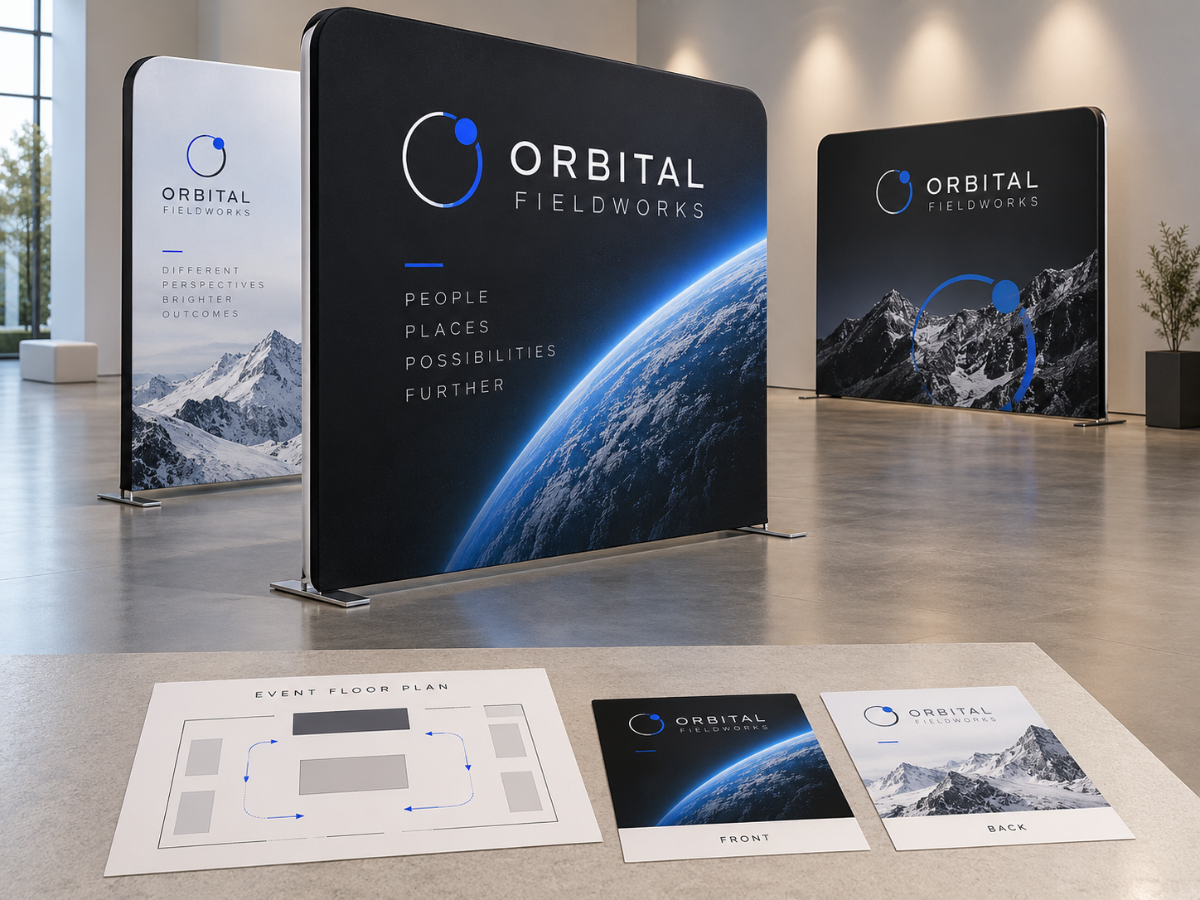
Double-sided printing is valuable when people can actually approach the display from both directions. If the back sits against a wall, curtain or booth boundary, printing another full graphic may add little value. Start with the traffic flow, then decide whether the reverse side needs branding.
Double-sided printing sounds automatically better.
Two printed surfaces must be more valuable than one.
But event displays are physical objects.
The value of the second side depends entirely on where that object stands.
A media wall placed against the rear boundary of a booth may have almost no visible back side.
A fabric display standing in the middle of an aisle can be approached from both directions.
A flag may be seen by people arriving from opposite sides.
A freestanding directional display may even need different information on the front and back.
Pryntco currently lists single- and double-sided options on several trade-show products, including selected Fabric Media Walls, Pillow Case Tube Displays, Feather Flags and Tear Drop Flags.
The decision should be made from placement rather than from the product menu alone.
1. What Does Single-Sided Printing Mean?
Single-sided printing means the primary intended graphic is printed for one viewing face.
It is appropriate when viewers will mainly approach from one direction.
Common examples include displays placed:
- Against a wall
- Behind a trade-show table
- At the back of a booth
- Against a curtain
2. What Does Double-Sided Printing Mean?
Double-sided printing creates intentional printed visibility on both faces of a supported display product.
The front and reverse may use:
- Same branding
- Different messages
- Opposite directional information
The actual construction depends on the specific product.
3. Is Double-Sided Printing Automatically Better?
No.
If nobody can see the second side, it adds little communication value.
Use the budget where the audience can actually experience it.
4. What Is the First Question to Ask?
Ask:
Can people approach this display from behind?
If the answer is no, single-sided printing may be completely sufficient.
5. When Is Single-Sided Printing the Obvious Choice?
It usually makes sense when the display:
- Sits directly against a physical wall
- Faces outward from the rear of a booth
- Backs onto a solid exhibit panel
- Has no visitor path behind it
6. When Is Double-Sided Printing the Obvious Choice?
It becomes more useful when the display is freestanding in an open area.
Examples include:
- Open event foyer
- Island trade-show booth
- Retail aisle
- Registration area
- Open promotional space
7. Why Does Traffic Flow Matter?
A display is only useful when its graphic faces the people who need to see it.
Observe where visitors:
- Enter
- Walk
- Queue
- Exit
before deciding how many printed faces are required.
8. Should You Draw a Floor Plan First?
Yes when the event setup is important.
A simple floor plan can show:
- Display position
- Table location
- Aisles
- Visitor direction
That can reveal whether the back is actually exposed.
9. Is Double-Sided Printing Useful in an Island Booth?
Often, yes.
An island booth can be approached from several directions.
A display placed near the centre may have no true “back.”
Two-sided branding can help maintain visibility around the space.
10. Is Double-Sided Printing Useful in an Inline Booth?
Sometimes less so.
An inline booth often has defined rear and side boundaries.
If the display sits directly against that rear boundary, the reverse may not be visible.
11. Should a Media Wall Be Double-Sided?
Only when the installation exposes the reverse.
Pryntco’s current straight Fabric Pillow Case Media Wall supports single- and double-sided printing.
A full-width media wall placed against the rear of a conventional booth may only need front artwork.
12. Should a Pillow Case Tube Display Be Double-Sided?
It can be especially useful when the display stands in an open position.
Pryntco currently offers optional double-sided printing on its Pillow Case Tube Display.
If it sits beside a wall, the second graphic may not be necessary.
13. Should a Feather Flag Be Double-Sided?
It can be when viewers approach from both directions and the selected construction supports the required result.
Pryntco’s current Feather Flags list both single- and double-sided printing options.
Confirm how the exact double-sided flag is constructed before preparing artwork.
14. Should a Tear Drop Flag Be Double-Sided?
The same placement logic applies.
Pryntco’s current Tear Drop Flags list single- and double-sided options.
Use two-sided printing when the reverse direction genuinely matters.
15. Does a Single-Sided Flag Show Anything on the Back?
Flag construction can vary.
Do not assume the reverse will look identical to the printed face.
Confirm the selected product’s construction and expected reverse appearance before ordering.
16. Should the Same Artwork Be Printed on Both Sides?
It can be.
Duplicating the same branding is useful when:
- Visitors approach from either direction
- The same message applies everywhere
- Directional information is not involved
17. When Should the Two Sides Be Different?
Use different artwork when each direction serves a different audience or purpose.
For example:
- Front → WELCOME
- Back → THANK YOU FOR VISITING
or:
- Front → REGISTRATION →
- Back → ← BALLROOM
18. Should Directional Arrows Be Mirrored Automatically?
No.
The correct arrow depends on where the viewer stands.
Proof each side according to the real installation orientation.
An arrow that is correct from one direction may be wrong on the reverse.
19. Can the Back Be Simpler Than the Front?
Yes.
A practical combination might be:
- Front → full campaign artwork
- Back → logo and brand colour
This can maintain visual quality without forcing two equally complex designs.
20. Should the Back Carry a Different Offer?
Only when the audience and placement justify it.
Two unrelated offers on one physical display can create confusion if visitors walk around the unit and see both.
Keep the communication connected.
21. Should Two-Sided Displays Use the Same Logo Position?
They can when visual consistency is helpful.
But furniture, viewing angle and surrounding objects may differ on each side.
Review each face as a real composition.
22. Does Double-Sided Printing Change the Artwork Workflow?
Yes.
There are now two faces to:
- Design
- Proofread
- Export
- Approve
Clearly label the files as front and back.
23. How Should Front and Back Files Be Named?
Use unambiguous names such as:
EventDisplay_FRONT_Approved.pdf
and:
EventDisplay_BACK_Approved.pdf
Do not rely on “version1” and “version2.”
24. Should Both Sides Use the Same Background Colour?
They often can, especially when the display is meant to feel like one physical brand object.
Different sides can still use different content while sharing:
- Colour palette
- Typography
- Graphic style
25. Can a Double-Sided Display Help Hide the Back of Hardware?
That depends on the specific product construction.
Do not assume two-sided printing changes all visible frame or hardware characteristics.
Review the actual display system rather than judging from artwork alone.
26. Is Double-Sided Printing Useful for Retail Displays?
Yes when customers pass on both sides.
Examples include:
- Open aisle
- Store centre
- Temporary product island
A display against a wall usually has less need for a second printed face.
27. Is Double-Sided Printing Useful for Registration Areas?
It can be.
One side may face arriving guests while the other remains visible to people already inside the venue.
The two faces can support different stages of the guest journey.
28. Is Double-Sided Printing Useful for Photo Areas?
Only when both faces will actually be used as backgrounds.
A backdrop sitting against a wall usually does not benefit from a printed rear surface.
A freestanding activation may.
29. Should Double-Sided Printing Be Used Just for Future Flexibility?
Possibly, but only when future layouts are realistically expected to expose both sides.
Do not pay for a configuration with no known use simply because it provides “more options.”
30. How Does Reuse Affect the Decision?
A reusable display may appear in several spaces over its lifetime.
Ask whether future use might include:
- Open foyer
- Island booth
- Retail activation
- Freestanding event area
If so, two-sided visibility may become more valuable.
31. Should Temporary Messages Be Printed on Both Sides?
Use caution.
If the display hardware will be reused, avoid locking both faces into one short-lived event or offer unless replacing the graphic later is part of the plan.
32. How Should QR Codes Be Used on Two-Sided Displays?
If both audiences need the same digital action, a QR code may appear on both sides.
If the sides serve different purposes, use clearly labelled destinations.
Always test every code separately.
33. Should the Reverse Side Be Treated as an Afterthought?
No.
If the business pays for a printed second side, that side should look intentional.
Do not simply enlarge a logo to fill empty space at the last minute.
34. How Should Double-Sided Displays Be Proofed?
Review both faces together.
Check:
- Correct front/back assignment
- Arrow directions
- Logos
- QR codes
- Event dates
- Orientation
Then compare the proof with the actual floor plan.
35. What Should Be Confirmed Before Ordering?
Confirm:
- Product supports the required configuration
- Actual placement
- Visitor directions
- Front artwork
- Back artwork
- Reuse plan
36. What Are the Most Common Single-Sided Display Mistakes?
Common problems include:
- Using one printed face in a location where half the audience sees the back.
- Pointing the graphic away from the main traffic path.
- Assuming visitors will walk around to find the message.
- Ignoring future open-space use.
37. What Are the Most Common Double-Sided Display Mistakes?
Common problems include:
- Printing the back when it will sit against a wall.
- Using incorrect reverse arrows.
- Submitting the wrong front and back files.
- Using unrelated messages on opposite sides.
- Assuming all products create the same reverse-side appearance.
38. When Is Double-Sided Printing Actually Worth It?
It is worth considering when the display genuinely has two audiences.
If people can walk behind it, approach from two aisles or see the unit from opposite directions, the second printed surface can turn otherwise unused space into useful branding or wayfinding.
If the display sits against a wall, backdrop or closed booth boundary, single-sided printing may already do everything required.
Do not choose two-sided printing because it sounds more complete.
Choose it because the physical location makes the second face visible.
Then decide whether that reverse should repeat the front or carry a related second message.
Directional graphics deserve special care because arrows may need to change according to orientation.
Pryntco currently lists single- and double-sided configurations on selected products including the Fabric Pillow Case Media Wall, Pillow Case Tube Display, Feather Flags and Tear Drop Flags.
For help planning a display around real booth or event traffic, review Pryntco’s Trade Show Printing Checklist or contact Pryntco.

