
What Should a Self-Storage Facility Print? Signs, Unit Identification and Move-In Materials
What Should a Self-Storage Facility Print? Signs, Unit Identification and Move-In Materials
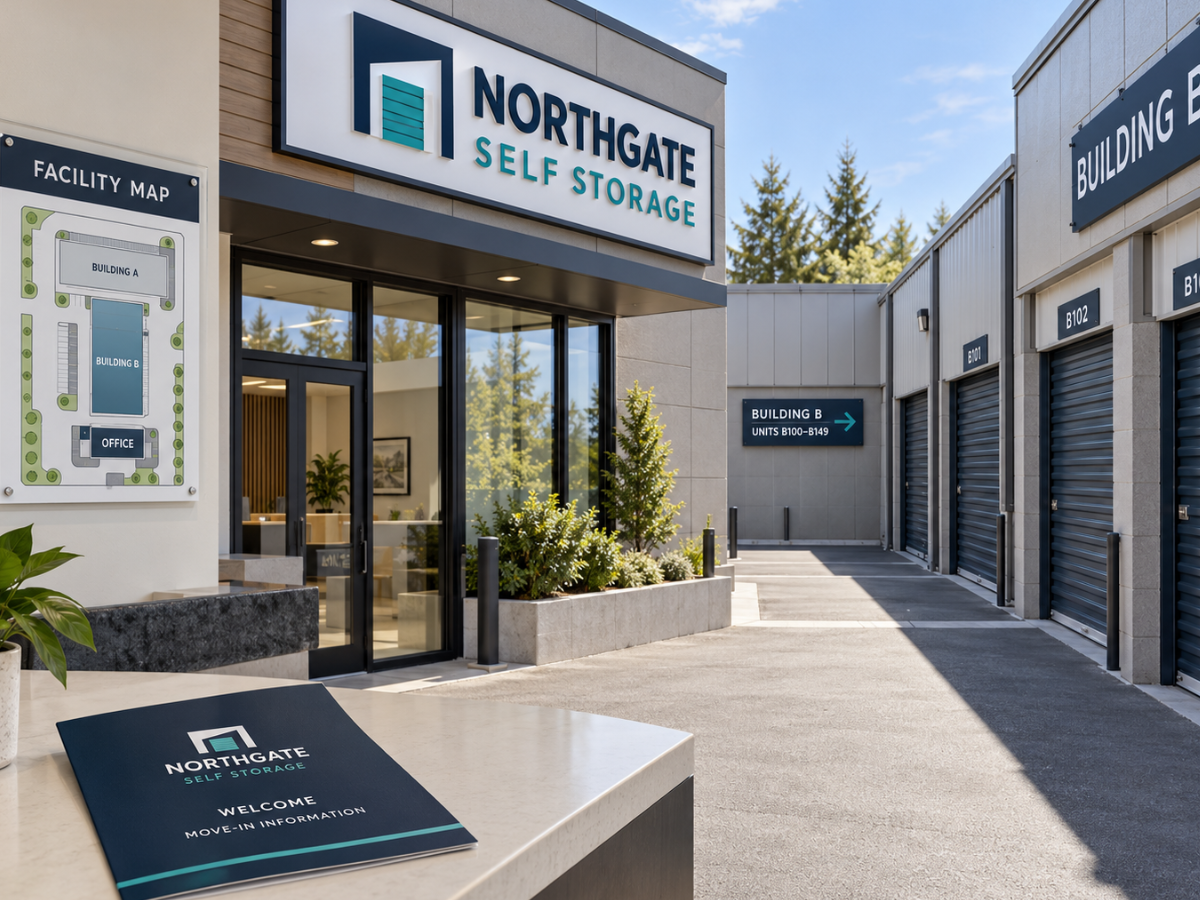
Self-storage facilities need printed materials that help customers recognize the property, locate the correct unit and understand approved facility procedures. Start with clear entrance identification and wayfinding, then coordinate unit numbers, office information, move-in documents and promotional materials. The strongest system separates permanent information from messages that change frequently and treats regulated safety signage as a distinct requirement.
A customer arrives at a storage facility with a rented moving truck. They have a unit number, a booking confirmation and a limited amount of time to unload.
At the entrance, they find several buildings that look nearly identical. The first directional sign is partly hidden behind a parked vehicle. A row of units has numbers that are difficult to read from the driving lane.
Nothing is necessarily wrong with the customer's reservation. The facility has simply made the physical journey harder than it needs to be.
For a self-storage operator, signs and printed information are not only advertising tools. They help people use a property where they may be unfamiliar with the layout, handling bulky belongings or visiting outside regular office hours.
The operator also needs materials for customer inquiries, move-ins, unit changes, local advertising and routine office communication.
A useful print system should make these interactions clearer without cluttering the facility with unnecessary graphics.
1. What Printed Materials Does a Self-Storage Facility Need?
Self-storage printing can be divided into four practical categories.
| Category | Typical Materials | Main Purpose |
|---|---|---|
| Property identification | Entrance signs, office signs, window graphics | Help customers recognize the location |
| Wayfinding | Building markers, directional boards, unit identification | Help customers locate their destination |
| Customer communication | Facility maps, move-in information, folders, approved notices | Explain the customer's next steps |
| Marketing | Flyers, business cards, temporary promotional signs | Introduce available services and generate inquiries |
Not every facility requires every format.
A single-building indoor facility has different wayfinding needs from a large property with several outdoor storage buildings, vehicle routes and loading areas.
Begin with the actual site layout and customer journey before choosing products.
2. Entrance Signs Should Confirm That Customers Have Arrived
At the main entrance, customers should be able to recognize the facility without slowing down unexpectedly or searching for a small company logo.
The primary identification sign should display the approved business name prominently, with sufficient contrast for the expected viewing conditions.
A separate entrance or office sign may be needed when the property has multiple access points.
Consider what a driver can reasonably read while approaching the site. A large amount of promotional text can compete with the most important information: the facility name and the correct entrance.
Existing sign structures, property approvals, lighting and installation requirements should be reviewed before commissioning new exterior graphics.
3. Why Facility Wayfinding Needs Its Own Plan
A storage facility is not organized like a conventional retail store.
Customers may need to navigate between buildings, rows, corridors, loading areas and individual units.
Some visitors arrive in passenger vehicles, while others use rental trucks or trailers. People may stop to check directions while managing unfamiliar equipment.
That makes wayfinding a practical operational concern.
Before designing signs, identify the points where customers need to make decisions.
These might include:
- The entrance from the public road.
- The office or customer service area.
- The first internal road junction.
- Separate building entrances.
- Indoor corridor intersections.
- Loading areas.
- Unit-number ranges.
- Exits and approved customer routes.
Do not install a sign simply because there is an empty wall. Place information where a customer actually needs it.
4. Use Building and Zone Identification Before Individual Unit Numbers
In a larger facility, the building or zone often matters before the individual unit number.
Imagine a fictional property with three storage buildings.
If customers are assigned units in Building B, they should be able to identify Building B from the main circulation route before searching for the exact door.
A useful hierarchy is:
BUILDING B
UNITS B100–B149
Directional information where appropriate
The unit range is an illustrative example of a numbering system, not a recommendation for every facility.
Using consistent building names and unit references across signs, facility maps and booking documents helps customers connect their reservation information to the physical property.
5. How Should Unit Numbers Be Designed?
Unit identification needs to be readable and consistent.
Choose a clear typeface with numerals that are easy to distinguish. Avoid decorative lettering that makes similar characters difficult to recognize.
Consider the difference between the number 1 and the letter I, or between zero and the letter O, when alphanumeric unit codes are used.
Good unit numbering should account for:
- Expected viewing distance.
- Available mounting surface.
- Door or wall colour.
- Contrast.
- Lighting conditions.
- Obstructions when doors are open.
- Consistent number placement.
- Maintenance and future replacement.
Where accessibility standards or other requirements govern identification signs, those requirements must take precedence over general graphic-design preferences.
6. Should Every Storage Unit Use an Identical Sign Template?
A consistent system makes the property easier to navigate and maintain.
Use the same typographic treatment, general dimensions and positioning wherever the physical conditions allow.
However, the design must accommodate the actual unit identifiers.
A sign reading B8 contains fewer characters than one reading B128. The template should handle both without making the longer number too small.
Test the longest unit identifier before producing the complete set.
For large projects involving many unique numbers, create a controlled unit list and confirm the available production method with the printer. Do not assume standard online sign configurations automatically include variable numbering or custom set assembly.
7. Which Printed Sign Materials Should Be Considered?
Material selection depends on where the sign will be installed and how long it must remain useful.
Some interior information boards can use lightweight rigid materials. Exterior signs need to be evaluated for the actual exposure and mounting conditions.
Pryntco offers Custom Coroplast Signs for selected indoor and outdoor applications.
Coroplast may be suitable for certain temporary directional or promotional signs, but it should not automatically be treated as the right permanent solution for every building or unit identifier.
For extensive unit numbering, specialized mounting requirements or materials outside standard product configurations, the project should be evaluated as a custom signage request.
8. What Makes an Internal Directional Sign Effective?
A directional sign has a simple job: help someone choose the correct route.
It should not need the same design treatment as a promotional poster.
Consider a junction with two corridors. A customer may need to know whether units B100–B119 are to the left or right.
The sign should present the relevant unit range and an unambiguous arrow.
Keep the message brief and position it where the decision occurs.
If several destinations need to appear on one sign, arrange them according to the site's actual navigation requirements rather than alphabetical order alone.
Test the proposed signs by walking the routes from the customer's perspective.
9. Avoid Conflicting Signage
A facility can become harder to navigate as new signs accumulate over time.
An older directional board may remain in place after a corridor is renamed. A temporary notice may contradict the permanent sign beside it. A new building map may use different terminology from the unit labels.
These problems are often caused by a lack of document and signage control rather than poor printing.
Maintain one approved location naming system.
Whenever an area is renumbered, expanded or reassigned, review every sign and customer document affected by the change.
Remove superseded information rather than leaving competing instructions visible.
10. Should the Facility Have a Printed Site Map?
A map can be useful when the property has several buildings, corridors or vehicle routes.
However, a printed map should show the information customers need, not reproduce every technical detail from a property plan.
Useful elements may include:
- Building names.
- General unit-number ranges.
- Office location.
- Customer entrances.
- Approved internal routes.
- Relevant loading areas.
- Other customer-facing locations established by management.
The orientation should be easy to understand.
For a map displayed at the entrance, a clearly marked "You Are Here" point may help visitors relate the printed layout to their surroundings.
Management should approve the map against the actual facility plan before printing.
11. One Large Site Map or Smaller Maps Throughout the Property?
That depends on the facility's complexity.
A compact property may need one good map near the entrance or office.
A larger facility may benefit from smaller local maps positioned at major junctions.
Those local maps should remain consistent with the master facility layout, but they can emphasize the immediate area.
For suitable indoor locations, Pryntco offers Foamcore Signs for rigid printed information displays.
Where signs require permanent mounting or exposure to demanding conditions, select a material and installation method appropriate to that environment.
12. Window Graphics Can Identify the Office
The rental office may be situated inside a larger building or separated from the main storage area.
Window graphics can help visitors recognize where to inquire, check in or speak with staff.
Possible information includes the approved company name, office identification and current contact details.
Do not fill the entire window with promotions if customers need to see through the glass or the business relies on daylight.
Pryntco's Window Decals can support selected storefront and office branding applications.
Measure each glass area carefully and confirm the intended installation surface before preparing the artwork.
13. What Should Go in a Customer Move-In Package?
A move-in package should help a new customer understand the next steps after renting a unit.
The exact documents depend on the operator's established procedures.
A useful packet may include:
- Welcome information.
- Facility contact details.
- Approved access instructions.
- Unit or building reference.
- Facility map where useful.
- Approved customer policies.
- Information about requesting assistance.
- Other required documents supplied by management.
Separate general information from documents containing personal information or confidential access credentials.
Do not distribute real customer access codes on sample marketing materials or in publicly visible printed displays.
14. Should Move-In Materials Use a Folder?
A folder can help when several documents need to remain together.
For example, a customer might receive a general facility information sheet, an approved map and individual documents associated with the rental.
Rather than permanently binding changing information into one booklet, a folder allows the operator to replace individual sheets when procedures or details change.
Pryntco offers Presentation Folders for organizing printed business documents.
Not every storage rental requires a physical folder. If the business already manages all customer documentation digitally, a concise printed reference sheet may be more practical.
15. What Information Should Remain Digital?
Some information changes too often or is too sensitive for general printed distribution.
Examples may include individual payment details, private access credentials, current unit availability and customer account information.
A public brochure or office sign should not expose personal details.
Where a QR code is used to direct customers online, explain what it does and ensure the destination is appropriate for public access.
Customer-specific functions should be handled through the operator's authorized systems, not improvised public links.
Printed materials are most useful when they provide stable guidance and clear contact information without creating conflicting records.
16. Should a Self-Storage Facility Print Unit Prices?
Only when the operator can keep the information accurate.
Rental rates and unit availability may change. A large permanent sign carrying detailed prices can become outdated quickly.
For general advertising, the business may choose to explain the types of storage available and direct prospective customers to current rental information.
If a specific promotion is advertised, its terms, eligibility and dates must be approved before printing.
Temporary promotional information should be separated from evergreen facility identification whenever practical.
This avoids replacing an entire permanent sign when one commercial detail changes.
17. Are Printed Flyers Useful for Self-Storage Marketing?
Flyers can support a specific local campaign when the audience and distribution method make sense.
A new facility, for example, may want to introduce its location to nearby residents or businesses.
The flyer should explain the service clearly and make it easy to find accurate information about the facility.
Useful elements include:
- Facility name.
- Location.
- Types of storage offered, where confirmed.
- Contact information.
- Website or rental inquiry destination.
- Approved promotional information, if applicable.
Avoid printing unsupported claims about security, climate control, insurance coverage or storage conditions.
Pryntco offers Custom Flyers for local promotional and business information campaigns.
18. How Should Temporary Notices Be Handled?
Facilities occasionally need to communicate temporary operational changes.
These may involve approved access changes, scheduled work, office-hour updates or other customer information.
A temporary notice should explain:
- What is changing.
- When the change applies.
- Which area or customers are affected.
- What action is required, if any.
- Where to obtain more information.
Use a controlled template so different employees produce consistent notices.
Remove the notice once it is no longer valid. Old instructions can create confusion long after the original issue has been resolved.
19. Keep Safety and Regulatory Signage Separate
Some storage-facility signs may be subject to building, fire, accessibility, security or other regulatory requirements.
These signs should not be designed using ordinary promotional guidelines alone.
Management should identify which messages, placements, materials and formats require professional or regulatory review.
That may include information relating to emergency procedures, restricted areas, fire protection, accessibility or other regulated matters.
The approved wording and specifications must come from the appropriate responsible parties.
A custom sign printer can work with supplied requirements, but generic marketing content should never invent mandatory safety instructions or substitute for a compliance assessment.
20. How Should Signs Be Planned for Different Mounting Surfaces?
A sign mounted to an interior wall may have different requirements from one attached to a metal door, fence, exterior post or glass surface.
Before ordering, confirm:
- The actual mounting location.
- Surface material and condition.
- Required sign dimensions.
- Expected exposure to weather and handling.
- Visibility when doors or gates are open.
- Any restrictions on drilling or adhesives.
- Who is responsible for installation.
Do not assume that every printed board comes with suitable mounting hardware.
Material compatibility and installation should be confirmed for the selected environment.
21. How Many Different Signs Should the Facility Order?
Start with a physical sign schedule rather than a single estimated quantity.
A sign schedule records the individual signs needed, their locations and their unique information.
For a fictional facility, the schedule might contain:
| Sign Group | Location | Content | Quantity Basis |
|---|---|---|---|
| Building markers | Each separate building | Building identifier | Number of required positions |
| Directional signs | Decision points | Approved route information | Site navigation review |
| Unit numbers | Individual units | Unique unit identifier | Approved unit inventory |
| Office signs | Customer service areas | Office identification | Actual entrances and positions |
These categories are illustrative. The exact schedule must match the actual property.
Recording each unique design is especially important when ordering numbered signage. A total quantity alone does not tell the printer which numbers are required.
22. How Can a Storage Operator Avoid Mistakes With Hundreds of Unit Numbers?
Large unit-numbering projects should use a single approved data source.
For example, the facility may maintain an inventory containing building identifiers and individual unit references.
Before production, confirm that the list matches the physical site and that every identifier is unique where required.
Organize the artwork and sign schedule using the same naming system.
When several people contribute to the project, assign one person to approve the complete list.
Special production methods may be needed for many unique signs, so the operator should confirm how the printer can handle variable artwork, assembly and any requested packaging sequence.
Do not assume a standard product automatically includes sequential numbering or installation sorting.
23. What Happens When the Facility Expands?
Expansion often exposes weaknesses in the original wayfinding system.
Adding a new building may change the route customers take through the property. A newly numbered row may require updated maps, directional signs and customer documents.
Before designing new signs, review the existing system as a whole.
The new building should not introduce identifiers that conflict with the current numbering scheme.
Where possible, use the same visual hierarchy, typography and approved materials as existing signs.
However, consistency should not prevent necessary improvements. If older signage is unclear, an expansion may be a useful opportunity to modernize the complete navigation system.
24. What Should Be Checked Before Printing?
Conduct a site and artwork review before production.
- Confirm the official facility name and branding.
- Verify each building and unit identifier.
- Check directional arrows against the actual site.
- Confirm sign dimensions and mounting surfaces.
- Review indoor and outdoor material suitability.
- Ensure text is readable at the intended viewing distance.
- Check maps against the approved facility layout.
- Verify customer contact information.
- Keep changing rates and offers off permanent signage where practical.
- Protect private customer and access information.
- Obtain appropriate approval for regulated signage.
- Confirm the printer can produce any required unique-number variations.
- Use the correct bleed, safe areas and artwork templates.
- Record the final location and quantity of every sign.
For a larger project, reviewing a representative sign at the actual installation location can reveal readability or mounting problems that are difficult to recognize from a digital mockup.
25. Building a Self-Storage Print System That Works
The strongest facility signage follows the customer through the property.
The entrance confirms they have arrived. Building and directional signs help them choose the correct route. Consistent unit identification makes it easier to find the assigned space.
The office and move-in materials then support the administrative side of the relationship, providing approved information without duplicating sensitive account records.
For the operator, the system should also be manageable.
Permanent information needs durable, appropriate construction. Temporary notices should be easy to replace. Unit numbering should follow one approved list. Future expansion should not require inventing an entirely different visual language.
By planning these elements together, the business can create a more professional customer experience while making the property easier to maintain.
Pryntco offers Rigid Signs, window graphics, printed marketing materials and business stationery for a range of commercial applications.
For facility-wide sign schedules, unique unit-numbering requirements, special mounting specifications or coordinated office materials, request a custom quote from Pryntco with the approved sign list, dimensions, artwork and intended installation conditions.

