
What Should Be in a Real Estate Agent’s Print Kit?
What Should Be in a Real Estate Agent’s Print Kit?
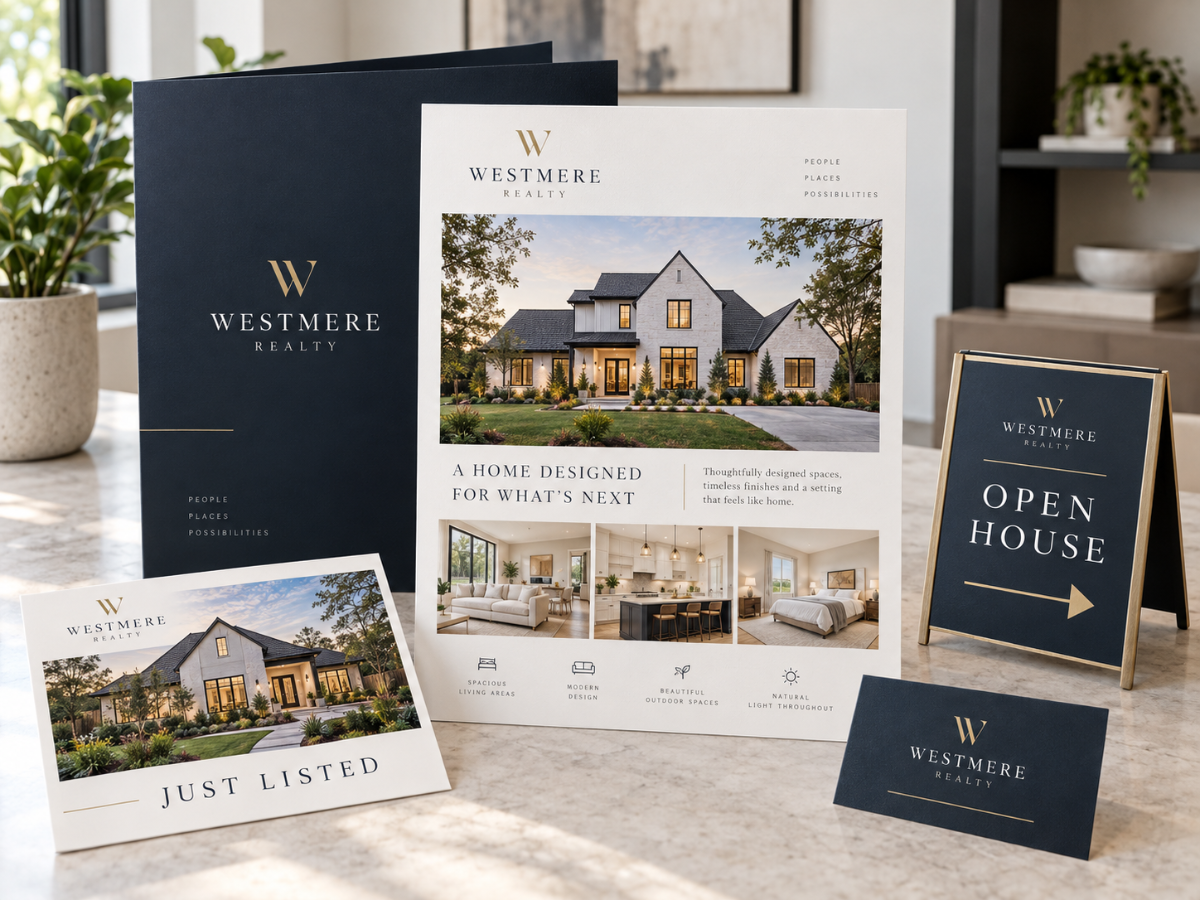
A useful real estate print kit is not one giant package handed to every prospect. It is a small collection of pieces that support different moments: introducing the agent, marketing a property, guiding an open house, following up with homeowners and presenting information professionally during a client meeting.
Real estate involves a lot of digital communication, but the work itself still happens in physical places.
Agents meet sellers at kitchen tables. Buyers walk through homes. Open-house visitors pick up property information. Neighbours notice signs. Prospective clients keep business cards. Listing presentations often include documents that are easier to review when they are organized in front of the client.
That creates a useful role for print.
The mistake is treating every printed piece as another advertisement.
A business card has a different job from a feature sheet. A feature sheet has a different job from an open-house sign. A presentation folder is not a replacement for direct mail, and a postcard should not try to contain the complete listing presentation.
Pryntco already has dedicated resources covering Real Estate Feature Sheets, Real Estate Direct Mail, Lawn Signs and Door Hangers.
This guide looks at how those pieces fit together around the agent’s actual workflow.
1. What Should Be in a Basic Real Estate Print Kit?
A practical kit may include:
- Business cards
- Property feature sheets
- Presentation folder
- Listing or service brochure
- Open-house signage
- Postcards
- Door hangers
- Follow-up or thank-you cards
Not every agent needs every item on day one.
Build the kit around the work you actually do.
2. Why Should an Agent Think in Terms of a Print Kit?
Because the pieces support different stages of the client relationship.
An agent may need to:
- Introduce themselves
- Win a listing
- Market a property
- Run an open house
- Stay visible in a neighbourhood
- Follow up after a transaction
A small coordinated system is easier to manage than designing something new every time one of those situations appears.
3. Does Every Real Estate Agent Still Need Business Cards?
They remain useful because real estate is relationship-driven.
A business card can be exchanged during:
- Listing appointments
- Open houses
- Community events
- Networking
- Property showings
The card does not need to explain every service. Its job is to help the person remember who you are and how to contact you.
4. What Should Be on a Real Estate Business Card?
Keep the essentials obvious.
Depending on the brokerage and applicable branding requirements, this may include:
- Agent name
- Role or title
- Brokerage information
- Phone number
- Website
Any required brokerage, licensing or regulatory wording should come from the agent or brokerage.
5. Should a Business Card Include a Headshot?
It can when the agent’s personal recognition is important to the brand.
A headshot is not mandatory.
If one is used, choose a professional image with enough resolution for print and keep the rest of the card uncluttered.
6. Should Real Estate Business Cards Have a QR Code?
They can, but the code needs one clear destination.
Useful options include:
- Agent website
- Current listings
- Contact page
- Digital contact card
Do not add a QR code simply because there is empty space.
7. What Is the Most Important Printed Piece for an Active Listing?
For many residential listings, the feature sheet is one of the most useful take-away pieces.
It helps buyers remember the property after viewing several homes.
A strong feature sheet can combine:
- Primary property image
- Address
- Approved property details
- Selected features
- Agent contact
- QR code to the online listing
8. What Should a Property Feature Sheet Avoid?
A feature sheet should not become a printed copy of the entire online listing.
Avoid:
- Dozens of tiny photographs
- Long blocks of listing copy
- Outdated property information
- Claims that have not been verified
Pryntco’s Real Estate Feature Sheet Guide covers the format in greater detail.
9. Should Every Listing Have Its Own Printed Feature Sheet?
Only when a physical take-away adds value.
Feature sheets are especially useful for:
- Open houses
- Private showings
- Sales centres
- Property presentations
For some highly digital sales processes, the agent may use fewer physical copies and direct visitors to current online information instead.
10. Should Feature Sheets Include Price?
Only when the price is current and appropriate to advertise.
If a listing changes, old feature sheets should be removed.
Do not continue distributing printed property information simply because copies remain.
11. What Should an Agent Bring to a Listing Presentation?
The presentation should support the conversation rather than overwhelm the homeowner.
Possible pieces include:
- Presentation folder
- Agent introduction
- Marketing plan
- Relevant market information supplied by the agent
- Sample property marketing
- Business card
Client-specific legal and contractual documents should remain separate from general marketing collateral.
12. Why Use a Presentation Folder?
A folder keeps separate materials organized without forcing everything into one brochure.
It can hold:
- Proposal
- Service overview
- Marketing examples
- Forms
- Business card
Pryntco’s Presentation Folder Guide specifically includes real estate presentations among its practical uses.
13. Should the Folder Contain Everything the Agent Has Ever Printed?
No.
A listing presentation should feel edited.
Include only material that helps the homeowner understand:
- The agent
- The marketing approach
- The next step
More paper does not automatically make the presentation stronger.
14. Should an Agent Have a General Services Brochure?
It can be useful when the business needs a reusable overview that is not tied to one listing.
A brochure may explain:
- Buying services
- Selling services
- Areas served
- General process
- Contact information
Keep temporary statistics and changing market data on separate pieces.
15. What Print Is Needed for an Open House?
An open house may use:
- Property feature sheets
- Directional lawn signs
- Main open-house sign
- Agent business cards
- Property information
The visitor should be able to find the property, understand the main details and contact the agent afterward.
16. What Should an Open-House Directional Sign Say?
Very little.
A useful sign may contain:
OPEN HOUSE
plus a large directional arrow and consistent agent or brokerage branding.
Drivers should not need to read property details while trying to decide where to turn.
17. Should Directional Signs Match the Main Property Sign?
Yes.
Use the same:
- Colours
- Logo treatment
- Typography
- General layout style
Consistency helps visitors recognize that they are following the correct route.
18. Are Lawn Signs Only for Listings?
No.
They can also support:
- Open-house direction
- New development activity
- Approved agent campaigns
- Event wayfinding
Placement should always follow property permission and applicable local rules.
19. When Are Postcards Useful for an Agent?
Postcards work when the campaign is designed around one local message.
Examples include:
- Just Listed
- Just Sold
- Open House
- Neighbourhood introduction
- Market update
Pryntco’s Real Estate Direct Mail Guide owns that deeper campaign-planning topic.
20. Should One Postcard Promote Several Listings?
Only when the campaign is intentionally about several properties or a broader market message.
A property-specific postcard is usually easier to understand when it focuses on that property.
Do not make every postcard perform every real estate marketing job.
21. When Are Door Hangers Useful?
Door hangers can support highly local neighbourhood activity where their distribution is appropriate.
They may introduce:
- Agent
- Open house
- Listing activity
- Homeowner service
Use one reason for the homeowner to pay attention.
22. Should Door Hangers Replace Direct Mail?
No.
They are different channels.
A postcard reaches the addressed household through mail.
A door hanger is physically distributed to a door.
The right format depends on the campaign geography, logistics and local rules.
23. Should Agents Print Neighbourhood Market Updates?
They can when the information is current, properly sourced and appropriate to distribute.
The print piece should identify:
- Area
- Time period
- Source where appropriate
- Agent contact
Do not present old market figures as current.
24. Should an Agent Print Buyer Guides?
A concise buyer guide can be useful when clients repeatedly ask the same process questions.
It may cover:
- General buying stages
- Viewing preparation
- Agent contact process
- Next-step checklist
Legal, mortgage and financial advice should remain with qualified professionals and approved sources.
25. Should an Agent Print Seller Guides?
Yes when a reusable guide supports seller conversations.
Possible sections include:
- Preparing the property
- Photography process
- Showing preparation
- Marketing overview
Avoid printing market-specific information into a long-lived guide when it changes frequently.
26. Should Printed Client Guides Replace Digital Information?
No.
A printed guide should make the core process easier to understand.
Current listings, changing schedules, market information and detailed resources can remain online.
Print and digital work better when each handles the information it is best suited to carry.
27. How Should QR Codes Be Used Across the Print Kit?
Use different QR destinations when the printed pieces have different purposes.
For example:
- Feature sheet → property listing
- Agent card → contact page
- Seller postcard → valuation request
- Open-house piece → property information
A generic homepage code is not always the most useful destination.
28. Should an Agent Use Review Cards?
A small review card can be useful after a genuine completed client experience.
Keep the request neutral.
Use wording such as:
SHARE YOUR EXPERIENCE
rather than requesting a specific rating.
29. Should an Agent Send Printed Thank-You Cards?
They can be especially appropriate after a completed transaction, referral or meaningful client interaction.
A short handwritten note can make a simple printed card feel far more personal than another promotional flyer.
The first message should be appreciation.
30. What Should Be Printed for Referral Relationships?
Keep referral material simple.
An agent may use:
- Business card
- Referral card
- Thank-you card
Any formal referral arrangement, incentive or compensation needs to follow the applicable brokerage and regulatory requirements.
31. How Should Multi-Agent Teams Handle Print?
Use a shared brand system with controlled personal fields.
Each agent version may change:
- Name
- Photo
- Phone
- QR destination
Keep brokerage and team branding consistent.
32. How Should Multi-Office Brokerages Handle Print?
Location-specific information needs careful version control.
Check:
- Office address
- Local phone number
- Agent roster
- QR code
Never assume one file works unchanged for every office.
33. How Much Real Estate Print Should Be Ordered at Once?
Order according to how quickly the information can change.
Evergreen pieces such as general business cards may have a longer useful life than:
- Property feature sheets
- Dated open-house materials
- Market updates
- Listing postcards
Short-lived information deserves conservative quantities.
34. What Real Estate Print Should Stay Evergreen?
Good candidates include:
- General agent brochure
- Presentation folder
- Business card
- Reusable directional branding where appropriate
Do not build dates, listing prices or temporary statistics into pieces intended for long-term use.
35. How Should Real Estate Print Files Be Named?
Use clear file names that identify the property and piece.
For example:
47_Maple_Ave_FeatureSheet_2026_FINAL.pdf
is safer than:
listing-final-new2.pdf
Clear naming reduces the risk of sending an old property version back to print.
36. What Should Be Proofed Before Real Estate Print Is Approved?
Check:
- Agent name
- Brokerage information
- Property address
- Price where shown
- Event dates and times
- Phone and email
- QR destination
- Property details
Property-specific pieces deserve a fresh proof every time.
37. What Are the Most Common Real Estate Print Mistakes?
Common problems include:
- Using an old listing price.
- Leaving outdated feature sheets at the property.
- Making directional signs too detailed.
- Using one QR code for unrelated campaigns.
- Overloading listing presentations with unnecessary pieces.
- Printing large quantities of dated material.
- Using incorrect brokerage or contact information.
38. What Should a Real Estate Agent Print First?
Start with the materials that support the work you perform every week.
For agent identity, have a clean business card and a consistent brand system.
For listings, prepare property-specific feature sheets when buyers benefit from a take-away reference.
For listing appointments, use a folder or organized presentation that keeps the relevant materials together without burying the homeowner in paper.
For open houses, prioritize clear directional signage and property information.
For neighbourhood marketing, use postcards or door hangers only when the campaign has one clear local purpose.
After the transaction, a genuine thank-you card or simple review request can support the relationship without turning every interaction into another sales pitch.
The strongest print kit is not the biggest one.
It is the one where every piece has a defined job.
For listing-specific guidance, review Pryntco’s Real Estate Feature Sheet Guide and Real Estate Direct Mail Guide.
For a coordinated custom print project, contact Pryntco or submit a custom quote request.

