What Property Managers Should Print for Tenants, Buildings and Leasing
What Property Managers Should Print for Tenants, Buildings and Leasing
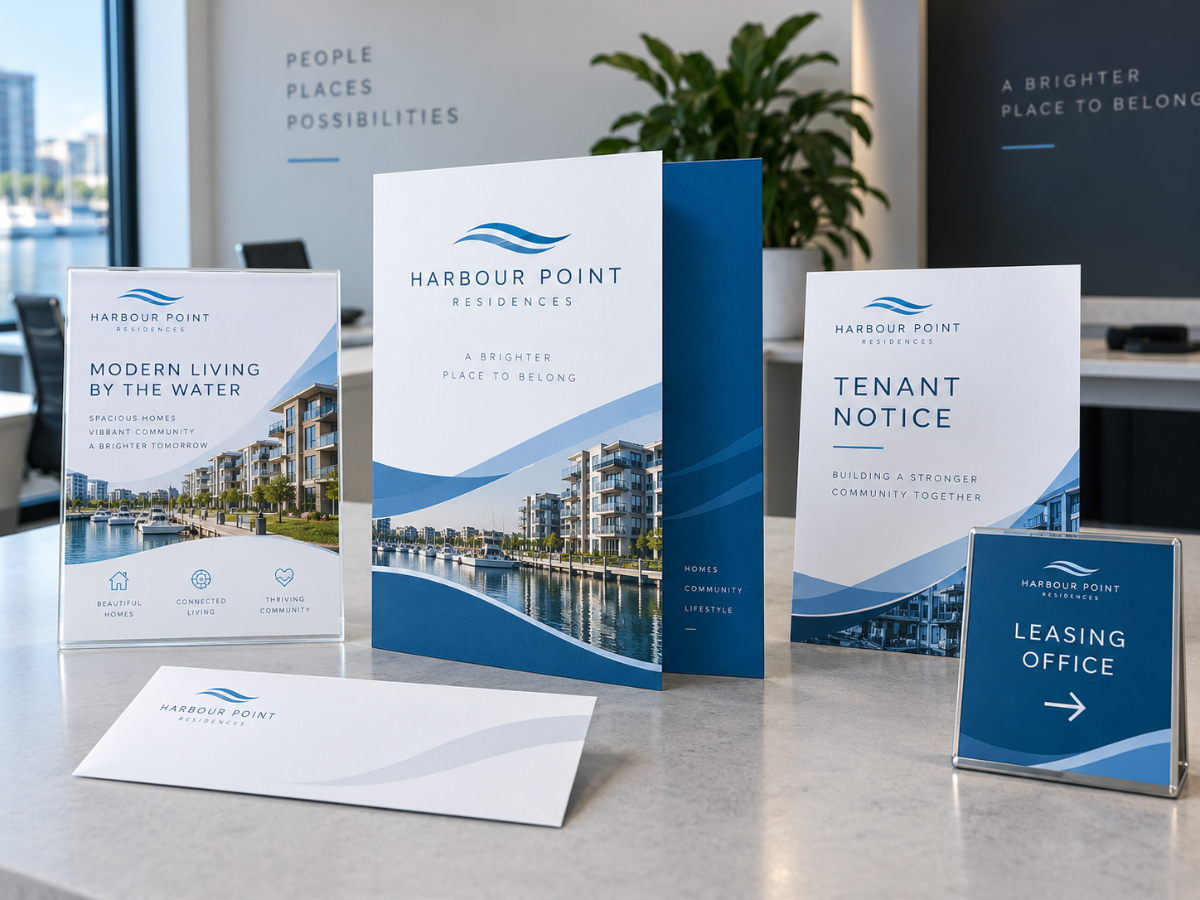
Property-management print has to serve two very different jobs: attracting new tenants and communicating clearly with the people already living or working in the building. Leasing materials should sell the property, while notices, forms, envelopes and building signs should make day-to-day operations easier to understand.
Property managers handle more printed communication than many businesses realize.
A leasing office may need brochures and flyers for prospective tenants while the same team is also producing move-in information, lobby notices, maintenance updates, parking communication, envelopes, forms and temporary signs.
Those materials should not all look or behave the same way.
A leasing flyer is persuasive. A tenant notice is operational. A lobby sign must be readable from a distance. A move-in package needs to organize several documents in a useful order.
The strongest property-management print system separates those purposes while keeping the building or management company recognizable across all of them.
Pryntco’s current Custom Envelope guide specifically lists property managers as users of printed envelopes for tenant notices, statements and building communication, while its presentation-folder, letterhead and signage resources provide additional formats that naturally support leasing and property operations.
1. What Printed Materials Do Property Managers Commonly Need?
Depending on the type of property, common materials may include:
- Tenant notices
- Letterhead
- Branded envelopes
- Move-in packages
- Leasing flyers
- Property brochures
- Application or information forms
- Lobby posters
- Directional signs
- Temporary building notices
- Resident-event materials
A residential tower, commercial property and multi-building management company may each need a different combination.
2. Why Should Leasing Print and Tenant Communication Be Separated?
They have different goals.
Leasing materials help prospective tenants understand the property and decide whether to inquire.
Tenant communication helps existing occupants understand something they need to know or do.
A leasing brochure may use photography and persuasive copy, while a maintenance notice should prioritize:
- Date
- Time
- Area affected
- Required tenant action
- Contact information
3. What Should Stay Consistent Across Property-Management Print?
Core identity should remain recognizable.
That may include:
- Management-company logo
- Building or property name
- Brand colours
- Typography
- Contact information
Operational documents can remain simple without looking disconnected from the company.
4. When Should Property Managers Use Letterhead?
Letterhead is useful for formal correspondence such as:
- Tenant letters
- Owner communication
- Vendor correspondence
- Building notices sent by mail
- Administrative communication
Pryntco’s Business Letterhead Design Guide explains how to keep the branded area professional while leaving enough usable space for the actual letter.
5. Why Are Branded Envelopes Useful for Property Managers?
A branded envelope can help the recipient identify the sender before opening the mail.
Property managers may use envelopes for:
- Tenant notices
- Statements
- Lease-related correspondence
- Owner communication
- Building updates
Pryntco’s Custom Envelope Printing Guide specifically includes property managers as a recurring business-envelope use case.
6. What Should a Tenant Notice Include?
A notice should make the action or information obvious.
Depending on the situation, include:
- Building or property name
- Notice subject
- Date
- Relevant time
- Area affected
- Required action
- Management contact
Any legally required wording should come from the property manager or appropriate professional source rather than being invented during design.
7. Should Property Managers Create a Reusable Notice Template?
Yes.
A consistent template can help staff create new notices without rebuilding the layout each time.
Keep fixed elements such as:
- Logo
- Header style
- Contact information
while leaving obvious areas for the subject, dates and instructions.
8. What Should Go in a Move-In Package?
A move-in package may include:
- Welcome letter
- Building contact information
- Move-in procedures
- Amenity information
- Parking information
- Waste and recycling information
- Approved building policies
Only include information relevant to that property.
9. Should Move-In Packages Use Presentation Folders?
A folder can be useful when several documents need to stay together.
A reusable branded folder allows the management company to update individual sheets without reprinting the complete package.
Pryntco’s Presentation Folder Guide explains how separate information and action documents can be organized into different pockets.
10. Should Move-In Documents Be Collated?
Yes when every new tenant receives the same sequence.
A logical order might be:
- Welcome
- Contacts
- Move-in information
- Building rules
- Amenities
- Additional forms
Pryntco’s Document Collating & Set Assembly Guide covers packet organization in more detail.
11. What Should a Leasing Flyer Focus On?
A leasing flyer should help a prospective tenant understand the opportunity quickly.
Depending on the property, it may include:
- Property name
- Location
- Selected features
- Strong property photography
- Contact information
- QR code to current availability
Do not crowd the page with every building detail.
12. Should Leasing Flyers Include Pricing?
Only when the pricing is current and expected to remain accurate for the life of the printed piece.
When availability or rates change frequently, it may be safer to direct prospects to a current online page for detailed information.
13. When Is a Property Brochure Better Than a Flyer?
A brochure is useful when the property requires more structured explanation.
It may include:
- Property overview
- Location information
- Amenities
- Floor-plan information supplied by management
- Contact details
A flyer is usually better for one concise leasing campaign.
14. Should Property Managers Use Lobby Posters?
Yes for information that several residents or visitors need to see.
Lobby posters may communicate:
- Maintenance work
- Resident events
- Building updates
- Temporary service changes
Use a clear headline and readable date rather than formatting the poster like a long letter.
15. What Makes a Building Notice Easy to Read?
Use a strong visual hierarchy.
A useful structure is:
WHAT IS HAPPENING
WHEN
WHO IS AFFECTED
WHAT RESIDENTS NEED TO DO
WHO TO CONTACT
16. When Are Directional Signs Useful?
Temporary directional signs can help visitors find:
- Leasing office
- Temporary entrance
- Resident event
- Elevator access
- Registration area
Permanent life-safety, accessibility or legally required building signage should follow the appropriate regulations and professional requirements.
17. Can Property Managers Use A-Frame Signs?
Where permitted, A-frame signs can support temporary messages such as:
- LEASING OFFICE
- OPEN HOUSE
- PLEASE USE OTHER ENTRANCE
- RESIDENT EVENT
Pryntco’s A-Frame Sign Design Guide explains how to keep short-distance and sidewalk messaging readable.
18. Are Door Hangers Useful in Property Management?
They can be useful for selected building communication when direct placement at a unit door is appropriate.
Examples may include:
- Service-visit reminder
- Inspection reminder
- Maintenance access information
Any notice requirements, privacy rules or legal obligations should be confirmed by management before the piece is used.
19. How Should Maintenance Communication Be Printed?
Maintenance notices should be specific.
Clearly identify:
- Work being performed
- Date
- Expected time window supplied by management
- Area affected
- Access instructions where applicable
Avoid vague headings such as “Important Notice” when a more precise title is available.
20. How Should Emergency Communication Be Handled?
Emergency and safety communication should follow the property’s established emergency procedures and applicable requirements.
Ordinary promotional print guidance should never replace required:
- Fire signage
- Evacuation information
- Safety notices
- Accessibility signage
Use professionally approved content for regulated information.
21. What Forms Might Property Managers Print?
Depending on operations, forms may support:
- Move-in administration
- Parking requests
- Amenity requests
- Maintenance requests
- Key or access administration
The property manager should determine exactly which information is necessary.
22. Should Property Forms Be Easy to Write On?
Yes when staff or tenants complete them by hand.
Prioritize:
- Readable labels
- Enough writing space
- Clear checkboxes
- Logical field order
Decorative design should never reduce usability.
23. How Should Property Managers Handle Private Information?
Do not expose tenant names, account information or other private data on public-facing notices unless there is a legitimate and appropriate reason.
Completed forms and tenant-specific documents should be handled according to the organization’s privacy procedures.
24. Can QR Codes Help With Building Communication?
Yes when they lead to a useful current destination.
A QR code may connect tenants or prospects to:
- Leasing information
- Maintenance request page
- Resident event registration
- Building information page
Label the code so people know why they should scan it.
25. Should Every Property Notice Have a QR Code?
No.
A QR code should only be used when the online destination adds useful information or allows the recipient to take action.
A simple notice about a temporary elevator shutdown may be clearer without one.
26. What Should Be in a Move-Out Package?
Where the property uses one, a move-out package may include management-approved information such as:
- Move-out procedures
- Key-return instructions
- Booking information
- Contact information
Any legal, financial or lease-related instructions should be supplied or approved by management.
27. How Should Vendor or Contractor Notices Be Handled?
When outside work affects tenants, notices should clearly identify the impact rather than advertise the vendor.
Focus on:
- Area affected
- Date
- Access changes
- Noise or service information supplied by management
- Contact point
28. Can Property Managers Use Print for Resident Events?
Yes.
Resident-event materials may include:
- Lobby poster
- Elevator notice
- Invitation
- Registration card
Use one consistent event name and date across every piece.
29. What Printed Signs Are Useful for Amenities?
Non-regulatory informational signage may help identify:
- Fitness room
- Party room
- Parcel area
- Bike storage
- Management office
Permanent signs should be planned with the building environment and applicable requirements in mind.
30. How Should Seasonal Building Communication Be Managed?
Temporary seasonal notices may relate to:
- Holiday office hours
- Seasonal maintenance
- Resident events
- Weather-related procedures supplied by management
Remove them once the information is no longer current.
31. Should Property Managers Print Owner or Board Packages?
They can when meetings require structured physical documents.
A packet might contain:
- Agenda
- Reports
- Supporting documents
- Meeting notes
Use clear page order and version control, particularly when documents are revised before a meeting.
32. How Should a Leasing Package Be Organized?
A prospective tenant should not receive an unstructured stack of pages.
A leasing package may include:
- Property overview
- Current availability information
- Amenity sheet
- Application or next-step information
- Contact card
Use a folder when several separate pieces need to stay together.
33. How Many Property-Management Materials Should Be Printed?
Base quantity on how quickly the information changes.
Evergreen pieces such as a general folder may justify a larger quantity than:
- Current leasing availability
- Temporary maintenance notices
- Event posters
- Seasonal information
34. How Should Files Be Named Across Several Buildings?
Include the property and document type.
For example:
Harbour_Tower_MoveIn_Package_2026_FINAL.pdf
is clearer than:
movein-new-final.pdf
Pryntco’s Multi-Location Print Guide provides broader guidance on managing location-specific versions.
35. How Can Property Managers Avoid Using Outdated Print?
Review stock whenever there is a change to:
- Management company
- Phone number
- Office hours
- Building policies
- Leasing information
Do not continue using old material merely because copies remain.
36. How Should Property-Management Artwork Be Prepared?
Before production:
- Confirm the correct property.
- Use current contact information.
- Use approved building photography.
- Prepare artwork at the correct size.
- Follow bleed and safe-area requirements.
- Test QR codes.
- Proof dates and building names carefully.
Pryntco’s Artwork Preparation Guide covers broader technical file setup.
37. What Are the Most Common Property-Management Print Mistakes?
Common problems include:
- Using the wrong building address.
- Printing leasing rates that become outdated quickly.
- Making tenant notices too dense to scan.
- Leaving expired maintenance notices posted.
- Mixing legal or safety communication with ordinary marketing design.
- Using old QR destinations.
- Exposing unnecessary private information.
- Using one generic file for several properties with different details.
38. What Should a Property Manager Print First?
Start with the materials used repeatedly.
For tenant communication, build a reliable letterhead, envelope and notice system so staff can produce clear building information quickly without redesigning every document.
For move-ins, organize the information into a predictable package. A branded folder or collated document set can keep welcome information, policies and building details together.
For leasing, use a separate set of materials designed around prospective tenants. A flyer, brochure or leasing package should explain the property clearly and direct the prospect to current availability.
For the building itself, use readable temporary posters and directional signs only where they genuinely help people navigate or understand current information.
Keep frequently changing information in smaller quantities.
Keep reusable branding separate from dates, rates and temporary instructions.
That simple separation makes the property’s entire print system easier to update and much harder to confuse.
Property managers planning custom notices, folders, stationery or building communication can contact Pryntco or submit a custom quote request.