
How to Build a Product Launch Print Kit for a New Product or Brand
How to Build a Product Launch Print Kit for a New Product or Brand
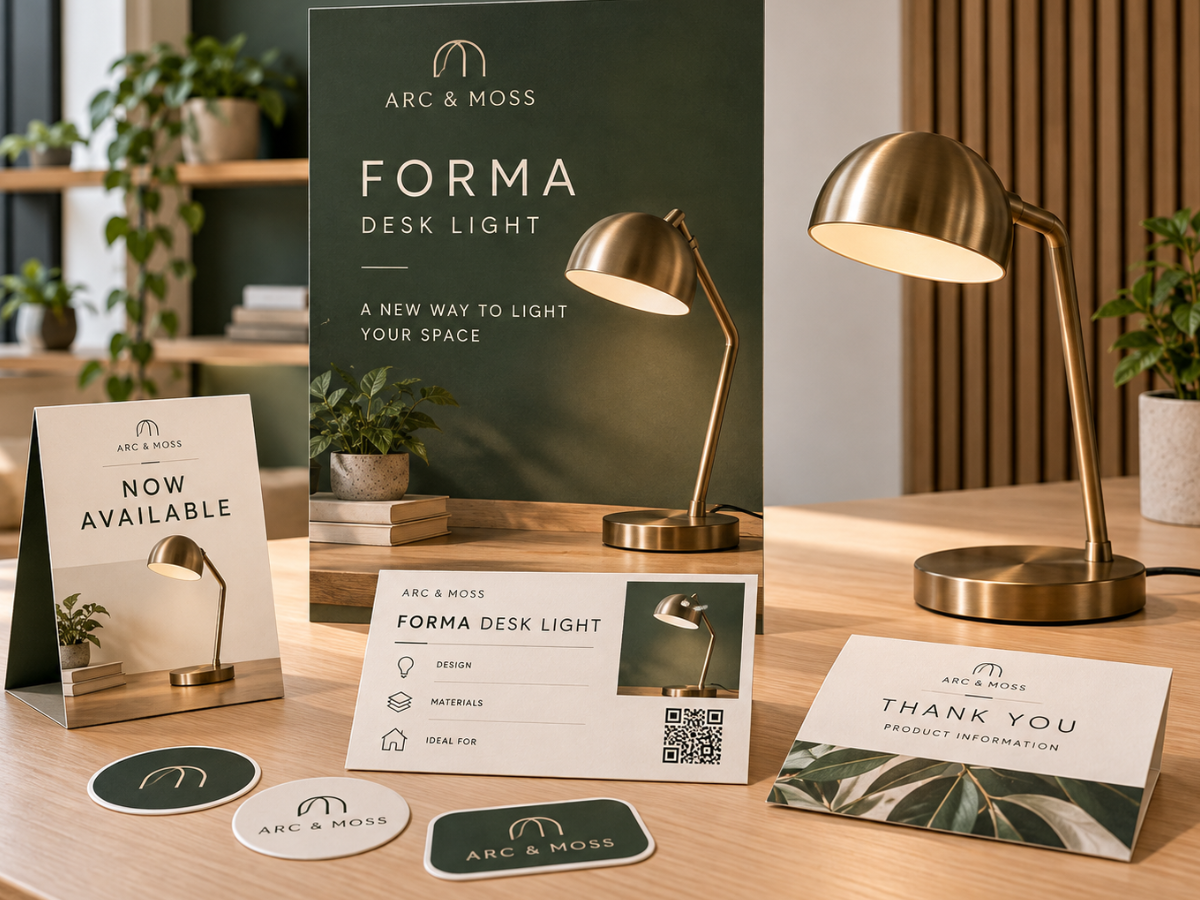
A product launch does not need every marketing piece at once. The launch kit should follow the customer journey: create awareness before release, explain the product at the point of discovery, support demonstrations or retail displays, and give buyers useful information after the purchase.
A new product can create an unusual amount of print.
Someone wants a launch poster.
The retail team needs shelf information.
The event team asks for a table cover.
The packaging needs a product card.
Sales wants brochures.
A photo backdrop is added for launch day.
Then the launch happens and several pieces say slightly different things.
The strongest product-launch print system starts with the customer journey rather than the product catalogue.
Before launch, print may need to build awareness.
At launch, it may need to attract attention and explain the product.
At purchase, it may need to support packaging or instructions.
After purchase, it may connect the customer to support, registration, care information or the next product.
Pryntco’s current offering spans Print Marketing Materials, product-information pieces, signs, trade-show displays and branded event materials that can support those different stages.
1. What Is a Product Launch Print Kit?
A product launch print kit is a coordinated group of printed materials used to introduce a new product or collection.
It may include:
- Posters
- Product cards
- Flyers or brochures
- Stickers or labels
- Hang tags
- Table displays
- Event graphics
- Packaging inserts
2. What Should Be Decided Before Anything Is Printed?
Define the launch goal.
The product may be launching through:
- Retail stores
- Ecommerce
- Trade show
- Press event
- Distributor network
- Pop-up activation
The print kit should reflect the actual launch channel.
3. Who Is the Launch Audience?
Separate the audience before building materials.
Possible groups include:
- Consumers
- Retail buyers
- Distributors
- Existing customers
- Media
- Event attendees
They may not need the same information.
4. What Print Is Useful Before Launch Day?
Pre-launch material may include:
- Coming-soon poster
- Teaser postcard
- Retail window graphic
- Event invitation
A pre-launch piece should create enough interest without pretending the product is already available when it is not.
5. When Should a Launch Poster Be Used?
A poster works when the product needs visibility in one physical location.
Pryntco’s current Poster Printing options can support:
- Retail launches
- Showrooms
- Events
- Reception areas
Use one strong product image and one main launch message.
6. Should the Poster Show Every Product Feature?
No.
The poster is an awareness piece.
Prioritize:
- Product name
- Primary image
- Short positioning message
- Launch or availability information where approved
Detailed specifications belong closer to the product.
7. What Is a Product Information Card?
A product information card gives customers useful details about the specific item.
It may include:
- Product name
- Short description
- Key approved details
- Usage or support information
- QR code
Pryntco’s Product Information Card Guide covers this format in detail.
8. Where Should Product Cards Be Used During a Launch?
They can sit:
- Beside a product
- On a retail display
- Inside packaging
- At a demonstration station
The card should answer questions relevant at that stage of the launch.
9. When Are Tent Cards Useful?
Tent cards work well for close-range product displays.
They can show:
- Product name
- Feature summary
- Launch message
- QR code
Pryntco’s live Tent Card product is specifically positioned for retail, events and point-of-sale displays.
10. When Should a Product Launch Use Stickers?
Stickers can support:
- Package branding
- Limited campaign identity
- Sample packaging
- Launch-event giveaways
Choose the material and adhesive for the actual surface.
11. When Are Custom Shape Stickers Useful?
A custom shape can be useful when the sticker itself is part of the brand experience.
Pryntco’s Custom Shape Sticker Guide covers artwork, cut lines and shape planning.
Do not use an unusual shape when a simple rectangle or circle communicates the brand better.
12. When Should a New Product Use a Hang Tag?
A hang tag makes sense when information needs to travel physically with:
- Apparel
- Accessories
- Textiles
- Gift products
The tag can carry product identity, approved specifications, care information or a QR code.
13. Should the Launch Kit Include a Brochure?
Only when the launch needs more explanation than one product card can provide.
A brochure may be useful for:
- Several related products
- New collection
- B2B buyers
- Technical overview
Do not create a brochure simply because the product launch feels important.
14. When Is a Flyer Better Than a Brochure?
A flyer is often enough when the launch message is:
- One product
- One event
- One announcement
The simpler format can make the launch easier to understand.
15. What Should a Launch Event Table Look Like?
Keep the table focused.
Possible elements include:
- Product sample
- One product-information card
- Business cards
- Small stack of brochures where relevant
Bulk materials should remain out of sight.
16. When Is a Branded Table Cover Useful?
A table cover can turn a standard event table into part of the launch environment.
Pryntco currently offers custom Table Covers for 6-foot and 8-foot tables.
Use the cover for brand identity rather than detailed launch copy.
17. When Does a Product Launch Need a Backdrop?
A backdrop or media wall can make sense for:
- Press photography
- Launch presentation
- Product demonstration
- Branded photo area
It should support the environment rather than become a giant specification sheet.
18. Should the Backdrop Use the Product Photograph?
It can.
A large hero image can help when the product itself is small or difficult to see from a distance.
Use the original high-resolution photograph and prepare the artwork specifically for the selected display.
19. Should Product Samples Have Separate Printed Information?
Yes when the sample alone does not explain:
- Model
- Variant
- Approved feature
- How to order
A small information card can prevent staff from repeating basic facts constantly.
20. What Should Go Inside the Product Package?
Only the information the customer genuinely needs after purchase.
That may include:
- Thank-you card
- Product information
- Care instructions
- Warranty or registration information
Do not insert four cards when one well-organized card can do the job.
21. Should a Launch Insert Ask for a Review?
It can direct customers to the proper review channel, but the timing should respect the customer experience.
A buyer who has just opened the package may not yet be ready to evaluate the product meaningfully.
22. How Should QR Codes Be Used During a Launch?
Use them to connect physical material with information that is better online.
Potential destinations include:
- Product page
- Demonstration video
- Technical documentation
- Current availability
- Registration or support
23. Should Every Printed Piece Have the Same QR Code?
Not necessarily.
The destination should fit the context.
A launch poster may send people to the product page.
A packaging insert may send existing buyers to support.
Label each destination.
24. How Should Pricing Be Handled?
Only print prices when they are confirmed and expected to remain current.
For a product with changing retail or wholesale pricing, a QR code or digital price list may be easier to maintain.
Do not allow one price change to make the entire launch brochure obsolete.
25. How Should the Launch Date Be Handled?
Date-specific artwork can be useful before launch.
After launch day, that same wording becomes outdated immediately.
Keep reusable displays more evergreen and use replaceable posters, cards or digital content for the date.
26. How Should Product Claims Be Handled?
Every claim should be supplied or approved by the business responsible for the product.
Do not invent:
- Performance claims
- Safety claims
- Environmental claims
- Health claims
- Certifications
because the launch needs stronger marketing language.
27. What About Regulated Products?
Any legally required information, warnings or disclosures should be provided by the responsible business and reviewed according to the applicable requirements.
A printer should not invent regulatory wording.
28. How Should Limited-Edition Language Be Used?
Only use:
LIMITED EDITION
when the business genuinely intends the product to be limited.
Do not manufacture urgency with unsupported inventory or availability claims.
29. What Print Does a Retail Product Launch Need?
A retail launch may combine:
- Window poster or graphic
- In-store poster
- Product tent card
- Hang tag or label
- Take-away flyer
Each piece should support a different stage of the shopping experience.
30. What Print Does an Ecommerce Product Launch Need?
An ecommerce launch may need less physical acquisition material and more post-purchase print.
Useful pieces can include:
- Packaging insert
- Product-information card
- Care card
- Thank-you card
The website carries much of the pre-purchase information.
31. What Print Does a B2B or Wholesale Launch Need?
Professional buyers may need:
- Product sheet
- Catalogue
- Specification table
- Presentation folder
- Current ordering or pricing information
Separate confidential wholesale information from consumer-facing launch pieces.
32. What Print Does a Trade Show Launch Need?
A trade-show launch may combine:
- Backdrop or banner
- Table cover
- Product cards
- Brochure
- Lead-capture sign
Pryntco’s Trade Show Printing Checklist covers the complete booth separately.
33. What Should a Press or Media Launch Kit Include?
Keep it concise.
Depending on the launch, useful material may include:
- Product overview
- Approved fact sheet
- Contact information
- QR link to approved photography
Do not overload journalists or partners with ordinary customer flyers.
34. How Should Staff Materials Be Handled?
Staff may need an internal quick-reference sheet containing approved:
- Product name
- Key positioning
- Frequently asked questions
- Response process
Internal material should be clearly separated from customer-facing print.
35. How Should Multi-Location Launches Stay Consistent?
Use one launch master and control the variables.
Location-specific fields may include:
- Address
- Event date
- Local availability
- QR code
Keep the core product identity and campaign visuals consistent.
36. How Many Launch Materials Should Be Printed?
Estimate from the actual channel.
Consider:
- Number of stores
- Event attendance
- Expected purchases
- Dealer count
- How long the launch campaign remains current
Print dated material more conservatively than evergreen product information.
37. What Are the Most Common Product Launch Print Mistakes?
Common problems include:
- Designing every piece independently.
- Using different product names across materials.
- Printing unstable pricing too early.
- Using unverified claims.
- Putting the launch date on reusable displays.
- Creating too many inserts inside the package.
- Using low-resolution product photography.
- Forgetting to plan what happens after launch day.
38. How Should You Build a Product Launch Print Kit From Start to Finish?
Start with the launch channel and audience.
Decide what customers need before release, at the point of discovery, during purchase and after the product is in their hands.
Use large-format print such as posters, displays and window graphics for awareness.
Use product cards, tent cards, hang tags and brochures for information closer to the buying decision.
Use a table cover or backdrop when the launch includes a physical event or demonstration.
Then plan the post-purchase experience.
A product-information card, care card, warranty piece or thank-you insert may be more valuable after the sale than another promotional flyer.
Keep temporary dates and unstable pricing off reusable displays.
Make sure every printed claim is approved and every product name, model and QR code is consistent.
The final launch kit should feel like one connected campaign rather than ten unrelated files created by different teams.
Pryntco can support launch materials through Print Marketing Materials, Posters, Table Covers and other signage and display products.
For a coordinated custom launch package, contact Pryntco or submit a custom quote request.

