What Printed Materials Should a Hotel or Event Venue Have?
What Printed Materials Should a Hotel or Event Venue Have?
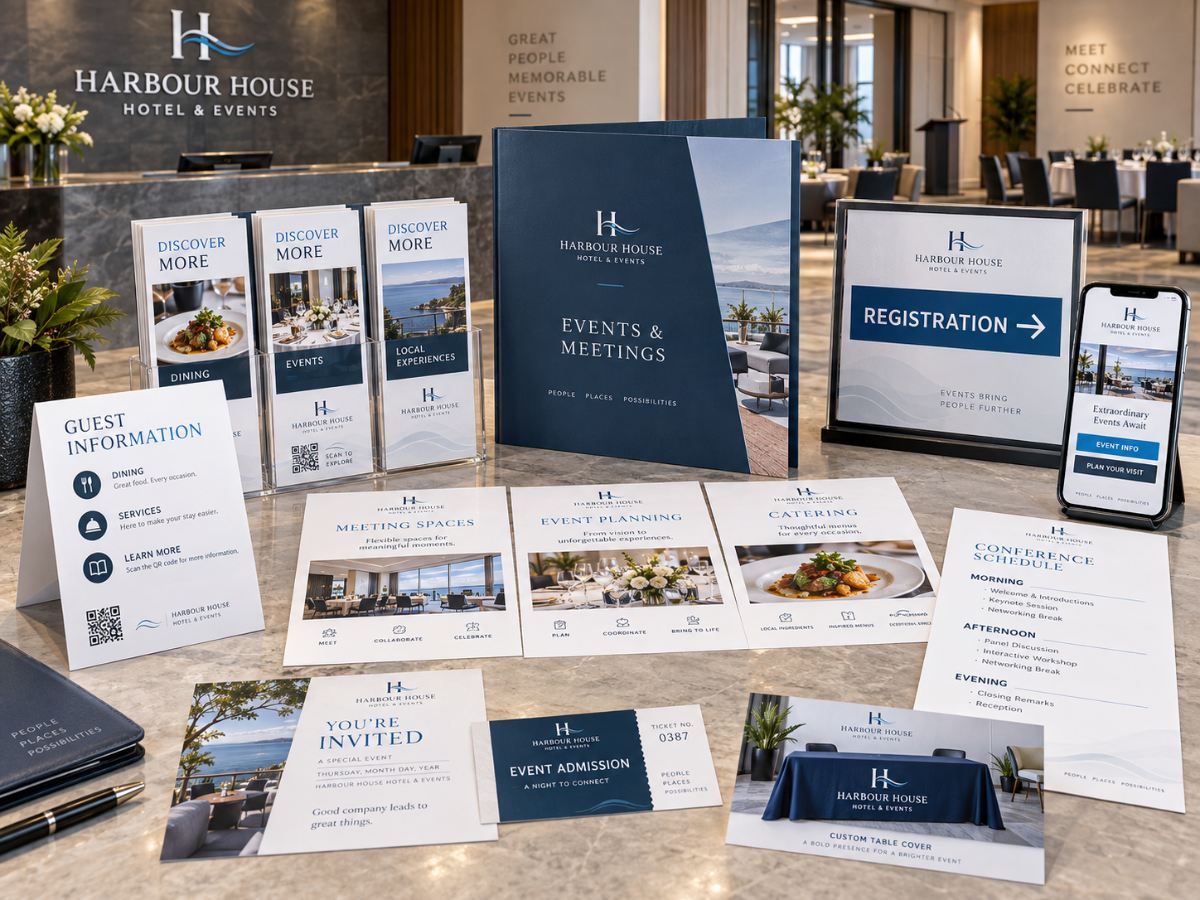
Hotels and event venues use print for much more than promotion. Guests need directions, planners need event packages, meeting attendees need schedules, visitors need local information and venue staff need materials that can be updated without rebuilding the entire brand every time something changes.
Hospitality businesses manage several audiences at once.
A hotel may communicate with overnight guests, conference organizers, wedding couples, corporate planners, restaurant visitors and local event attendees on the same day.
That makes printed communication especially important.
A rack card may introduce a nearby attraction. A tent card may explain guest services. A presentation folder may hold a wedding or meeting package. Directional signs may guide conference attendees. An invitation or event ticket may reach guests before they arrive.
Those pieces should not all contain the same information.
Each one belongs to a different moment in the hospitality experience.
Pryntco’s existing guides already identify hotels, conference centres and event venues as users of rack cards, tent cards, presentation folders, table covers and event materials.
This guide explains how those pieces can work together without turning every guest-facing surface into an advertisement.
1. What Printed Materials Does a Hotel or Event Venue Use?
Common materials can include:
- Rack cards
- Guest information cards
- Table tents
- Meeting packages
- Presentation folders
- Event invitations
- Tickets
- Directional signs
- Schedules
- Posters
- Table covers
- Event handouts
The exact mix depends on whether the business is primarily a hotel, conference venue, wedding venue or multi-purpose hospitality property.
2. Why Does Hospitality Print Need a System?
Guests interact with the property at several stages.
They may encounter:
- Pre-arrival information
- Reception materials
- Room information
- Venue signage
- Meeting materials
- Dining information
A coordinated system makes these materials easier to recognize and update.
3. What Should Stay Consistent Across Hotel Print?
Maintain consistent:
- Logo
- Brand colours
- Typography
- Photography style
- Direction symbols
Temporary event messaging can change while the underlying venue identity remains stable.
4. Why Are Rack Cards Useful in Hospitality?
Rack cards work well in locations where visitors are actively deciding what to do next.
They may promote:
- Hotel amenities
- Nearby attractions
- Dining
- Spa services
- Meeting services
- Local experiences
Pryntco’s Rack Card Design Guide specifically discusses hotels and hospitality use.
5. What Should Be at the Top of a Hotel Rack Card?
The upper portion should quickly explain the experience.
Use:
- Short headline
- Strong image
- Service or attraction name
- Main reason to respond
The lower section may be partially hidden by the holder.
6. Should Hotels Display Rack Cards From Other Businesses?
They can where the property has an appropriate partnership or visitor-information display.
The hotel should decide:
- Which businesses fit the guest experience
- Where the cards will be displayed
- How outdated pieces will be removed
7. What Are Guest Information Cards?
Guest information cards provide short, useful instructions inside rooms or common areas.
They may explain:
- Wi-Fi access process
- Dining information
- Housekeeping requests
- Checkout information
- Guest services
Keep the content current and easy to scan.
8. Should Guest Information Be Printed on One Permanent Card?
Only when the information is stable.
Frequently changing details may be better handled through:
- Replaceable inserts
- Short-run cards
- QR code to current information
This reduces the amount of outdated stock.
9. When Are Tent Cards Useful in Hotels?
Tent cards can work in:
- Guest rooms
- Reception areas
- Meeting rooms
- Restaurants
- Service counters
Pryntco’s Tent Card Guide identifies hotels and venues as common users.
10. What Should a Hotel Tent Card Say?
Use one focused message.
Examples include:
- Guest-service instructions
- Dining information
- Event schedule
- Future-event booking
- Feedback link
Do not turn a small table display into an entire property directory.
11. What Printed Materials Do Meeting Planners Need?
A meeting or conference package may include:
- Venue overview
- Room information
- Capacity information supplied by the venue
- Catering details
- Event policies
- Contact information
Keep property specifications current.
12. Why Are Presentation Folders Useful for Venues?
A folder can organize several separate documents without forcing all information into one brochure.
It may contain:
- Venue overview
- Room sheets
- Menus
- Policies
- Pricing supplied by the venue
- Business card
13. What Should Go in a Wedding Venue Package?
A wedding package may include:
- Venue introduction
- Available spaces
- Food and beverage information
- Scheduling information
- Contact details
- Planning checklist
Only include current venue policies and approved package information.
14. What Should Go in a Corporate Meeting Package?
Corporate planners may need:
- Meeting-room overview
- Technology information supplied by the venue
- Catering options
- Accommodation information
- Parking or access information
- Planner contact
Organize information around the planner’s decision process.
15. Should Venue Packages Use One Large Brochure Instead?
Sometimes, but not always.
A brochure works well when the information is relatively stable.
A folder is more flexible when individual sheets such as menus, pricing or room specifications change at different times.
16. How Can Hotels Use Presentation Folders?
Pryntco’s Presentation Folder Guide identifies hotels and event venues as suitable users for wedding packages, meeting options and catering information.
A reusable branded folder can remain consistent while the inserts are updated separately.
17. When Should a Venue Use Printed Invitations?
Invitations can support:
- Venue opening
- Corporate reception
- Private dinner
- Fundraising event
- Wedding-related event
The invitation should clearly communicate date, time, venue and RSVP instructions.
18. What Information Belongs on an Event Invitation?
At minimum, consider:
- Event name
- Host
- Date
- Time
- Venue
- Address
- RSVP information
Pryntco’s Event Invitation Guide covers these decisions in detail.
19. When Does an Event Need Printed Tickets?
Tickets may be useful for:
- Admission
- Reserved seating
- Fundraisers
- Banquets
- Conferences
The entry process should be defined before ticket artwork is prepared.
20. What Should a Venue Ticket Include?
Depending on the event:
- Event name
- Date
- Start time
- Venue
- Admission type
- Seat or table where appropriate
- Entry code where actually used
Pryntco’s Event Ticket Printing Guide explains ticket information and entry planning.
21. How Important Is Wayfinding at an Event Venue?
Very.
Visitors should be able to find:
- Registration
- Meeting rooms
- Ballroom
- Washrooms
- Dining
- Exit
Required building, emergency and accessibility signage should follow applicable standards.
22. What Makes Event Directional Signs Easy to Follow?
Use:
- Consistent arrows
- Large room names
- Strong contrast
- Consistent colours
A visitor should recognize that every directional sign belongs to the same event.
23. Should an Event Venue Use A-Frame Signs?
A-frame signs can work for temporary event directions where placement is permitted.
They may identify:
- Registration
- Ticket pickup
- Entrance
- Parking direction
Keep wording brief.
24. When Are X-Stand Banners Useful?
X-stands can support temporary displays such as:
- Conference entrances
- Registration areas
- Sponsor recognition
- Session information
Pryntco’s X-Stand Banner Guide includes hotels, conferences and event applications.
25. What Should an Event Banner Communicate?
From a distance, prioritize:
- Event name
- Primary direction
- Major sponsor where appropriate
- Registration or room information
Detailed schedules belong on closer-range materials.
26. How Can Custom Table Covers Help a Venue?
Table covers can create a consistent branded base for:
- Registration
- Information desks
- Sponsor booths
- Recruitment tables
Pryntco’s Table Cover Guide includes hotel and venue registration areas among common applications.
27. Should a Table Cover Include Event Dates?
Only when the cover will be used for one specific event.
A logo-led design is more reusable across:
- Conferences
- Open houses
- Wedding shows
- Community events
28. How Should Event Schedules Be Printed?
The format depends on how the schedule will be used.
Possible options include:
- Flat handout
- Folded brochure
- Poster
- Packet insert
Use a clear time-based hierarchy.
29. Should Conference Attendees Receive Printed Packets?
They can when attendees need several pieces in one place.
A packet may contain:
- Schedule
- Speaker information
- Venue map
- Session notes
- Sponsor information
A digital version can complement the physical packet.
30. How Should Hotels Promote On-Site Services?
Use the guest touchpoint closest to the service.
For example:
- Room tent card for dining
- Rack card for spa
- Reception flyer for tours
- Poster for an event
Do not repeat the same promotion on every surface.
31. How Should Hotels Promote Local Attractions?
Use rack cards or visitor-information displays where appropriate.
Focus on:
- What the visitor can experience
- Location
- Booking method
- Current hours where included
Remove outdated third-party materials regularly.
32. How Should Hotels Manage Frequently Changing Information?
Separate evergreen branding from temporary details.
For example:
- Reusable branded folder
- Replaceable pricing sheet
- Short-run event schedule
- QR code to live information
This makes updates easier.
33. How Should Multi-Property Hotel Groups Manage Print?
Control the master design while changing local fields such as:
- Property name
- Address
- Phone
- Amenities
- QR destinations
Each property version should be proofed separately.
34. How Many Hospitality Materials Should Be Printed?
Base quantity on where the piece will be used.
Examples:
- Room cards based on rooms plus replacements
- Rack cards based on display locations and refill frequency
- Event packets based on registration
- Temporary signs based on venue zones
35. How Can Hotels and Venues Avoid Waste From Outdated Print?
Keep dated or price-sensitive content in smaller runs.
Review stock whenever:
- Packages change
- Hours change
- Event dates change
- Contact information changes
36. How Should Hospitality Artwork Be Prepared?
Before production:
- Confirm room and venue names.
- Verify event dates.
- Use high-resolution property photography.
- Prepare artwork at final size.
- Follow bleed and safe-area requirements.
- Test QR codes.
- Proof wayfinding arrows carefully.
Pryntco’s Artwork Preparation Guide covers broader file preparation.
37. What Are the Most Common Hotel and Venue Print Mistakes?
Common problems include:
- Using outdated event schedules.
- Printing room information that changes frequently in large quantities.
- Using inconsistent directional arrows.
- Making event signs too text-heavy.
- Leaving old rack cards on display.
- Printing outdated package pricing.
- Sending QR codes to expired event pages.
- Using one universal property file for locations with different information.
38. What Printed Materials Should a Hotel or Event Venue Prioritize?
Start with the information guests and planners need most often.
At reception, printed materials should help visitors understand the property and find the right service.
In guest rooms, keep information concise and current. Avoid printing frequently changing details into expensive long-term pieces when a replaceable card or digital destination would be easier to maintain.
For event sales, use presentation folders or modular packages that allow wedding, meeting and catering information to be updated individually.
For active events, focus heavily on wayfinding. Directional signs, X-stands and registration materials should all use the same event identity and arrow system.
For visitors exploring the area, rack cards can provide compact information about attractions, dining and services.
The overall principle is simple:
Permanent branding should remain reusable. Temporary information should remain easy to replace.
Pryntco’s hospitality-relevant resources include the Rack Card Guide, Tent Card Guide, Presentation Folder Guide and Event Ticket Guide.
Hotels and event venues planning coordinated custom print can contact Pryntco or submit a custom quote request.