
Print Materials for Catering Companies: From Quotations to Event Setup
Print Materials for Catering Companies: From Quotations to Event Setup
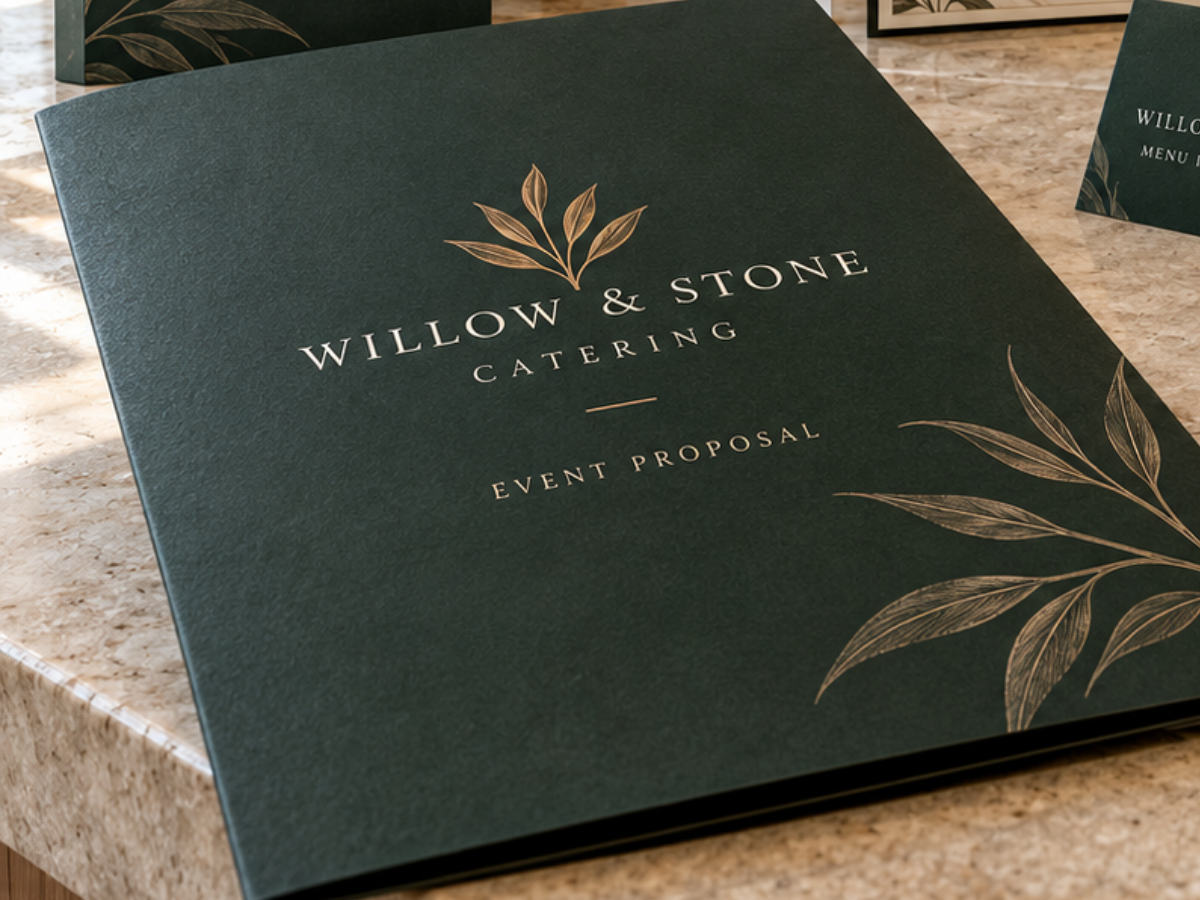
A catering company needs different printed materials at different stages of an event. Sales brochures and proposal folders help clients evaluate the service, while approved menus, event documents, place cards and staff information support delivery. The most effective print system separates reusable branding from details that change with each booking, such as guest counts, menu selections, schedules and individual event instructions.
A catering company may handle a wedding reception on Saturday, a corporate lunch on Monday and a private dinner later in the week.
Each client expects a professional experience, but the details change with every booking.
Guest counts vary. Menus are adjusted. Venues have different access arrangements. Service schedules depend on the event. Some bookings require printed guest menus and place cards, while others need only practical documentation for the catering team.
That creates a printing challenge.
Too much permanent printed information becomes outdated. Too little preparation leaves staff creating documents at the last minute or using inconsistent materials on site.
Good catering print should support the entire workflow, from the first client meeting to the final event handoff.
The objective is not to put the company's logo on everything. It is to identify which physical materials help the team communicate clearly, present the service professionally and deliver the agreed event.
1. Organize Catering Print Around the Booking Process
Rather than beginning with a list of products, divide the customer experience into stages.
| Stage | Possible Printed Materials | Primary Purpose |
|---|---|---|
| Initial inquiry | Business cards, service brochure | Introduce the company and available services |
| Proposal and planning | Presentation folder, approved quotation documents | Help the client review the proposed event |
| Tasting and menu selection | Tasting menu, notes sheet | Make options and feedback easier to organize |
| Event preparation | Approved event summary, staff reference documents | Coordinate the confirmed service |
| On-site service | Menus, place cards, approved signs, name tags | Help guests and staff navigate the event |
| Post-event communication | Appropriate contact or appreciation cards | Maintain professional customer relationships |
Not every booking requires all these items.
A company that serves primarily corporate lunches may have different needs from a caterer specializing in large weddings.
2. The Sales Brochure Should Explain the Catering Service
Prospective clients often need to understand what a catering company can provide before discussing an individual menu.
A brochure can introduce the types of events the business serves, the general style of its food and service, and the process for requesting a proposal.
It should not attempt to reproduce every possible menu combination.
Useful content might include:
- Company introduction.
- Types of catering offered.
- Examples of relevant event formats.
- Approved service descriptions.
- Representative photography.
- General booking process.
- Service area.
- Contact information.
Pryntco's Custom Brochures can support a professional company overview.
Keep the brochure relatively evergreen. Specific package pricing, seasonal menus and date-dependent offers may be better handled in separate documents.
3. Should a Caterer Print Package Prices in the Brochure?
Only when the pricing structure is stable and accurately represents what customers can purchase.
Catering prices may depend on guest count, service style, menu, equipment, venue conditions, staffing and other details.
A permanent brochure containing one simplified price can create unrealistic expectations if the actual booking requires a different arrangement.
Instead, the brochure can explain what is included in the service and how a client obtains a tailored proposal.
If fixed packages are genuinely available, their details and limitations should be approved before printing.
Changing prices should be managed through a controlled document process rather than leaving outdated printed information in circulation.
4. Use a Presentation Folder for Client Proposals
A presentation folder gives the company a consistent way to deliver several documents without permanently combining them into one brochure.
For a wedding proposal, the folder might contain a company overview, proposed menu, event outline and approved quotation.
For corporate catering, it could hold service options, a sample menu and relevant booking information.
The folder retains the same branding even though the contents change from one inquiry to another.
This is particularly useful when the business provides several types of service and regularly adjusts proposals.
Pryntco offers Presentation Folders for business proposals and professional document packages.
5. What Should Go in a Catering Quotation?
A catering quotation should be prepared from approved operational and pricing information.
The printing designer's job is to organize the document, not invent the commercial terms.
Depending on the company's established process, a quotation may identify:
- Client or event reference.
- Proposed date and location.
- Estimated or confirmed guest count.
- Selected service arrangement.
- Proposed menu or package.
- Approved charges and applicable terms.
- Quotation validity.
- Contact responsible for revisions.
Keep the layout clear enough that the client can distinguish the proposed services from optional items or matters requiring confirmation.
Any contractual, deposit, cancellation or payment wording must come from the catering company's approved documents.
6. Design Documents So Clients Can Compare Options
Some clients will request several versions of a proposal before making a decision.
For example, a company planning a staff event may compare a buffet arrangement with a plated meal or a different menu selection.
A clear document layout makes those differences easier to identify.
Use consistent headings and organize the options in comparable sections.
Do not hide material differences in dense paragraphs or place essential terms in decorative fine print.
Where the business provides revised quotations, display the relevant version information so the client and catering team can identify the current document.
That reduces the risk of an older proposal being mistaken for the final confirmed plan.
7. Are Printed Tasting Menus Worth Preparing?
For caterers conducting formal tasting appointments, a small printed menu can help structure the experience.
It provides guests with a reference for the dishes being presented and can create space for notes.
The design should reflect the tasting's purpose.
A client selecting dishes for a wedding may need a different document from a corporate buyer evaluating several service packages.
A practical tasting menu can include:
- Event or client reference.
- Confirmed tasting date.
- Approved dish names and descriptions.
- Clear menu groupings.
- Appropriate space for feedback.
Do not include unverified ingredient or allergen statements.
Those details must be supplied and reviewed by the catering team responsible for the actual food.
8. How Are Catering Menus Different From Restaurant Menus?
A restaurant menu is often designed for ongoing daily use.
A catering menu may be specific to one event, service arrangement or guest group.
Its content may be approved only after several discussions with the client.
That makes version control especially important.
For example, a printed wedding reception menu should reflect the final agreed dishes rather than a preliminary proposal.
Likewise, a corporate event menu may need to correspond to the approved service schedule and final food selection.
Pryntco offers Custom Menu Printing with selectable sizes and finishing options.
Choose the printed format according to how guests will encounter the menu during the event.
9. When Should a Caterer Use Individual Guest Menus?
Individual menus can be appropriate for seated dinners, formal celebrations and events where guests benefit from seeing the courses in advance.
A single printed card at each place setting may provide enough information.
For a buffet or station-based event, larger displayed menus may be more practical than printing an individual card for every attendee.
The choice should follow the actual service format.
Discuss this with the client before ordering, particularly if the venue or event planner is also preparing printed table materials.
Duplicating the same information across several products may increase cost without improving the guest experience.
10. What Should Be Printed for Buffet and Food Stations?
Buffet events frequently require clear presentation of food choices.
Depending on the event, approved printed materials might include station identification, dish names and guest-facing information supplied by the catering company.
The format should be readable from a comfortable position without creating unnecessary congestion.
A small card may work beside a serving item. A larger sign may be needed where several guests approach from a distance.
Consider the available display surface and how frequently the information will change during service.
Pryntco's Tent Cards are one option for approved tabletop messages and event information.
Do not place paper products where they are likely to come into direct contact with food, heat, liquids or unsuitable equipment.
11. Allergen Information Requires More Than Attractive Signage
Food allergen communication is a responsibility that must be taken seriously.
A professionally printed card can help display approved information, but printing does not establish that the underlying food description is accurate.
Ingredient details, preparation methods, cross-contact considerations and applicable disclosure requirements must be assessed by the catering company and other responsible parties.
Do not create universal "allergen-free" claims simply because a dish does not contain an obvious ingredient.
Likewise, a decorative icon should not replace information the business is required to provide.
If menus or dish cards include allergen-related wording, establish who approves the information, when it is checked and how changes are communicated to the event team.
A good design makes approved information visible without overstating what it means.
12. Why Event-Specific Print Needs Version Control
An event may go through several planning revisions.
The original inquiry might estimate 80 guests. Later, the client confirms 95. A menu choice changes, the service time moves and an additional food station is added.
If the catering team prints documents without a controlled approval process, different employees may carry conflicting information.
Use a simple naming and revision system for event documents.
For example:
EVENT-042_MENU_REV03_APPROVED.pdf
The precise naming convention is less important than keeping it consistent.
Only approved final versions should be sent for printing.
Older files should remain identifiable but should not be mixed with the documents used for active production.
13. What Should Be Included in an Event Service Sheet?
A service sheet is an operational document used by the catering team.
Its purpose is different from a guest menu or marketing brochure.
Depending on the company's workflow, it may contain approved information about:
- Event identification.
- Venue and assigned areas.
- Relevant staff contacts.
- Confirmed guest numbers.
- Service timing.
- Selected menu.
- Approved delivery arrangements.
- Equipment or setup responsibilities.
- Other confirmed operational instructions.
The exact contents should come from the company's event-management procedures.
Keep confidential customer information separate from public-facing printed materials.
A readable operational sheet is more useful than a highly decorative document that staff struggle to scan during setup.
14. Could Printed Carbonless Forms Be Useful?
Some catering businesses use physical documentation for deliveries, equipment handoffs, administrative acknowledgements or other approved processes.
Where multiple handwritten copies are genuinely needed, carbonless NCR forms may be useful.
For example, a company might have an established delivery acknowledgement procedure in which one copy remains with the venue and another returns to the office.
However, the form's legal and operational content must come from the business.
Pryntco offers NCR Forms for business paperwork.
Confirm the required format and production options before ordering. Do not assume that all customized numbering, copy configurations or document functions are included by default.
15. What Role Do Place Cards Play?
Place cards can help identify guests at assigned seats for formal events.
They may also be useful where the organizer has established a seating arrangement or needs approved table identification.
For a catering company, it is important to determine who is responsible for that information.
The venue, wedding planner or client may already manage seating assignments and guest stationery.
Duplicating their work can cause conflicting versions.
If the caterer is responsible for the printed cards, confirm the final approved names and quantities before production.
Do not invent names, table assignments or special meal indicators from incomplete planning notes.
16. Staff Name Tags and Event Presentation
Name tags may be helpful at events where guests, planners and venue employees need to identify catering staff or supervisors.
They are especially useful when several businesses work together at the same venue.
A name tag should make the relevant person or role recognizable without including unnecessary personal information.
For some events, job titles or team identifiers may be more useful than individual names.
Coordinate the name-tag design with the company's uniforms and any venue-specific identification requirements.
Keep the appearance professional and suitable for the event.
17. Reusable Branding Versus One-Time Event Print
One of the most useful ways to control printing costs is to distinguish permanent company materials from event-specific pieces.
A reusable service brochure or proposal folder may work across many bookings.
An individual wedding menu is usually tied to one event.
A tasting template may be reusable as a design, but its printed content changes with the dishes being evaluated.
Before choosing quantities, ask how long each printed piece is expected to remain accurate.
Do not order thousands of event-specific documents simply because a larger quantity reduces the unit cost.
Similarly, avoid rebuilding the complete company brochure whenever a seasonal menu changes.
18. How Much Should a Catering Company Print?
Estimate quantities by purpose rather than giving every product the same order amount.
For example, a fictional company may be preparing for a seated event with 120 guests.
If every guest receives an individual menu, the planning quantity begins with 120 copies plus a reasonable reserve for late changes or damaged pieces.
But a buffet event with the same guest count may need several station displays rather than 120 individual menus.
The company might also require only a small number of operational sheets for the team.
These are illustrative examples, not Pryntco ordering minimums or a universal event-printing formula.
Confirm the final requirements with the client and venue before placing the order.
19. What Should Be Checked Before Sending Catering Artwork to Print?
Every event-specific order should go through a final review.
- Correct client and event reference.
- Confirmed event date.
- Approved menu items and descriptions.
- Correct guest count and printed quantities.
- Accurate venue and service information.
- Approved food and allergen-related wording.
- Final document revision.
- Correct names and seating information when applicable.
- Clear readable text at final printed size.
- Appropriate stock and finish for the intended setting.
- Correct layout, bleed and safe areas.
- Approved logo and brand colours.
- Proper handling of confidential event information.
Assign a specific person to approve the final exported artwork. Do not rely on informal verbal approval from several departments.
20. Common Catering Print Mistakes
The most expensive mistakes often involve information that changed after the design was created.
- Printing preliminary menus as though they were final.
- Using old guest counts or venue details.
- Including unsupported claims about ingredients or allergens.
- Combining proposal information and guest-facing menus into one inappropriate format.
- Ordering too many one-time event materials.
- Printing permanent pricing on brochures that will be reused.
- Failing to coordinate seating materials with the event planner.
- Creating operational forms without the catering team's approval.
- Using tiny decorative fonts for information guests actually need to read.
- Allowing several revised artwork files to circulate without clear identification.
- Choosing print materials without considering the handling conditions at the venue.
21. Building a Better Catering Print System
A professional catering company needs a consistent brand, but it also needs flexibility.
Reusable brochures and presentation folders can introduce the business without changing for every booking.
Approved quotations, menu documents and tasting materials help clients make decisions.
Event-specific guest menus, tabletop displays and staff documents support the actual service.
The important distinction is that these materials serve different audiences.
A prospective customer wants to understand what the caterer offers. A client reviewing a quotation needs accurate commercial information. A guest needs a clear menu. An employee setting up the event needs the latest approved instructions.
When each piece is designed for its actual purpose, printing becomes part of a more reliable workflow rather than an unnecessary expense.
For company materials, explore Pryntco's brochures and presentation folders. For event service, consider the available printed menu and tabletop display formats.
Businesses planning coordinated catering print can request a custom quote from Pryntco with their approved artwork, product requirements and quantities.

