
When Should You Request a Physical Print Sample Instead of Relying on a PDF Proof?
When Should You Request a Physical Print Sample Instead of Relying on a PDF Proof?
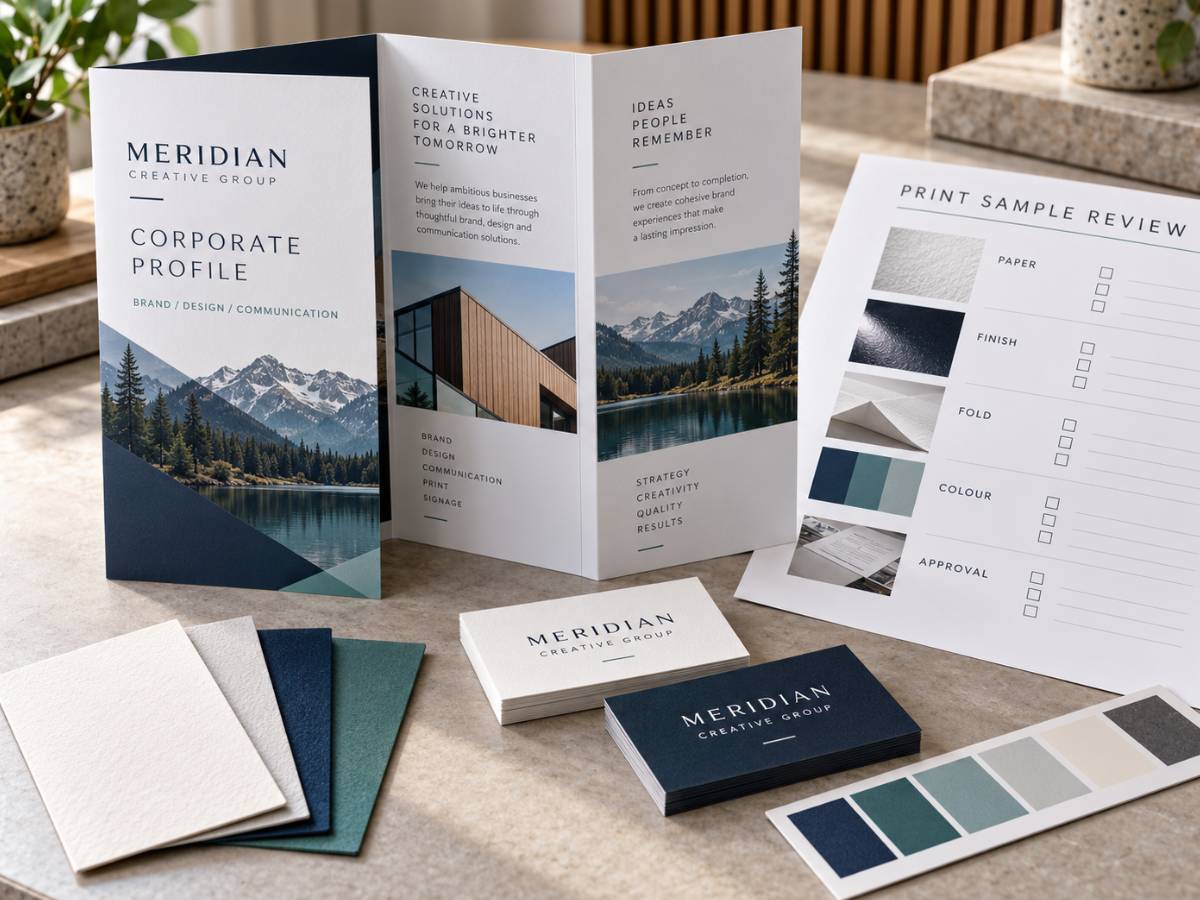
A PDF proof is normally the right tool for checking artwork, wording, layout and page order. A physical sample becomes more valuable when the decision depends on something a screen cannot demonstrate properly, such as paper stiffness, folding behaviour, surface finish or the appearance of a critical colour. The important question is what needs to be tested before the full order is produced.
A brochure can look excellent on a computer screen and still feel wrong when someone picks it up.
The paper may be lighter than expected. A fold might interrupt an important photograph. A dark background could look different on the selected stock, or a business card that appeared substantial in the artwork might feel too flexible for the intended presentation.
None of those problems necessarily means the PDF proof was incorrect.
A digital proof and a physical print sample answer different questions. Understanding that distinction helps businesses make better purchasing decisions, especially when ordering unfamiliar materials or committing to a substantial quantity.
1. What Is the Difference Between a PDF Proof and a Physical Print Sample?
A PDF proof shows the artwork prepared for printing. It allows the customer to review the design, confirm information and identify problems before production.
A physical sample allows the customer to examine a printed object or representative material in person.
The distinction matters because a monitor does not reproduce the weight, texture, rigidity or actual surface of a printed product.
| What Needs Checking? | PDF Proof | Physical Sample |
|---|---|---|
| Spelling and contact details | Strong choice | Can also be checked |
| Layout and page order | Strong choice | Useful for assembled pieces |
| Paper weight and stiffness | Cannot demonstrate physically | Useful |
| Texture and tactile finish | Limited | Useful |
| Folded dimensions | Can verify measurements | Useful for testing the final object |
| Colour appearance on stock | Approximate screen preview | Depends on sample type and production conditions |
| QR code destination | Can be checked | Useful for final-size scanning |
| Packaging or holder fit | Limited | Useful |
Neither method replaces the other entirely. Even after examining a physical sample, the final production artwork still needs careful proofreading.
2. Is a Physical Sample the Same as a Press Proof?
No, and this is one of the most important distinctions to make when speaking with a printer.
A stock sample may simply demonstrate a particular paper or finish. A plain mockup may demonstrate the size and folding structure of a brochure without reproducing the final artwork.
A printed prototype may show the customer's design on a selected material, while a press proof is generally produced under more specifically controlled production conditions.
These options differ in cost, purpose and how closely they represent the eventual production run.
Ask the printer exactly what kind of sample is being discussed. A sample of a similar product is useful for comparing materials, but it should not be mistaken for a production-approved proof of your exact design.
3. When Is a PDF Proof Usually Enough?
For a straightforward repeat order using previously approved artwork and the same known product configuration, a carefully reviewed PDF may be sufficient.
Consider a company reordering business cards. Its team has used the same stock before, knows the finished result and only needs to update an employee's contact information.
The important checks are the name, title, telephone number, email address, file version and order configuration.
Producing another physical sample would offer relatively little new information unless something significant has changed.
Pryntco's PDF Proof Approval Checklist provides a detailed review process for artwork and content accuracy.
4. When Is a Physical Sample Worth Considering?
Consider requesting a sample or preparing a prototype when the physical characteristics of the product could change the purchasing decision.
Typical situations include:
- Ordering an unfamiliar paper stock.
- Comparing different card thicknesses.
- Choosing between textured and smooth finishes.
- Introducing an unfamiliar folding style.
- Checking whether a finished brochure fits its holder.
- Evaluating a booklet's opening behaviour.
- Reviewing important brand colours on a particular material.
- Testing packaging dimensions or insert fit.
- Preparing a substantial first order with expensive consequences if the specification is wrong.
It is not necessary to sample everything. Identify which physical characteristic presents the greatest uncertainty and choose a practical way to test it.
5. Why Paper Weight Is Difficult to Judge on a Screen
A PDF does not communicate the difference between lightweight text paper and heavier cover stock.
Both may display the same photograph, colours and dimensions on a monitor, yet feel entirely different when handled.
For a brochure, the paper affects how the piece folds and how comfortably someone can open it. For business cards, thickness influences stiffness. For a presentation insert, the paper affects how the sheet sits inside a folder.
Paper weight is also not a complete description of stiffness. Two stocks with similar nominal weights can feel different because of their construction and finish.
Businesses comparing premium cards should review the selected stocks rather than assuming a larger number always means a better result.
6. Should You Request Samples of Different Paper Finishes?
That can be worthwhile when appearance and handling are important to the project.
A coated surface may present photography and saturated graphics differently from uncoated paper. A matte finish can create a different impression from a glossier surface, particularly under direct lighting.
Uncoated stock may also be preferable for pieces that require handwriting, depending on the selected product and writing instrument.
For example, an appointment card and a photography-heavy promotional postcard have different practical requirements even when their dimensions are similar.
Rather than choosing by finish name alone, consider how the customer will use the printed piece.
7. Can a Physical Sample Guarantee the Final Printed Colour?
Not automatically.
Printed colour is influenced by the material, printing process, ink behaviour, finishing and production conditions. A generic stock sample cannot guarantee how a particular brand colour will appear on a future order.
Even a printed prototype may not reproduce every condition of the full production run.
For colour-sensitive work, explain what needs to be matched and ask what proofing method is appropriate for the actual product.
Do not treat an ordinary office printout or an uncalibrated desktop monitor as an exact production-colour reference.
8. Which Projects Deserve More Careful Colour Evaluation?
Colour deserves special attention when it forms an essential part of the brand identity or when the finished product will appear beside previously printed materials.
Examples include a branded presentation kit, premium retail packaging, a corporate brochure or a coordinated collection of signs and promotional pieces.
If a brochure, business card and banner are being produced on different materials, some visual variation may be unavoidable.
Use approved brand references and consistent source artwork. When colour is especially critical, discuss realistic matching expectations with the printer before approving the order.
9. How Does a Physical Mockup Help With Folded Brochures?
Folded pieces are particularly good candidates for a low-cost physical test.
A tri-fold brochure may look balanced while the artwork is displayed flat. Once folded, however, the designer may discover that the front panel feels cramped, the opening sequence is awkward or a photograph crosses a fold in an unfortunate position.
A basic paper dummy can reveal those problems without reproducing the final print quality.
Print the panels on ordinary paper, assemble them in the planned order and open the piece as a customer would.
Pryntco offers Brochure Printing with half-fold, tri-fold, Z-fold and accordion options. Use the exact selected product template when preparing production artwork.
10. Should You Test a Brochure in Its Holder or Envelope?
Yes, when fitting into another object is part of the design requirement.
A brochure may have the correct printed dimensions and still be unsuitable for the way the business intends to distribute it.
For example, a company planning a reception display should confirm that the folded piece fits inside its chosen holder without bending or hiding the main headline.
The same principle applies to a printed insert placed inside an envelope or presentation folder.
A simple correctly sized dummy is often sufficient for testing the fit. A production-quality sample is not always necessary.
11. What About Business Card Thickness and Texture?
Business cards are a good example of a product where the tactile experience matters.
A customer may be deciding between a practical everyday card and a heavier premium presentation. Photographs on a product page can show the artwork and general appearance, but they cannot fully communicate how the card feels between the fingers.
The card's stiffness, edge, texture and finish influence the overall impression.
For repeat purchases, a company may already know the stock it prefers. For a new premium design, comparing representative samples can be more informative than examining enlarged digital renderings.
Browse Pryntco's Business Card Products to review the available material categories.
12. Should Booklets Be Physically Tested?
Booklets have physical characteristics that are difficult to evaluate from flat pages.
The number of sheets, paper choice, binding method and page layout all affect how the finished publication opens and handles.
A short booklet may lie differently from a thicker version. Information positioned too close to the inside edge may become uncomfortable to read, especially when pages are bound together.
Before printing a substantial booklet order, a correctly assembled paper mockup can help the team check page sequence, opening behaviour and whether important artwork is being lost visually near the binding.
It is particularly useful when the design contains full-spread photography, detailed charts or closely positioned captions.
13. When Is a Printed Prototype Better Than a Paper Dummy?
A paper dummy tests structure. A more representative printed prototype tests physical appearance and behaviour.
If the only concern is whether a brochure folds correctly, an ordinary paper dummy may be enough.
If the decision depends on a particular coated stock, the way a finish looks under lighting or how the completed piece feels in a customer's hand, a more representative sample may be necessary.
Define the question before choosing the proofing method. Requesting the most elaborate possible sample is not always the most efficient way to reach a decision.
14. Does a Large Order Automatically Require a Physical Sample?
No, but larger quantities increase the consequences of a mistake.
Consider two fictional orders.
The first is a small batch of replacement business cards using artwork and stock the company has ordered several times before. The uncertainty is low.
The second is a substantial quantity of presentation folders using a new paper, finish and layout. The artwork will be distributed to clients at an important business event.
The second project has several unfamiliar physical details, so a sample or structured mockup may justify the additional preparation.
The decision should reflect both the order's value and the risk of choosing the wrong specification.
15. What Should You Actually Check on a Physical Sample?
Evaluate the sample against the reason it was requested.
For a paper or cardstock sample, examine the texture, stiffness, surface appearance and intended writing behaviour.
For a folded brochure, open it several times and review panel order, crease placement and how the piece sits when closed.
For an assembled presentation package, place the intended documents inside and check that the contents fit comfortably.
For a printed prototype, inspect the image quality, small lettering, colour relationships and finish under ordinary viewing conditions.
Record the observations. A comment such as "the inside panel feels too crowded" is more actionable than simply saying the sample does not look right.
16. Why Should Samples Be Viewed Under Real Lighting?
Lighting changes how printed colours and finishes appear.
A brochure reviewed under strong office lighting may look different when handled in a dim event venue. Glossy surfaces can also produce reflections that affect readability.
Examine a representative sample in the environment where the piece will actually be used whenever practical.
This is especially useful for reception displays, menus, premium sales materials and other products that must remain readable under predictable lighting conditions.
The objective is not to find lighting that makes the sample look most impressive. It is to evaluate the result under realistic conditions.
17. Can You Use an Office Printer as a Physical Proof?
An office printer is useful for checking practical layout issues.
It can help verify approximate type size, page sequence, folds, margins and whether the content is comfortable to read at its final dimensions.
However, an office printout does not establish how a commercial press, selected production stock or specialized finish will reproduce the artwork.
Its paper and printing process may be entirely different.
Use the office proof for the questions it can answer, and avoid interpreting it as a guarantee of commercial print quality.
18. What Should You Ask Before Requesting a Sample?
Be specific about the requirement rather than simply asking for a sample of everything.
Useful questions include:
- Is a representative stock or finish sample available?
- Would the sample use the actual chosen material?
- Would it show our artwork or only a generic example?
- Would it use the same production method as the final order?
- Would the sample include the intended finishing?
- Are there additional costs or lead times?
- Could a correctly sized paper dummy answer the question instead?
Sample availability and the most appropriate proofing method depend on the product and production arrangement. Confirm the possibilities before building them into the project schedule.
19. Should a Sample Be Approved by the Designer or the Business Owner?
The right approver depends on what the sample is intended to prove.
A designer may be responsible for typography, layout, colour relationships and artwork placement.
A marketing manager may be responsible for brand consistency and the customer experience.
An operations manager may need to confirm that an insert fits its packaging or that a form provides adequate writing space.
For important projects, the sample may require input from more than one person. However, one authorized decision-maker should record the final approval so production instructions do not become contradictory.
20. Does an Approved Physical Sample Replace the Final PDF Review?
No.
A sample may establish that the paper, finish or physical construction is suitable. The final print file can still contain a wrong date, outdated telephone number, incorrect image or missing page.
Approval should therefore distinguish between the physical specification and the final artwork.
Keep the accepted material or sample reference alongside the current approved artwork and order details.
If the design changes after the sample was reviewed, determine whether that change affects anything that was tested.
21. What Should Be Recorded for Future Reorders?
When a company is happy with a printed product, preserving the specification can be as important as preserving the design file.
Useful records include:
- Product name and selected configuration.
- Finished dimensions.
- Paper or material selection.
- Finish and folding requirements.
- Approved artwork version.
- Relevant colour references.
- Any accepted sample or prototype details.
- Notes explaining why the configuration was chosen.
Those records make it easier to request a consistent reorder, although future stock and production availability must still be confirmed.
22. How Should You Decide Whether Sampling Is Worth the Cost?
Consider three questions.
What remains uncertain? If the answer is only the spelling and layout, a PDF proof is usually the correct starting point.
What would happen if the physical specification were wrong? A minor difference on a small internal handout may be tolerable. A poor fit on an expensive packaging component may not be.
What is the simplest reliable test? A stock swatch, folded dummy, actual-size office print and representative printed prototype solve different problems.
The strongest proofing process is proportionate to the risk. It does not add unnecessary production steps to every ordinary print job.
23. Choosing the Right Proof Before You Print
A PDF proof should remain central to checking the final design. It is where you confirm content, dimensions, page order, artwork placement and the information customers will see.
A physical sample becomes useful when the printed object's material or construction is part of the decision.
For straightforward repeat orders, careful digital approval may be enough. For unfamiliar paper stocks, complicated folds, important colour considerations or high-value printed packages, a representative sample or physical mockup can resolve uncertainties that the PDF cannot.
Choose the test according to the actual problem, understand the limitations of the sample and keep clear approval records.
Businesses comparing paper stocks, printed marketing products or custom specifications can browse Pryntco's Print Marketing Products.
For projects where physical sampling or special production requirements are important, request a quote from Pryntco and describe what needs to be evaluated. Sample options should be confirmed before ordering.

