
How to Order Roll Labels for Multiple Products Without Mixing Up Sizes, Colours or SKUs
How to Order Roll Labels for Multiple Products Without Mixing Up Sizes, Colours or SKUs
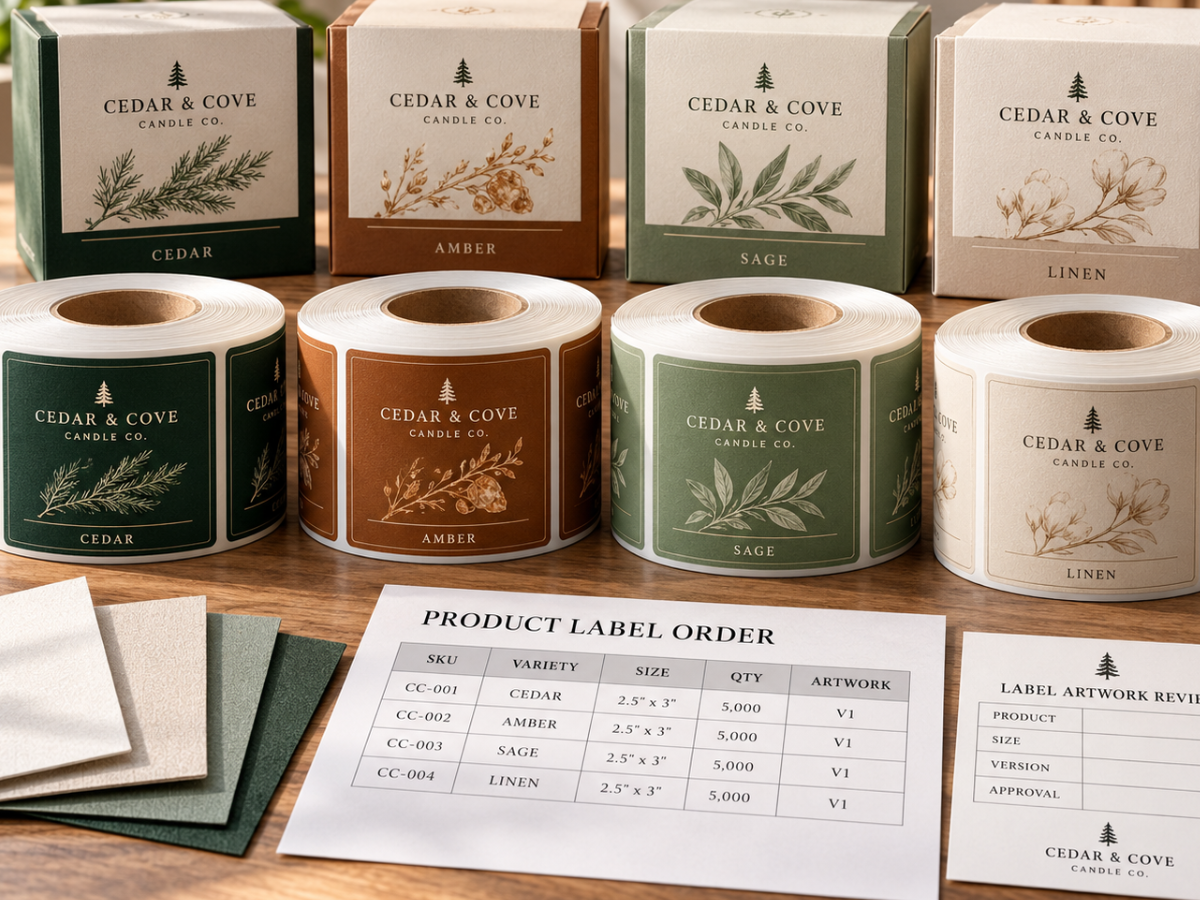
When ordering roll labels for several products, build a complete SKU and artwork list before requesting quantities. Confirm which products share the same label dimensions and materials, calculate quantities for each design separately and establish a clear approval process. The biggest risk is often not the printing itself, but assigning the wrong artwork, barcode or label quantity to the wrong product.
A business launches one product with one label. The process is manageable: choose the size, approve the artwork and place the order.
Then the product range expands.
The original coffee blend gains three new varieties. The candle company introduces several fragrances. A skincare brand adds different bottle sizes. Suddenly, the business is dealing with multiple designs, packaging dimensions, barcodes, inventory quantities and artwork revisions.
From the printer's perspective, these are distinct printed versions, even when they share the same brand identity.
From the business's perspective, the challenge is making sure every finished roll matches the correct product and that there are enough labels to complete packaging without accumulating excessive unused stock.
That requires coordination between design, inventory planning, packaging and print production.
This guide focuses on managing a multi-product roll label order. For choosing shapes, finishes and materials for an individual label, see Pryntco's Custom Roll Label Guide.
1. Why Multi-Product Label Orders Need a Different Approach
When only one design is being printed, identifying the correct file and quantity is straightforward.
With several products, each variation introduces opportunities for mistakes.
A company might have five fragrances in two container sizes. If every combination requires a distinct design, that means ten separate artwork versions.
Those versions may share the same logo and typography, yet contain different product names, size information, identifiers or approved instructions.
Without a controlled list, it becomes easy to approve the right artwork under the wrong filename or order the correct total quantity with the wrong distribution between products.
The first step is to organize the order by product variation, not by the number of labels the business expects to purchase overall.
2. Begin With a Complete SKU List
A stock keeping unit, or SKU, is an internal identifier used to distinguish one inventory item from another.
A SKU may represent a product, size, colour, fragrance, flavour, package format or another variation important to the business.
The label order should reflect the variations that genuinely require different printed information.
For each item, record:
- SKU or internal product identifier.
- Approved product name.
- Product variation.
- Package or container type.
- Label dimensions.
- Selected label material and finish.
- Unique artwork filename.
- Quantity required.
- Barcode or other identifier where applicable.
- Artwork approval status.
The list becomes the reference point for design, purchasing and receiving.
3. Does Every SKU Need a Different Label?
Not necessarily.
Two inventory items may use the same label when the printed information is identical and the business's operating process permits it.
However, products with different names, ingredient information, package quantities, barcodes or other required details may need distinct versions.
Do not create separate artwork merely because two items have different internal warehouse locations. Conversely, do not reuse one design when the product information is different.
Have the person responsible for product information identify which variations need unique printed artwork before preparing the files.
4. Build a Label Matrix Before Designing
A label matrix is a simple table connecting products, artwork and quantities.
Consider a fictional candle company preparing a new collection.
| SKU | Product | Container | Label Version | Required Labels |
|---|---|---|---|---|
| CN-101 | Cedar | Small jar | CEDAR-S | 600 |
| CN-102 | Cedar | Large jar | CEDAR-L | 350 |
| CN-103 | Amber | Small jar | AMBER-S | 500 |
| CN-104 | Amber | Large jar | AMBER-L | 250 |
These quantities are illustrative planning figures, not Pryntco order minimums.
Although the company has only two fragrances, it has four printed versions because the containers and their artwork differ.
Once this matrix is approved, the designer and purchasing team have a much clearer basis for their work.
5. Should All Products Use the Same Label Size?
Using one common label size can simplify the production and packaging process when the containers support it.
However, standardization should not be forced when the physical packaging is different.
A wide label designed for a large glass jar may not fit a smaller container comfortably. A rectangular label that works on a flat pouch may cross an unsuitable curve when applied to a narrow bottle.
Measure each container and establish which products genuinely share usable application dimensions.
Group products by physical label specification before deciding how artwork versions will be prepared.
6. Why Should Label Size and Artwork Version Be Tracked Separately?
A company may have six different designs using one size, or one product design that requires two different sizes.
These are separate variables.
For example, a brand could use one label dimension for three coffee varieties and another dimension for larger retail packages.
The artwork matrix should show both the printed design and the dimensions for which that design was prepared.
Do not assume that the artwork for a small label can simply be enlarged or reduced without affecting type size, proportions, margins and image quality.
7. How Do You Keep a Product Range Visually Consistent?
A coordinated label family should be recognizable even when customers see different varieties beside each other.
Decide which design elements remain fixed:
- Logo placement.
- Primary typefaces.
- Brand colours.
- Product-name hierarchy.
- General spacing system.
- Placement of approved information.
Then determine which elements may change between products.
A coffee range might distinguish varieties using accent colours and individual names. A candle collection might use the same composition with different fragrance descriptions.
The design should make the products easy to distinguish without making them look like unrelated brands.
8. Why Colour Alone Is Not Enough to Identify a SKU
Using colour to differentiate products can work well visually, but the label should still contain clear written identification.
Similar shades may be difficult to distinguish under warehouse lighting, and labels may be handled by employees who have difficulty perceiving certain colour differences.
Small changes between two shades of blue, for example, should not be the only way to distinguish separate products.
Keep the product name, variation or appropriate identifier readable.
A simple naming system reduces picking and packing mistakes while supporting the consumer's experience.
9. How Should Product Names and Variations Be Displayed?
Establish a clear information hierarchy before creating dozens of variations.
A practical layout might prioritize:
- Brand name.
- Specific product name.
- Variety or distinguishing feature.
- Package quantity where required.
- Other approved product information.
Keep the relative positions consistent between products whenever possible.
This makes it easier for customers to locate information and for employees to inspect labels during packing.
Any legally required wording, including industry-specific statements, must be supplied and approved by the business. Do not shorten regulated information simply to preserve an attractive layout.
10. What Happens When Product Names Have Different Lengths?
One of the less obvious problems with a shared label template is that product names rarely occupy identical space.
A short name such as "Cedar" may fit on one line, while a longer approved variation name could require two.
If the template is built around the shortest name, longer versions may become cramped.
Test the longest approved product name before committing to the design system.
Allow for natural line breaks without making one label look dramatically different from the others.
11. Should Every Label Have Its Own Barcode?
Barcodes should follow the business's product identification and retail requirements.
Products with different retail identities may require distinct barcode values, while internal inventory arrangements may use a separate system.
Do not assume that every SKU automatically requires a particular type of barcode or that an internal SKU can be substituted for an official retail identifier.
Confirm the relevant identification requirements before artwork approval.
Each barcode must be associated with the correct product variation. A visually perfect label with the wrong barcode can create significant problems during retail checkout and inventory handling.
12. How Should Barcodes Be Proofed?
Barcode approval requires more than seeing black lines on a PDF.
Verify the encoded information using an appropriate method and check its association with the correct product.
Also confirm that the code has suitable dimensions, contrast and clear space according to the applicable barcode requirements.
Test the printed result under representative conditions when barcode scanning is important.
The business or its authorized barcode provider should confirm the identifiers. The printer should not be expected to invent product codes.
13. Can Several Label Designs Be Printed on One Roll?
Do not assume that a standard roll-label product automatically supports mixing multiple artwork versions on the same roll.
Some production arrangements may allow special combinations, but this depends on equipment, specification, quantity and supplier capabilities.
Separate rolls for each approved artwork version are often easier to manage operationally.
If the business requires alternating designs, mixed artwork or a specific roll sequence, confirm that requirement before placing the order.
Pryntco offers Custom Roll Labels. Special multi-version arrangements should be submitted for confirmation rather than assumed to be included in a standard configuration.
14. What If the Business Applies Labels by Machine?
Machine application changes the technical questions that must be answered.
Depending on the equipment, the applicator may require specific information about the roll core, liner, winding direction, spacing and how the printed label is oriented as it unwinds.
These details should come from the packaging equipment's specifications and be confirmed with the printer.
A roll that contains the correct printed artwork may still be unsuitable for an applicator if its physical configuration does not match the machine.
Businesses applying labels manually may have more flexibility, but they should still check that the selected dimensions and material are appropriate for the package.
15. How Do You Calculate Label Quantities for Each SKU?
Do not divide the total required quantity equally between artwork versions unless demand is actually equal.
Forecast each product separately.
A practical calculation is:
Labels required = Planned units to be packaged + Approved application allowance + Other committed requirements
For example, a fictional company plans to package 1,200 units of one product during its next production period.
If it allows 30 additional labels for setup, testing and ordinary handling losses, its planning requirement becomes 1,230 labels for that particular design.
That does not establish what quantity Pryntco will offer for the selected configuration. The business should compare its calculated requirement with the available ordering options.
16. Why Should You Allow for Application Waste?
Labels can be damaged or misapplied during setup, manual application and normal production work.
The appropriate allowance depends on the packaging process, employee experience, equipment and the quality of the containers being labelled.
There is no reliable universal percentage.
Review previous packaging runs where data is available.
A business applying labels by hand may have different waste patterns from one using an established automatic system.
Choose a measured allowance rather than automatically adding the same large reserve to every product.
17. Should Slow-Selling Products Receive Smaller Label Orders?
Often, yes.
A fast-selling product may consume its labels quickly enough that a larger stock is reasonable.
A slow-selling variation may sit on the shelf for a long time, especially when the business has several similar products.
Overordering creates risk when packaging, ingredients, product names, prices or other information may change.
Forecast demand by SKU and consider how long the printed information is expected to remain accurate.
The objective is to balance available order quantities with the cost of holding inventory that may eventually become unusable.
18. How Should Seasonal and Limited-Edition Labels Be Managed?
Seasonal designs require more careful quantity planning because they may not be reusable once the campaign ends.
A limited-edition candle or promotional gift set may use different artwork from the regular product.
Track that artwork as a separate version with its own production forecast and planned end date.
Do not combine permanent and temporary inventory without identifying the distinction.
Once the campaign is finished, unused labels may have little value even if the underlying product remains available.
19. How Should Artwork Files Be Named?
File naming should make it possible to identify the product, dimensions and revision without opening every PDF.
A practical filename might be:
NORTHCO_CEDAR_SMALL_FRONT_REV04_APPROVED.pdf
For a company with several packaging formats, include the exact approved dimensions or an internal specification code.
Avoid confusing names such as:
- label-final.pdf
- label-final-new.pdf
- label-fixed2.pdf
- label-final-really-final.pdf
Those filenames offer little protection against submitting an older design.
Maintain one controlled master location for approved artwork and archive obsolete versions away from the files used for active orders.
20. Why Is a Single Approval Sheet Important?
A multi-product order may involve a designer, marketing manager, inventory coordinator, packaging employee and purchasing manager.
Without clear responsibility, different people may approve different versions.
Use one approval sheet that connects every printed design to its SKU and specification.
The sheet should record:
- SKU.
- Artwork filename.
- Product and variation.
- Label size and material.
- Barcode confirmation where applicable.
- Requested quantity.
- Reviewer.
- Approval status and revision.
Do not submit files that are still waiting for content approval.
21. How Should Label Artwork Be Checked Before Production?
Every version needs an individual review, even when the designs look almost identical.
Check the artwork at its final printed dimensions.
- Correct product name and variation.
- Correct label dimensions and orientation.
- Approved logo and brand colours.
- Accurate product-specific information.
- Correct barcode or identifier.
- Required bleed and safe areas.
- Readable text at actual size.
- Appropriate material selection.
- Correct artwork filename.
- Final approved revision.
Inspecting only one version from a collection can miss errors introduced when another product name or data field was changed.
22. Should You Test the Label on the Actual Container?
Yes, especially when introducing new packaging.
A test at the intended dimensions can reveal problems that are difficult to identify on a monitor.
For example, a rectangular label may cross a curve, interfere with a bottle shoulder or cover a seam. A product name that looks readable when magnified may appear too small on a narrow jar.
Use a correctly sized paper mockup for initial placement planning.
When adhesive compatibility or environmental performance matters, ask about an appropriate material test. An ordinary paper mockup cannot establish how the production adhesive will perform.
23. What Should Be Checked When the Labels Arrive?
The receiving process is part of the quality-control system.
Before moving the rolls into general inventory, compare the shipment with the approved order matrix.
Confirm the number of distinct designs, labelled quantities, product identification and any approved physical specifications that can be checked.
Inspect representative prints for obvious artwork or handling issues.
When appropriate, test a sample on the intended container and confirm barcode scanning.
Do not remove all product identification from the rolls before staff know which version belongs to which packaging line.
24. How Should Finished Label Rolls Be Stored?
Keep label inventory organized by design and revision.
A useful storage system identifies:
- Product SKU.
- Label version.
- Received quantity.
- Remaining inventory.
- Approved use.
- Relevant storage instructions.
Follow the storage guidance for the actual material and adhesive.
Do not assume every label construction has the same tolerance for temperature, humidity or long-term storage.
Keep older or obsolete versions separated so they cannot accidentally return to the packaging line.
25. How Do You Reorder One Label Without Reprinting Everything?
A controlled label matrix makes selective reordering easier.
If the Cedar small-jar label is running low, the purchasing team should be able to locate its exact artwork, dimensions, material and last approved configuration without reviewing the entire product collection.
Check whether the underlying product information or packaging has changed since the previous order.
Do not automatically reuse the old file simply because it printed correctly last time.
Version control allows the business to reorder accurately while avoiding unnecessary changes to the other designs.
26. The Most Common Multi-SKU Roll Label Mistakes
The mistakes that matter most often involve mismatched information rather than a dramatic visual printing defect.
- Submitting a correct label design under the wrong SKU.
- Using the wrong barcode for a variation.
- Combining quantities across different artwork versions.
- Assuming all containers accept the same dimensions.
- Identifying similar products by colour alone.
- Printing an obsolete ingredient or specification statement.
- Ordering seasonal labels in excessive quantities.
- Assuming different designs can be mixed on one roll.
- Ignoring the requirements of automatic label applicators.
- Failing to review every artwork variation.
- Using unclear file names or conflicting approval versions.
- Allowing obsolete rolls to remain in active inventory.
27. How to Prepare a Reliable Multi-Product Roll Label Order
Begin with the complete product list and identify every variation that requires its own printed information.
Group products by compatible packaging and label specifications. Confirm the dimensions against the physical containers before building the final artwork.
Develop one coherent visual design system, then prepare and proof each individual version. Product names, barcodes and other variable details deserve the same scrutiny as the logo and colours.
Calculate quantities by SKU rather than dividing the total order equally. Allow for genuine application losses and consider how long each design will remain useful.
Finally, submit a controlled order matrix with the correct approved artwork files.
That preparation becomes increasingly valuable as the product range grows. It allows purchasing, packaging and design teams to work from the same information instead of relying on memory or separate email conversations.
Pryntco offers Custom Roll Labels for product and packaging applications, with available configurations depending on the selected material, shape, size and finish.
For multiple artwork versions, special winding requirements or packaging configurations not covered by the standard product, request a custom quote from Pryntco and provide the SKU matrix, specifications and required quantities.

