
How Many Uniform Shirts Should a Business Order? Staff Sizes, Spare Stock and Reordering
How Many Uniform Shirts Should a Business Order? Staff Sizes, Spare Stock and Reordering
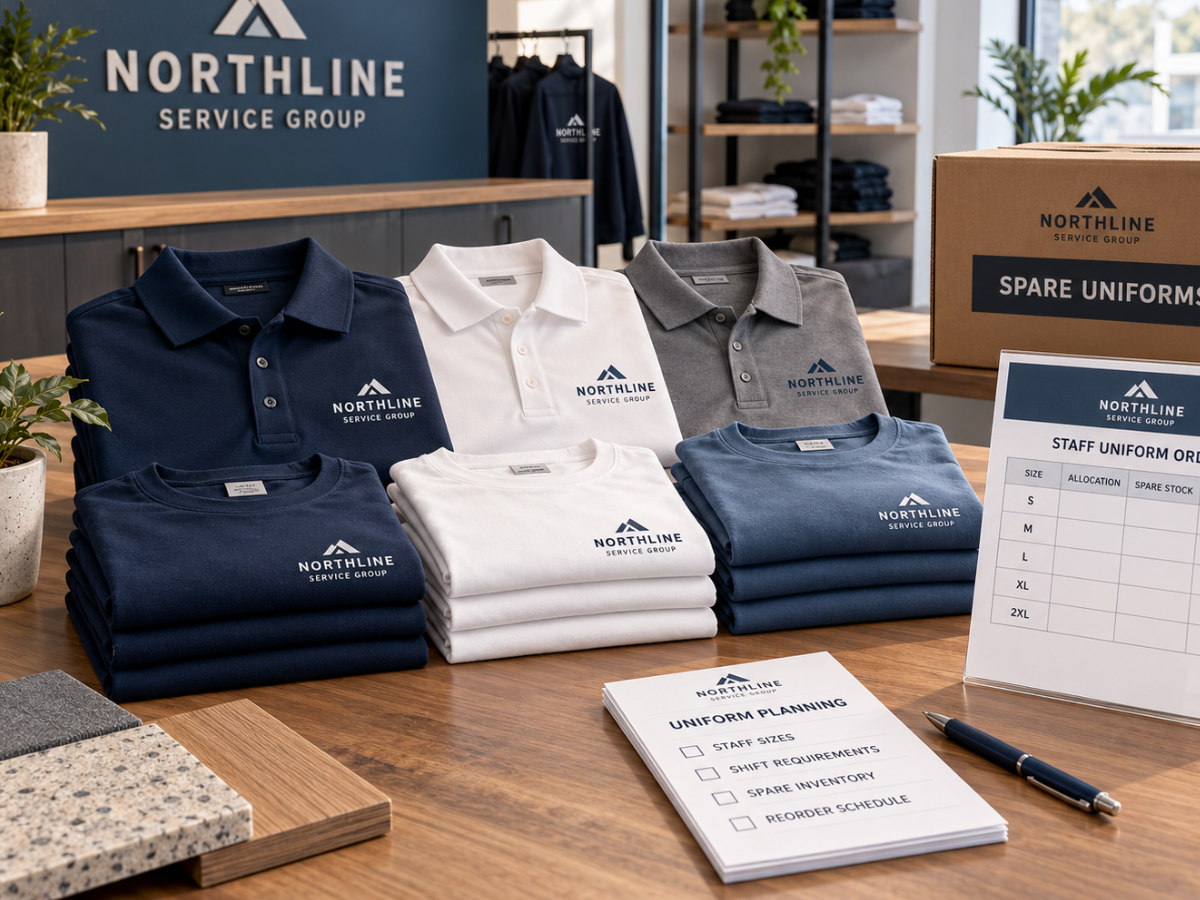
The right uniform shirt quantity depends on how many employees need them, how often they work, how frequently shirts can be washed and how much replacement stock the business needs. Start with an accurate staff size list, calculate shirts per employee and add a deliberate reserve rather than guessing a single bulk quantity.
Ordering branded shirts for a business sounds straightforward until the size breakdown arrives.
A company with 25 employees does not necessarily need 25 shirts. Some employees work five days a week, others work occasional shifts and new team members may join after the order is placed. Shirts also need washing, replacing and sometimes separating by department or job function.
Ordering too few can leave employees without the clothing they need. Ordering too many in the wrong sizes ties up money in stock that may never be worn.
The solution is to treat uniform purchasing as a small inventory-planning exercise rather than a promotional merchandise order.
This guide focuses on the operational questions behind ordering branded staff T-shirts, polos and related uniform apparel. For garment style and branding decisions, businesses can browse Pryntco's current Men's T-Shirts and other apparel categories.
1. How Many Uniform Shirts Should Each Employee Receive?
There is no universal number that suits every business.
An employee wearing a branded shirt once a week may only need one or two. Someone working several consecutive days may need enough shirts to avoid depending on daily washing.
Start by considering three things:
- How many days the employee wears the uniform each week.
- How often laundry can realistically be completed.
- Whether the job creates frequent dirt, perspiration or clothing changes.
The allocation should support the actual working schedule rather than simply giving every employee the same quantity.
2. What Is a Practical Starting Point for Full-Time Staff?
For planning purposes, a business might begin with three to five shirts per employee who wears a uniform throughout the working week.
This is an illustrative planning range, not a universal requirement.
A clean office or showroom environment may have different needs from a restaurant kitchen, landscaping crew or physically demanding service operation.
Ask employees how many shirts they can realistically rotate between laundry days before choosing the final allocation.
3. How Many Shirts Should Part-Time Employees Receive?
Part-time staff usually need fewer shirts when their working days are limited and predictable.
For example, an employee working two days each week might reasonably use two shirts, with additional coverage depending on laundry and the type of work.
However, part-time status alone does not determine uniform needs.
Someone working two demanding outdoor shifts may need more replacement flexibility than an employee working three short shifts in a controlled indoor environment.
4. Should Casual and On-Call Staff Be Included?
Yes, if the business expects them to wear the same branded clothing.
Casual employees are easy to overlook because they do not appear on every weekly schedule.
Create a separate category for occasional staff and record their expected uniform needs.
Do not rely on borrowing another employee's shirt unless the business has an appropriate, hygienic shared-uniform system.
5. How Do You Calculate the Total Shirt Quantity?
Use a simple formula:
Total shirts = Employee allocations + Approved spare stock + Confirmed upcoming hires
For example, consider a fictional company with:
- 12 full-time employees receiving four shirts each: 48 shirts.
- 8 part-time employees receiving two shirts each: 16 shirts.
- 6 additional shirts allocated as spare stock.
- 2 incoming employees receiving three shirts each: 6 shirts.
The planned order would be 76 shirts.
This calculation is an example of the method, not a recommendation that every company use those quantities.
6. Why Is Employee Headcount Not Enough?
Headcount tells you how many people work for the business. It does not explain how many shirts those people require.
Two companies with 20 employees could have very different requirements.
One might operate a small reception team with occasional uniform use. Another might run a busy service operation with staff working across rotating shifts.
Use headcount to establish the number of people receiving uniforms, then calculate individual allocations according to how the garments will be used.
7. How Should Laundry Frequency Affect the Order?
Laundry is one of the largest practical factors in uniform quantity planning.
If employees wash their uniforms twice a week, they may need fewer shirts than employees who can only wash clothing at the end of the week.
Businesses should establish whether laundry is handled by employees or by the company.
A centrally managed laundry program may allow predictable rotation, while individually managed uniforms require enough flexibility for different household schedules.
8. Do Physically Demanding Jobs Need More Shirts?
Often, yes.
Employees working around heat, dust, food preparation, cleaning products or physically demanding activities may need a fresh shirt more frequently.
The quantity should account for normal working conditions and any hygiene or workplace requirements that apply to the job.
For these businesses, an extra clean shirt may be a practical operational necessity rather than unnecessary inventory.
9. Should Office and Customer-Facing Staff Have Different Allocations?
They can.
A showroom employee wearing a polo shirt every day may need a regular rotation. An office employee wearing branded apparel only for client meetings may need considerably fewer pieces.
Separating allocations by actual uniform use helps avoid treating occasional promotional clothing as a daily uniform.
10. How Should Businesses Collect Employee Sizes?
Use a controlled size collection process before placing the order.
For each employee, record:
- Name or internal employee identifier.
- Department or role.
- Selected garment model.
- Required size.
- Quantity allocated.
- Colour or approved uniform version.
Have employees confirm their own selections rather than estimating sizes based on appearance.
11. Can You Assume Employees Wear Their Usual T-Shirt Size?
No.
A size medium in one garment model may not feel identical to a medium in another.
Differences in cut, fabric, shoulder width, length and intended fit can change how a shirt sits on the body.
Use the size information for the exact garment being ordered rather than treating size labels as interchangeable across brands.
12. Should Employees Try on Sample Garments?
For a substantial or recurring uniform program, a fitting exercise can prevent expensive size mistakes.
Where practical, let employees try the selected garment style or review accurate measurements against clothing they already own.
A sample does not need to be fully branded to help confirm fit.
Record the final selected size and model rather than simply noting that an employee tried on a large shirt.
13. Should Men's, Women's and Unisex Shirts Be Ordered Separately?
They should be tracked separately when different garment models are selected.
Do not combine all medium shirts into one inventory line if the order contains different cuts.
Pryntco currently lists separate categories for Women's T-Shirts and Unisex T-Shirts.
The size distribution must match the specific garment model and available options.
14. Is a Unisex Shirt Easier for Staff Uniform Ordering?
A unisex style may simplify purchasing when employees are comfortable with its fit.
Using fewer garment models can reduce the number of separate inventory combinations.
However, simplicity should not come at the expense of comfort or appropriate fit.
Employees should have a reasonable opportunity to evaluate sizing before the business standardizes a uniform style.
15. Should Every Employee Receive the Same Garment Style?
Not necessarily.
Different departments may require different clothing for practical reasons.
A front-desk employee might wear a branded polo while a warehouse employee wears a T-shirt.
Those garments can share the same logo and brand colours without being identical products.
Keep each garment model in a separate purchasing and inventory line.
16. Are Polo Shirts Better for Customer-Facing Teams?
Polos can create a more structured appearance for reception, sales, hospitality and showroom teams.
T-shirts may be more suitable for active roles, casual environments and promotional crews.
The right choice depends on the organization's dress expectations, comfort requirements and daily activities.
Pryntco lists multiple styles in its Men's Polos category for businesses comparing customer-facing uniform options.
17. Should Managers Have Different Uniforms?
Different colours or garment styles can help identify supervisors when that distinction is useful to customers or staff.
However, every additional version creates another inventory requirement.
If managers need a different uniform, record their quantities and sizes separately and consider whether the distinction is necessary before ordering.
18. How Many Extra Shirts Should Be Kept in Stock?
Extra stock should be based on expected replacement needs rather than an automatic percentage.
Consider the number of employees, staff turnover, garment availability and how quickly the company can place another order.
A small business may keep only a few carefully selected replacements. A larger operation with frequent new hires may benefit from a more structured reserve.
The goal is to reduce disruption without creating piles of unused shirts.
19. Which Sizes Should Be Included in Spare Stock?
Start with the actual size distribution from the employee order.
If most team members wear particular sizes, those sizes may be more useful for general replacement inventory.
However, do not assume that less common sizes are unimportant.
Consider keeping employee-specific replacement coverage for sizes that may be difficult to obtain quickly.
20. Should You Order Extra Large Sizes Just in Case?
Do not substitute guessing for a proper size survey.
Some apparel models have different size availability, and the available colour selection may also vary by size.
Ordering large quantities of unsupported sizes can create unnecessary cost.
Confirm the actual size requirements first, then review which sizes and garment colours are available in the selected Pryntco product configuration.
21. How Should New Employees Be Included?
Separate confirmed upcoming hires from speculative growth.
If a company has already hired three employees who will start next month, their uniform requirements can be included in the current order once their sizes are known.
If management only expects possible future hiring, a limited spare inventory may be more appropriate than placing a large order based on uncertain staffing plans.
22. How Should Staff Turnover Affect Quantity Planning?
Businesses with frequent staffing changes may need a reliable replacement process.
Instead of printing a large unknown quantity, track how many new uniform sets were issued over the previous several months.
That history provides a stronger basis for reserve stock and reorder frequency than a general assumption about how often people leave.
23. Should Employee Names Be Printed on Shirts?
Personalization can be useful for customer-facing roles, but it reduces flexibility.
A shirt carrying an employee's name cannot easily be reassigned when that employee leaves.
Businesses expecting significant staff movement may prefer a common company logo with separate name tags.
Confirm personalization availability and pricing for the specific project before designing around individual names.
24. Is It Better to Print One Logo on Every Shirt?
Using one approved logo version can simplify ordering, replacement and brand consistency.
Different departments may still require different garments, but unnecessary variations in artwork can complicate future orders.
Maintain one approved source file and document any legitimate differences in placement or design.
25. Should the Logo Go on the Front or Back?
The answer depends on how the shirt will be worn and how customers encounter the employee.
A front logo can help identify staff during face-to-face interactions.
A larger back graphic may be useful for event crews or employees working where customers often approach from behind.
Before approving either position, review the printable area and permitted decoration options for the chosen garment.
26. Does Printing or Embroidery Change the Order?
It can affect decoration suitability, the visual result and how the uniform program is configured.
Printing may suit large colourful designs, while embroidery can create a stitched appearance for suitable logos and garments.
Some small artwork details may need to be simplified for embroidery.
For a broader comparison, see Pryntco's Printing vs Embroidery for Branded Apparel guide.
27. Should Seasonal Uniforms Be Ordered Separately?
Yes when the business uses different garments during different parts of the year.
For example, a company may use lightweight T-shirts in warm weather and long-sleeve garments or sweatshirts in cooler conditions.
Forecast each garment category separately instead of assuming one shirt quantity covers the complete annual uniform program.
28. Should Event Staff Shirts Be Added to the Regular Uniform Order?
Only when the event shirts are compatible with normal staff use.
A permanent company logo may make the garment useful beyond the event.
Event-specific dates, sponsors or campaign graphics can make the shirts difficult to reuse later.
Keep event allocations separate when the design or purpose differs from regular staff uniforms.
29. How Should Shirt Quantities Be Split by Size?
Build a size allocation table before ordering.
| Size | Employee Allocation | Spare Stock | Total to Order |
|---|---|---|---|
| S | 8 | 1 | 9 |
| M | 20 | 2 | 22 |
| L | 16 | 2 | 18 |
| XL | 8 | 1 | 9 |
These figures illustrate the planning process. They are not recommended size percentages.
Create a separate table for each garment model, colour and decoration configuration.
30. How Can a Spreadsheet Prevent Ordering Errors?
A spreadsheet can keep all size and quantity decisions together.
Useful columns include:
- Garment model.
- Garment colour.
- Size.
- Number of employees receiving that variation.
- Shirts per employee.
- Reserve quantity.
- Final order quantity.
- Internal approval status.
Assign one person to maintain the final version so multiple departments do not submit conflicting totals.
31. Should You Order Everything at Once or Reorder Smaller Batches?
One consolidated order can simplify initial distribution when the requirements are stable.
Smaller reorders may make more sense when employee numbers, sizes or uniform policies change frequently.
Compare the cost and administrative effort of each approach using the current product configuration.
Do not assume a future reorder will always have the same unit price, stock availability or colour selection.
32. When Should a Business Reorder Uniform Shirts?
Create a reorder trigger before inventory runs out.
For example, a business could review stock whenever a new employee receives a uniform or when reserve inventory falls below an internally established threshold.
The threshold should reflect how quickly the business can approve artwork, place an order and receive the garments.
Do not rely on an unverified production timeframe when setting the threshold.
33. Why Should Businesses Keep Their Original Artwork?
Approved artwork helps preserve consistency between the first order and later reorders.
Keep the original logo file, its approved placement, colour information and final garment configuration together.
A screenshot of a previously printed shirt is not an adequate replacement for the actual artwork when preparing a future order.
34. How Should Uniforms Be Distributed to Employees?
Sort finished garments by employee or department before distribution.
For a larger order, a distribution sheet can record:
- Employee name.
- Garment style and size.
- Number of shirts issued.
- Date of issue.
- Remaining allocation if applicable.
This avoids confusing an employee's original allocation with replacement inventory.
35. How Do You Track Replacement Shirts?
Record when replacements are issued and why they are needed.
Common reasons might include damage, normal wear, sizing changes or a new job requirement.
Over time, this information reveals which sizes and garments are used most often and whether the original allocation was sufficient.
It also helps distinguish genuine uniform demand from poor inventory control.
36. What Should Be Confirmed Before Ordering?
Review the complete order rather than approving only the logo.
- Exact garment names and models.
- Approved garment colours.
- Size availability for each model.
- Final quantity for every size and colour.
- Approved logo files and positioning.
- Decoration method and supported artwork requirements.
- Employee allocations and spare inventory.
- Order cost and applicable configuration options.
- Required delivery or pickup arrangements.
Confirm any uncertain configuration details before placing the order.
37. What Are the Most Common Staff Uniform Ordering Mistakes?
Several recurring mistakes create unnecessary expenses:
- Ordering one shirt per employee without considering working schedules.
- Guessing sizes instead of collecting accurate selections.
- Combining different garment models into one size total.
- Ordering extra stock without a reasoned size breakdown.
- Ignoring laundry and replacement requirements.
- Adding employee names to every shirt when reassignment flexibility matters.
- Assuming different brands use identical sizing.
- Using the wrong logo version for reorders.
- Forgetting confirmed new hires.
- Failing to record who received which garments.
38. How Many Uniform Shirts Should Your Business Actually Order?
Begin with the employee roster, not the printer's quantity options.
Determine who genuinely needs branded clothing and how often each person will wear it. Separate full-time, part-time, casual and event-only staff when their uniform needs differ.
Collect actual size selections for the exact garment models. Do not estimate everyone's size or combine fitted, men's, women's and unisex products into one generic distribution.
Calculate an appropriate number of shirts per employee based on shifts, laundry and working conditions. Add approved quantities for confirmed new hires and a measured replacement reserve.
Then organize the complete order by garment model, colour, size and decoration configuration.
Finally, establish a reorder process. Keep approved artwork and garment records so future purchases can be planned using real inventory rather than starting over.
Pryntco offers multiple branded apparel categories, including T-shirts, polos, long-sleeve shirts and other styles for business uniforms, teams and promotional programs.
For a coordinated staff order, browse the relevant apparel products and confirm the required size and colour combinations. Businesses with special garment or decoration requirements can also request a custom quote from Pryntco.

