
How Many Branded Shirts Should You Order for Staff?
How Many Branded Shirts Should You Order for Staff?
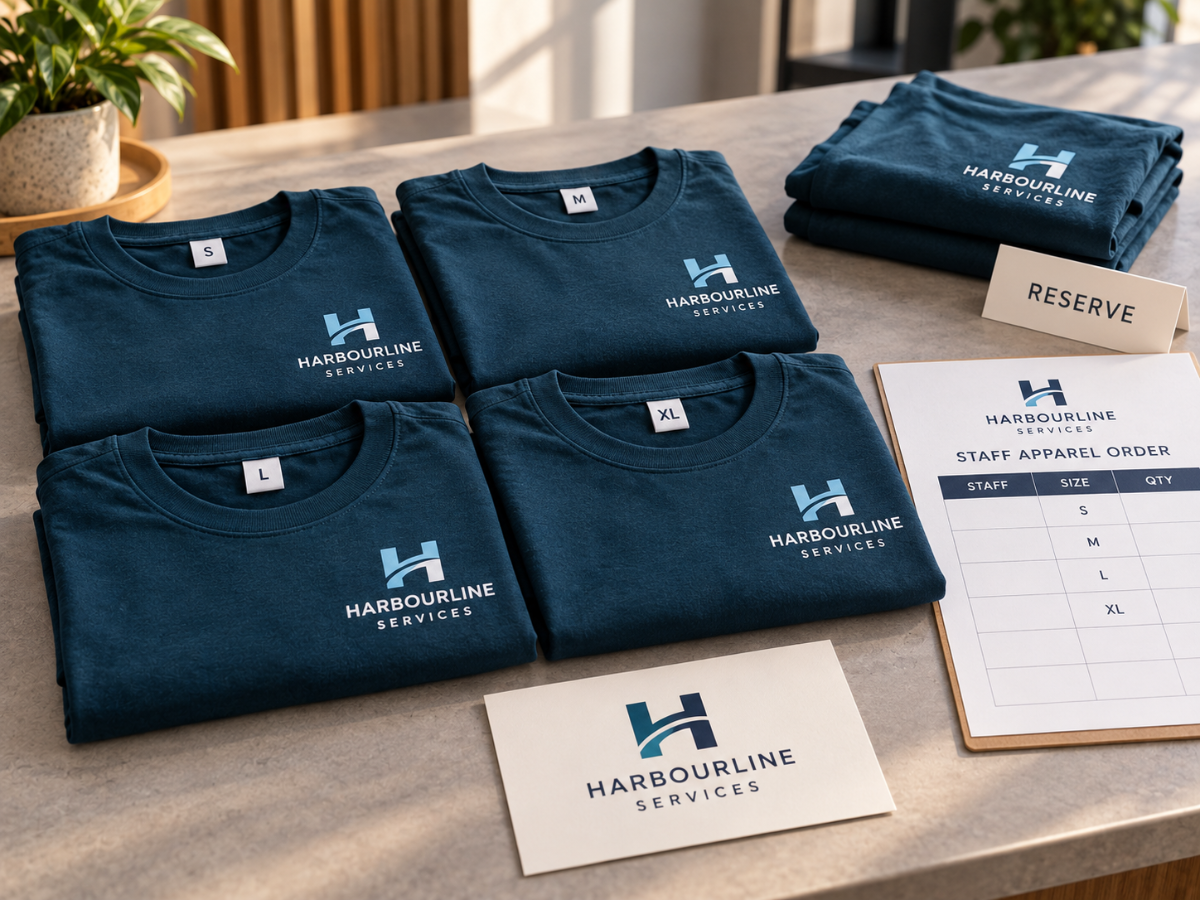
The right staff-shirt quantity is not simply your employee count multiplied by an arbitrary number. Start with how often each role wears the garment, collect confirmed sizes, separate current staff from future reserve inventory and plan reorders before the first batch runs out.
Ordering branded shirts sounds straightforward when a company has ten employees.
There are ten people.
Order ten shirts.
Then Monday arrives.
The shirts are part of the daily uniform.
By Wednesday, employees are either washing them constantly or wearing something else.
So the next instinct is to order five shirts for everyone.
Then two employees leave, three new people join in different sizes and a box of unused shirts sits in storage for a year.
The right quantity is somewhere between those two extremes, but there is no universal number because businesses use branded apparel differently.
A retail employee wearing the company shirt every working day needs a different allocation from a salesperson who only wears it at quarterly trade shows.
Pryntco’s current Apparel catalogue includes T-shirts, long sleeves, polos, sweatshirts, hoodies, tank tops and headwear for staff, teams, events and promotional apparel. Quantity planning should begin with the specific garment and the role it serves.
1. What Is the First Number You Need Before Ordering Staff Shirts?
The number of people who actually need that garment.
Do not use total company headcount automatically.
Separate employees by:
- Role
- Location
- Uniform requirement
- Event participation
A warehouse employee, receptionist and remote accountant may not require the same apparel allocation.
2. Should Every Employee Receive the Same Number of Shirts?
No.
Allocate according to frequency of wear.
An employee wearing branded shirts five days a week may need several.
An employee wearing one only at events may need one or two.
Uniform quantity should reflect use, not organizational hierarchy.
3. How Does Wear Frequency Affect Quantity?
The more often the garment is worn, the more pieces the employee needs in rotation.
Ask:
- Daily?
- Several days per week?
- Occasional client meeting?
- Events only?
This question is more useful than starting with a generic “three shirts per employee” rule.
4. Why Does Laundry Frequency Matter?
Employees need enough garments to get through a normal work and laundry cycle.
If a uniform shirt is worn every day, one shirt is obviously impractical.
The organization should decide what is reasonable for the work schedule and expectations.
5. How Many Shirts Does a Daily Uniform Employee Need?
There is no universal number, but the allocation should cover repeated weekly wear without requiring unrealistic washing between shifts.
Consider:
- Days worked
- Physical demands of the job
- Access to laundry
- Whether another approved garment is available
6. How Many Shirts Does an Event-Only Employee Need?
Often fewer.
If the garment is only worn for:
- Trade shows
- Community events
- Quarterly meetings
one or a small number of approved shirts may be enough depending on event length and frequency.
7. What About Customer-Facing Staff?
They may need a reliable rotation because the garment needs to be available and presentable throughout the week.
Consider whether the staff uniform includes:
- T-shirt
- Polo
- Long sleeve
- Outer layer
The total apparel system may reduce the number required of any single garment.
8. Should Staff Receive Both T-Shirts and Polos?
Only when their role uses both.
For example:
- T-shirt → production or casual day
- Polo → client-facing meeting
Do not double the apparel inventory without a real workplace reason.
9. Should Seasonal Garments Be Counted Separately?
Yes.
A winter hoodie and summer T-shirt are separate apparel needs.
Do not calculate one annual total and assume every garment should receive the same allocation.
10. How Should Short- and Long-Sleeve Shirts Be Planned?
Use the season and work environment.
A company may provide:
- More short sleeves for everyday wear
- Fewer long sleeves as a seasonal option
Another business may use long sleeves as its primary uniform for part of the year.
11. Should Hoodies Be Ordered in the Same Quantity as T-Shirts?
Usually not automatically.
A hoodie may function as an outer layer that the employee wears repeatedly over several base shirts.
The required quantity may therefore be lower.
Plan it according to actual workplace use.
12. Should Every Employee Get a Spare?
A spare can be useful, but the company should define why.
Possible reasons include:
- Unexpected damage
- Long shift
- Travel
- Operational backup
Do not build a large reserve just because “extra is safer.”
13. Should the Company Keep Extra Shirts in Storage?
Some reserve inventory can be useful.
It can cover:
- New hires
- Damaged garments
- Unexpected events
- Temporary staff
The reserve should be based on real turnover and hiring patterns rather than guessing.
14. How Much Reserve Inventory Should Be Kept?
There is no universal percentage.
A high-turnover operation may need more ready stock than a stable office team.
Review:
- Hiring frequency
- Employee turnover
- Typical sizes
- Reorder lead time
Then set an internal reserve target.
15. Should Reserve Inventory Be Spread Evenly Across Sizes?
No.
Use the size distribution of the actual team.
If the organization rarely uses one particular size, there is little reason to hold the same reserve quantity as a size used by many employees.
16. How Should Sizes Be Collected?
Collect the size for the exact garment.
Your order sheet should include:
- Employee name
- Garment
- Fit
- Size
- Quantity
Do not maintain only one generic “shirt size” field if several garment models are being used.
17. Why Should You Avoid Guessing Employee Sizes?
Because guessed shirts become unusable inventory quickly.
Ask the employee to choose from the approved product and size information whenever possible.
This is especially important when mixing men’s, women’s and unisex fits.
18. Should Size Distribution From the Last Order Be Used?
It can help as a planning reference, but confirm the current staff list.
Teams change.
A historical size breakdown should not replace current employee information.
19. What If Several Employees Are Between Sizes?
Use the exact garment’s size information and, when practical, evaluate a sample before a large recurring order.
Do not assume moving up or down one size produces the same result across every brand and fit.
20. Should New Hires Receive Apparel Before Their First Day?
They can if:
- Role is confirmed
- Garment is confirmed
- Size has been collected
Do not print personalized or size-specific inventory too early if employment details are still uncertain.
21. How Should New-Hire Inventory Be Managed?
Maintain one approved apparel list.
Record:
- Product name or code
- Colour
- Decoration
- Approved size range
This prevents a new employee from receiving a completely different shirt because the original product was forgotten.
22. What Happens When an Employee Leaves?
The company should have its own policy for company-issued garments.
From an inventory perspective, departure patterns can help reveal whether the company is overstocking apparel for roles with high turnover.
23. Should Personalized Shirts Be Used?
Only when the role benefits from individual names or titles.
Personalization can make unused or returned apparel much harder to reassign.
Generic branded shirts are usually more flexible for staff changes.
24. How Should Multiple Locations Order Staff Apparel?
Separate the order by branch.
Track:
- Employee
- Location
- Garment
- Size
- Quantity
This helps prevent one branch from receiving another location’s size distribution.
25. Should Every Location Hold Its Own Reserve?
It can if branches hire independently or need immediate replacements.
For smaller organizations, one central reserve may be easier to manage.
The correct system depends on how quickly garments can be transferred between locations.
26. How Should Part-Time Staff Be Counted?
According to how often they wear the uniform.
A part-time employee working two shifts a week may not need the same allocation as a full-time employee working five.
Use actual schedule frequency.
27. How Should Temporary Event Staff Be Counted?
Build a separate event allocation.
Do not merge temporary event shirts into permanent staff inventory if they have a different purpose or design.
Confirm whether the garments will be reused at future events.
28. Should Company Shirts Be Replaced on a Fixed Schedule?
Not necessarily.
Replacement depends on:
- Wear
- Role
- Garment condition
- Brand updates
A heavily used field shirt may need replacement sooner than an event polo worn several times per year.
29. How Should Damaged or Worn Shirts Be Replaced?
Keep a simple replacement process.
Record why replacements occur.
If one garment repeatedly wears out faster than expected in a particular role, the company may need to reconsider the chosen apparel rather than continually reordering the same item.
30. Should Apparel Quantities Be Planned Around Price Breaks?
Price matters, but do not buy unnecessary garments simply to reach a larger quantity.
The savings are not useful if the extra shirts:
- Never fit anyone
- Become outdated
- Remain in storage
Compare current pricing against realistic demand.
31. What Happens if the Brand Changes?
Old inventory can become obsolete immediately.
If a logo, colour or uniform system is likely to change, avoid building an excessive reserve before the decision is finalized.
32. Should Shirts With Old Branding Still Be Used?
That is a brand decision.
For customer-facing uniforms, inconsistent logos can make the team look disorganized.
When a rebrand is planned, coordinate the transition rather than allowing old and new apparel to circulate indefinitely.
33. How Should Reorder Points Be Set?
Do not wait until the last shirt is used.
Track reserve inventory and set an internal reorder point based on:
- Typical monthly hiring
- Replacement rate
- Production timing
- Upcoming events
34. Should Apparel Be Reordered Monthly, Quarterly or Annually?
Choose a cadence that fits the business.
A growing company may benefit from smaller scheduled reorders.
A stable team may order less frequently.
Frequent small emergency orders often indicate that inventory planning needs improvement.
35. What Should Be Recorded After Every Apparel Order?
Keep a simple apparel record containing:
- Product
- Colour
- Decoration
- Sizes ordered
- Quantities
- Date
- Final approved artwork
This makes future reorders much easier.
36. What Are the Most Common Reasons Companies Underorder?
Common problems include:
- Ordering one shirt per employee for a daily uniform.
- Forgetting laundry cycles.
- Ignoring new hires.
- Keeping no replacement stock.
- Forgetting multi-day events.
37. What Are the Most Common Reasons Companies Overorder?
Common problems include:
- Buying equal reserve quantities in every size.
- Ordering for projected hires who never arrive.
- Chasing quantity discounts.
- Buying too much seasonal apparel.
- Ignoring an upcoming rebrand.
- Ordering several garment types nobody requested.
38. How Many Branded Shirts Should You Order for Staff?
Begin with confirmed current employees who actually need the garment.
For each role, determine how often the shirt will be worn.
Then assign a practical per-person rotation that covers normal work and laundry without creating unnecessary inventory.
Collect the exact garment and size from each employee instead of guessing.
After the current-team quantity is established, plan reserve stock separately.
Base that reserve on actual hiring frequency, replacement needs and the sizes the company commonly uses.
Seasonal garments such as long sleeves and hoodies should have their own quantities rather than matching the T-shirt order automatically.
Multi-location companies should track each branch separately.
Finally, establish a reorder point before inventory reaches zero.
The strongest staff-apparel program is not the one with the largest stockroom.
It is the one where employees consistently have what they need while the company avoids boxes of obsolete sizes, old branding and unused seasonal apparel.
Businesses can review current T-shirts, polos, long sleeves, sweatshirts, hoodies and other options through Pryntco’s Apparel catalogue.
For a staff apparel order across several sizes, fits or locations, contact Pryntco or submit a custom quote request.

