
Holiday Card or Branded Calendar? Choosing a Year-End Client Touchpoint
Holiday Card or Branded Calendar? Choosing a Year-End Client Touchpoint
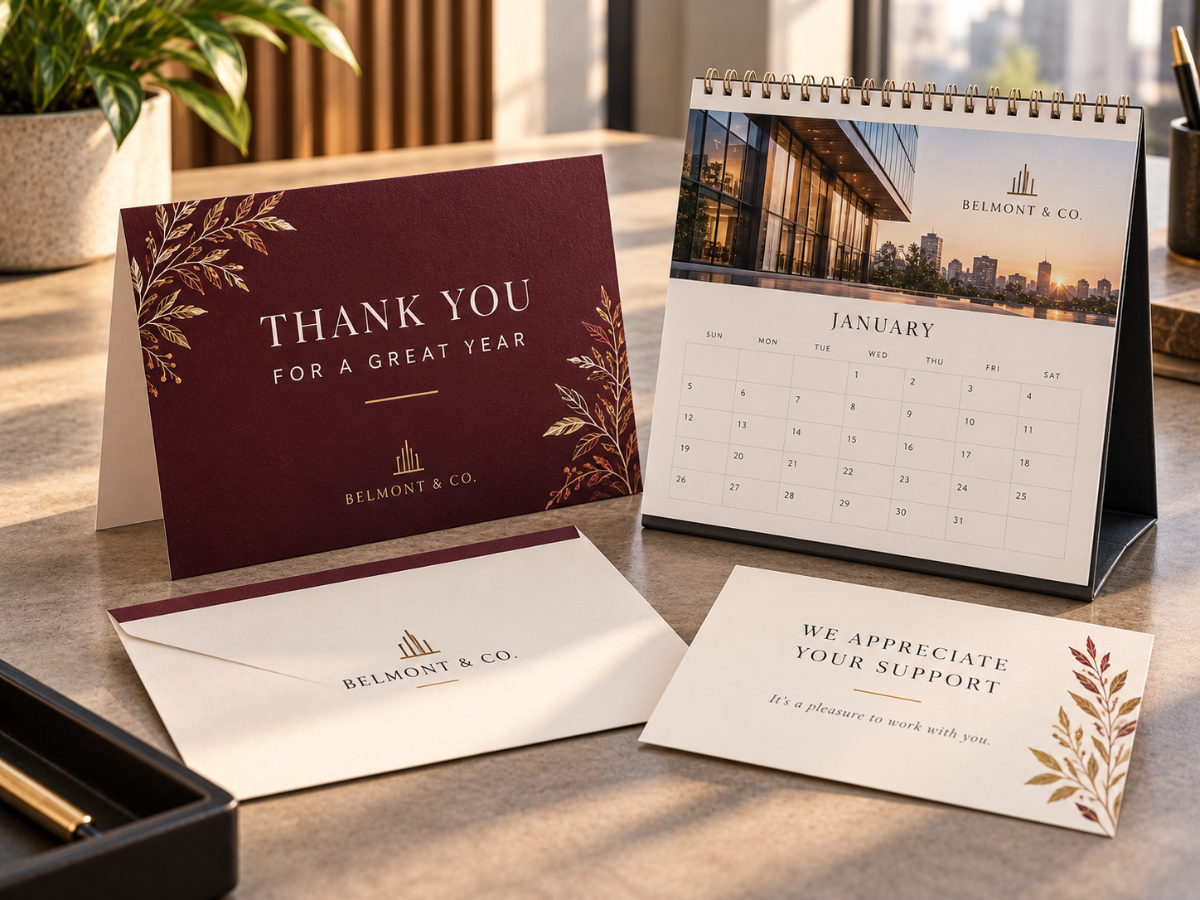
A holiday card creates one personal moment. A branded calendar tries to remain useful long after the year-end message is over. Choose the card when the relationship and message matter most; choose the calendar when the recipient has a realistic reason to keep the product visible throughout the coming year.
Businesses often reach the end of the year and ask the same question:
What should we send clients?
The default answer is often a holiday card.
Another common choice is a branded calendar.
Both can arrive around the same time.
Both can thank clients.
Both can carry the company’s brand.
But they do completely different jobs.
A greeting card is relationship-focused.
Someone opens it, reads the message and understands why the company reached out.
A calendar is utility-focused.
Its value depends on whether the recipient wants to use it repeatedly over the next year.
Pryntco’s current Custom Greeting Card Guide covers business holiday cards in detail, while its Desktop vs Wall Calendar Guide explains how branded calendars can remain useful at desks, offices, workshops and other customer spaces.
The decision between them should begin with the client relationship.
1. What Is the Main Difference Between a Holiday Card and a Branded Calendar?
A holiday card is primarily communication.
A calendar is primarily a functional product.
The card says:
We appreciate the relationship.
The calendar says:
Here is something we hope remains useful next year.
2. When Is a Holiday Card the Better Choice?
Choose a card when the message itself is the most important part.
It can work particularly well for:
- Long-term clients
- Professional partners
- Suppliers
- Referral partners
- Employees
The recipient does not need another object in order for the gesture to have value.
3. When Is a Branded Calendar the Better Choice?
Choose a calendar when the recipient is likely to use one.
Good environments may include:
- Office desk
- Reception area
- Workshop
- Service counter
- Shared workspace
Usefulness should come before advertising space.
4. Which One Feels More Personal?
A holiday card usually has the advantage.
The inside can contain:
- Personal message
- Team signatures
- Handwritten note
- Client-specific appreciation
A calendar generally communicates through design and utility rather than a longer personal message.
5. Which One Keeps the Brand Visible Longer?
A calendar potentially can.
If the recipient uses it, the brand may remain visible across many months.
But that only matters if the calendar is actually useful enough to stay on the desk or wall.
A calendar that goes directly into storage provides no long-term visibility at all.
6. Is Long-Term Visibility Automatically Better Than a Personal Message?
No.
Marketing value should not replace relationship value.
A thoughtful card sent to an important client can be more appropriate than a heavily branded calendar the client never wanted.
7. Should Every Client Receive the Same Year-End Piece?
Not necessarily.
The business may choose:
- Holiday cards for most clients
- Calendars for clients who regularly use them
- Both for selected long-term relationships
Distribution should reflect the real audience rather than one universal rule.
8. Should a Holiday Card Be Sent to Every Contact in the Database?
No.
Clean the list first.
Remove:
- Duplicates
- Outdated contacts
- Former companies
- People with no meaningful current relationship
A smaller relevant list can feel more intentional.
9. Should Calendars Be Sent to Every Customer?
No.
A calendar has more physical commitment than a greeting card.
Ask whether the recipient has a realistic place and reason to use it.
Targeting calendars thoughtfully can reduce unnecessary production and shipping.
10. Which Is Better for Professional-Service Clients?
A card is a natural fit because the relationship is often personal and professional.
A desktop calendar can also work for clients who spend significant time at a workstation.
Do not assume every professional wants a branded wall calendar in the office.
11. Which Is Better for Contractors and Trades?
A wall calendar can be useful in:
- Workshop
- Office
- Job-planning space
- Service counter
A card may still be the better choice for clients when the intention is simply to express appreciation.
12. Which Is Better for Restaurants or Hospitality Clients?
A wall calendar may have practical shared-space use, while a greeting card can provide a warmer relationship message.
The choice should reflect where the client actually works and whether a calendar fits naturally into that environment.
13. Which Is Better for Individual Consumers?
A holiday card may be simpler because it does not assume the customer wants a branded object in the home.
A calendar can work when the brand already has a strong visual or community relationship with customers.
14. Which Is Better for B2B Clients?
Either.
A B2B card can recognize the relationship and the team behind it.
A calendar can be useful when the client’s workplace genuinely uses physical calendars.
Know the recipient before deciding.
15. How Should the Holiday Card Message Be Written?
Start with the relationship.
A simple structure is:
- Seasonal or year-end greeting
- Specific appreciation
- Warm closing
- Sender or team name
Do not turn the inside of the card into a service advertisement.
16. Should the Card Say “Merry Christmas” or Use a Broader Greeting?
Choose language appropriate to the actual recipient list and brand.
Possible approaches include:
- MERRY CHRISTMAS
- HAPPY HOLIDAYS
- SEASON’S GREETINGS
- THANK YOU FOR A GREAT YEAR
The best wording depends on who will receive it.
17. Should the Card Include a Sales Offer?
Usually not if the primary goal is appreciation.
A holiday card can lose its warmth quickly when the inside message immediately shifts into:
BUY NOW AND SAVE.
Run a separate promotional campaign when sales are the real objective.
18. How Much Branding Should Be on a Holiday Card?
Enough to identify the sender.
A restrained logo, colour palette or team photograph can be sufficient.
The company does not need to list:
- Every service
- Phone number several times
- Sales claims
- Multiple QR codes
19. How Much Branding Should Be on a Calendar?
Controlled branding is even more important because the recipient may look at the product for months.
A calendar overloaded with advertisements on every page may be less likely to remain on display.
Keep the date grid and photography useful first.
20. Should Every Calendar Month Promote a Different Service?
Not necessarily.
A calendar can use:
- Strong photography
- Illustration
- Company projects
- Local imagery
with restrained branding.
The product should not feel like twelve flyers bound together.
21. Should a Calendar Use Company Photography?
It can when the images are genuinely worth looking at.
Examples include:
- Completed projects
- Architecture
- Destination photography
- Products
- Original artwork
Use high-resolution source files appropriate to the final print size.
22. Should a Holiday Card Use a Team Photograph?
It can, especially for businesses where clients know the team personally.
Use a current high-quality photograph and confirm that everyone appearing in it is appropriately included.
A team photo should support the greeting rather than crowd the card with other design elements.
23. Is a Desktop or Wall Calendar Better?
That depends on the recipient.
Pryntco’s calendar guide recommends desktop calendars for close individual use and wall calendars where larger shared visibility is useful.
Think about the recipient’s environment before choosing the format.
24. Which Calendar Is Better for Office Clients?
A desktop calendar can work naturally beside:
- Computer
- Telephone
- Notebook
- Reception terminal
A wall calendar can make more sense in a shared office or meeting area.
25. Which Calendar Is Better for Workshops and Shared Spaces?
A wall calendar may provide better visibility because several people can view the same month from farther away.
Use a date grid large enough to remain functional in that setting.
26. Should a Business Give Both a Card and a Calendar?
It can for selected relationships.
The card carries the personal message.
The calendar becomes the practical gift.
If both are sent, keep the calendar branding restrained so the package does not become overly promotional.
27. When Should Holiday Cards Be Designed?
Earlier than December.
Allow time for:
- Recipient list
- Message approval
- Photography
- Design
- Proofing
- Printing
- Signing
- Mailing or delivery
Pryntco’s Seasonal Print Marketing Calendar specifically recommends preparing holiday campaigns before the season becomes urgent.
28. When Should Calendars Be Designed?
Calendars need even more planning because the artwork contains many dates and often multiple pages.
They should be ready early enough to reach clients while the coming year’s calendar is still useful.
Do not begin the project after most recipients have already chosen a calendar.
29. When Should the Pieces Be Distributed?
A holiday card should arrive while the greeting still feels timely.
A calendar is usually most useful shortly before or around the beginning of the year it covers.
Distribution timing should be planned backward from the desired arrival period.
30. Which Product Requires More Proofing?
Both require careful review, but calendars contain an unusually large amount of date information.
Calendar proofing should check:
- Weekdays
- Date numbers
- Month names
- Year
- Approved holidays where included
One incorrect date can reduce the usefulness of the entire product.
31. What Should Be Checked on a Holiday Card?
Confirm:
- Greeting
- Year where included
- Company name
- Team names
- Photographs
- Inside message
- Envelope fit
- Mailing list
Print and fold a paper proof when possible to check panel orientation.
32. Should Holiday Cards Be Hand-Signed?
They can be, particularly for smaller or higher-value client lists.
A handwritten signature or brief note can make the card feel more personal.
Leave appropriate writable space if signing is part of the plan.
33. Can Calendars Be Personalized?
They can, but the benefit needs to justify the additional complexity.
For most business calendars, a strong universal design is simpler to distribute.
A personalized cover or message may make sense for a small high-value client group.
34. How Should Quantities Be Planned?
Start from real recipients.
For cards, use the cleaned mailing or delivery list.
For calendars, identify people and locations likely to use them.
Add only a reasonable reserve for:
- New clients
- Replacement pieces
- Late year-end meetings
35. What Happens to Leftover Year-End Print?
Dated material has a limited useful life.
A holiday card printed with a year may be unusable the next season.
A calendar becomes obsolete as the year progresses.
That makes conservative, list-based quantity planning especially important.
36. What Are the Most Common Holiday-Card Mistakes?
Common problems include:
- Starting too late.
- Using a generic message that sounds like advertising.
- Sending to outdated contacts.
- Adding too many promotional messages.
- Forgetting space for signatures.
- Ordering excessive dated inventory.
37. What Are the Most Common Branded-Calendar Mistakes?
Common problems include:
- Treating every month like an advertisement.
- Using date grids that are too small.
- Choosing the format without considering where clients work.
- Using low-resolution monthly photography.
- Failing to independently proof every date.
- Distributing the calendar too late.
38. Should You Send Clients a Holiday Card or a Branded Calendar?
Choose a holiday card when the main goal is relationship-building.
It provides room to say thank you, acknowledge the year and communicate in a way that can feel personal without asking the recipient to keep another branded object.
Choose a calendar when the customer has a realistic reason to use one throughout the coming year.
A desktop calendar can suit individual office users, while a wall calendar can work in workshops, shared offices and other spaces where larger monthly visibility is useful.
Keep the calendar practical enough that the recipient wants to keep it.
For important clients, the two can also work together:
holiday card for the relationship + useful calendar for the year ahead.
But do not send either product simply because December arrived.
Define the audience, build the recipient list and choose the piece that makes sense for the relationship.
Pryntco currently offers Custom Greeting Cards for client and holiday communication.
For calendar projects, Pryntco does not currently list desktop or wall calendars as fixed standard online products, so businesses should confirm the desired format, finished size, construction, page structure and quantity before preparing final artwork.
Review Pryntco’s Desktop vs Wall Calendar Guide for deeper planning, or request a custom quote for a year-end calendar project.

