
What Should a Farmers’ Market Vendor Print? A Complete Booth Kit
What Should a Farmers’ Market Vendor Print? A Complete Booth Kit
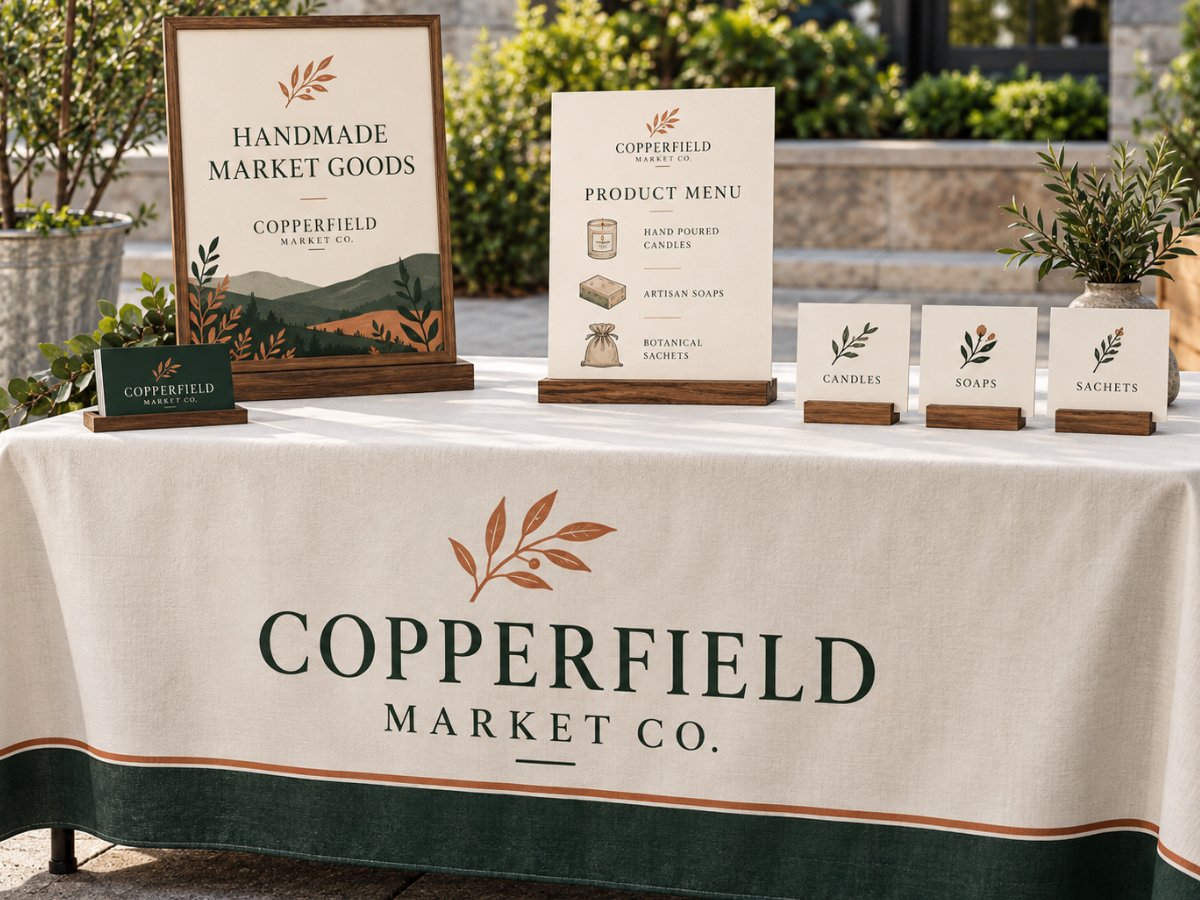
A farmers’ market booth needs to work at three distances. The canopy, banner or table cover should help people recognize the vendor from the aisle. Price and product signs should make the display easy to shop. Business cards, loyalty pieces and packaging materials should continue the relationship after the customer walks away.
A farmers’ market booth has very little time to explain itself.
People are walking.
They are looking at several vendors at once.
They may be carrying bags, talking with friends or deciding where to stop next.
The booth needs to communicate quickly without becoming covered in signs.
A large brand name helps people recognize the vendor.
A clear product or menu sign helps them understand what is being sold.
Small price cards reduce repeated questions.
Labels, hang tags and information cards can explain individual products at close range.
A business card or loyalty card gives interested customers something useful to keep after the market ends.
Pryntco’s current display range includes custom Table Covers for 6-foot and 8-foot tables, while its wider Trade Show & Display collection includes banners, flags, portable displays and canopy tents that can support temporary vendor setups.
1. What Printed Materials Does a Farmers’ Market Vendor Need?
The exact booth depends on the product, but useful materials may include:
- Table cover
- Primary booth sign
- Price cards
- Menu or product list
- Product information cards
- Labels or stickers
- Hang tags
- Business cards
- Loyalty cards
- Small take-away flyers
The vendor does not need every item. Start with what makes the booth easier to recognize and easier to shop.
2. What Should Customers Understand Before They Reach the Table?
They should be able to identify:
- Business name
- General product category
- Whether the booth is relevant to them
A shopper should not need to stand directly in front of the table before discovering whether the vendor sells baked goods, candles, coffee, produce, apparel or handmade products.
3. What Should Be the Main Visual Anchor of the Booth?
Choose one dominant branding element.
That might be:
- Canopy branding
- Large banner
- Branded table cover
- Vertical display
Do not make every surface compete to become the main sign.
4. Is a Custom Table Cover Worth Using?
It can be one of the simplest ways to make a standard folding table feel like part of the brand.
Pryntco currently offers custom table covers for 6-foot and 8-foot tables.
Use the front for:
- Logo
- Short brand name
- Simple graphic treatment
Do not fill it with a complete menu that products and customers will cover.
5. When Does a Canopy Tent Make Sense?
A canopy can provide a larger branded presence at outdoor markets when the market permits vendor tents.
Pryntco’s current display range includes a 10' × 10' canopy-tent option.
Before ordering, confirm:
- Market booth dimensions
- Venue requirements
- Permitted tent type
- Required weights or anchoring rules
The market organizer should supply the relevant setup requirements.
6. Should the Vendor Use a Banner or Flag?
Use one when visibility from farther down the aisle is important.
A banner or flag can carry:
- Brand name
- Product category
- Very short message
A banner should not reproduce every price and product available on the table.
7. What Should the Main Booth Sign Say?
Make the business immediately understandable.
A useful structure is:
BRAND NAME
followed by a short descriptor such as:
SMALL-BATCH BAKED GOODS
or:
HANDMADE HOME GOODS
Do not rely on a poetic slogan if nobody can tell what the vendor sells.
8. How Should Product Prices Be Displayed?
Prices should be easy to see without requiring customers to ask about every item.
Use:
- Small product cards
- Tent cards
- Menu-style board
- Simple grouped price list
Keep the product name and price visually connected.
9. When Is a Printed Menu Useful?
A menu-style piece works well for vendors selling:
- Prepared food
- Beverages
- Baked goods
- Several standard product options
Pryntco’s current Menu Printing options include several standard sizes with single- or double-sided printing.
10. Should Every Product Have Its Own Information Card?
No.
Use individual cards when customers genuinely need product-level information.
A card may help explain:
- Product name
- Variant
- Approved ingredients or materials
- Short description
- Price
Keep required or regulated information under the control of the vendor.
11. When Are Tent Cards Useful?
Tent cards can stand directly beside products without requiring separate frames.
Pryntco currently positions Tent Cards for retail and point-of-sale displays as well as events.
They can identify:
- Featured item
- Price
- Bundle
- QR code
12. When Should Products Use Labels or Stickers?
Labels and stickers can help when the branding or product information needs to remain physically attached to packaging.
Potential uses include:
- Brand seal
- Product name
- Variant
- Package identification
Choose the label material according to the actual package surface and environment.
13. When Are Hang Tags Better Than Stickers?
Hang tags can work when the vendor does not want to adhere a label directly to the product.
They are particularly useful for:
- Apparel
- Textiles
- Accessories
- Handmade goods
Pryntco’s Hang Tag Guide covers retail product identification in more detail.
14. Should a Market Vendor Have Business Cards?
Yes when customers may need to contact the vendor after the event.
Business cards can support:
- Custom orders
- Wholesale inquiries
- Event bookings
- Online ordering
Keep the website or primary contact method current.
15. Should a Vendor Use Loyalty Cards?
They can work well for businesses that attend the same markets regularly or operate another permanent location.
A printed loyalty program should clearly explain:
- What counts
- How rewards are earned
- What the real reward is
Pryntco’s Loyalty Card Guide covers stamp and punch-card planning.
16. Should the Vendor Ask for Google Reviews at the Booth?
Only after the customer has actually had an experience worth reviewing.
A small review card can be included with a completed purchase rather than placed aggressively in front of every shopper.
Do not make a review the condition of receiving normal customer service or a product.
17. Should a Vendor Hand Out Flyers?
Use flyers only when customers need more information than the booth can communicate.
A small flyer may explain:
- Custom-order process
- Upcoming market schedule
- Catering or event service
- Wholesale program
Do not automatically hand one to every passerby.
18. Should a QR Code Be Used at the Booth?
Yes when it gives the customer a useful next step.
Possible destinations include:
- Online store
- Pre-order page
- Market schedule
- Custom-order form
- Social page
Label the destination clearly.
19. Where Should the QR Code Go?
Place it where customers can comfortably scan it.
Good locations may include:
- Small table sign
- Product card
- Business card
- Take-away flyer
A QR code printed several feet away on the top of a canopy is not useful.
20. Should Payment Information Be Printed?
A simple payment sign can reduce repeated questions.
Only show the payment methods the vendor actually accepts.
If the payment system changes regularly, use a replaceable small sign rather than building the information into an expensive long-term display.
21. How Should Ingredient, Allergen or Product Claims Be Handled?
The vendor is responsible for supplying and approving any product-specific or legally required information.
Do not invent claims such as:
- Allergen-free
- Organic
- Certified
- Non-toxic
- Medical or health benefits
unless the business has verified authority to make them.
22. Should Seasonal Availability Be Printed?
Only on easily replaceable pieces when the product range changes often.
A seasonal price or availability list may work better on a small menu card than on the permanent branded table cover.
23. How Should Sold-Out Products Be Handled?
A removable or replaceable sign can help.
Do not cover the booth with improvised handwritten corrections if the same issue happens every market.
Consider a reusable card such as:
SOLD OUT — BACK NEXT MARKET
24. How Should Custom Orders Be Promoted?
Use one compact call to action.
For example:
CUSTOM ORDERS AVAILABLE
paired with:
- Website
- QR code
- Business card
Do not force the entire custom-order process onto the tabletop.
25. How Should Wholesale Inquiries Be Handled?
If retailers or other businesses may approach the booth, keep a separate business-facing piece available.
That may be:
- Business card
- Wholesale information sheet
- Catalogue link
There is no need to give wholesale pricing to every retail shopper.
26. How Should the Table Be Organized?
Think in layers.
A clean table might contain:
- Products
- Price cards
- One payment sign
- One small stack of business cards
Bulk print stock should stay under or behind the table rather than covering the selling surface.
27. Should Signs Be Flat or Vertical?
Use vertical signs when customers need to see information before reaching the table.
Use flat or low tabletop cards for details read at close range.
The viewing distance should determine the format.
28. How Large Should the Text Be?
Large enough for the intended reading distance.
The main booth name should be readable from the aisle.
Price cards can use smaller text because customers are already close.
Do not use one font size across every piece.
29. Should Product Photography Be Used?
Only when the actual products are difficult to see or when a service needs explanation.
A food or product photograph can help advertise something not physically displayed, but photographs should not compete with the real products already on the table.
30. How Should Outdoor Conditions Affect Print Choices?
Outdoor markets introduce:
- Wind
- Sun
- Moisture
- Repeated setup and packing
Choose display products appropriate to the environment and follow organizer requirements.
Do not assume every paper sign should remain exposed outdoors.
31. Which Pieces Should Stay Evergreen?
Good evergreen candidates include:
- Table cover
- Primary logo sign
- Business cards
- General brand labels
Avoid putting one market date or temporary price on expensive reusable items.
32. Which Pieces Should Be Easy to Replace?
Use replaceable formats for:
- Prices
- Seasonal products
- Market dates
- Temporary offers
This lets the permanent booth branding stay useful longer.
33. How Should Vendors Attending Several Markets Handle Their Materials?
Keep one consistent core booth system and change only the location-specific information.
For example:
- Same table cover
- Same brand sign
- Different schedule card
- Different market-specific offer when appropriate
34. How Many Printed Pieces Should a Vendor Order?
Estimate from real market activity.
Consider:
- Number of market dates
- Average transactions
- How many customers actually take the piece
- How often information changes
Do not order a year of dated material before knowing how the booth performs.
35. How Should Booth Materials Be Transported and Stored?
Keep reusable materials together.
Label containers for:
- Signs
- Cards
- Table cover
- Display hardware
Protect printed surfaces from bending, moisture and crushing between events.
36. What Should Be Checked Before Every Market?
Confirm:
- Correct market date
- Current prices
- Current product availability
- Working QR codes
- Payment methods
- Enough business and loyalty cards
- All reusable signs packed
37. What Are the Most Common Farmers’ Market Print Mistakes?
Common problems include:
- No visible business name from the aisle.
- Prices that customers have to ask about repeatedly.
- Too many small signs competing with the products.
- Printing temporary prices on permanent booth graphics.
- Using QR codes without explaining where they lead.
- Inventing product claims that have not been verified.
- Leaving no simple way for customers to find the business after the market.
38. What Should a Farmers’ Market Vendor Print First?
Start with the pieces that solve the biggest booth problems.
Make the business recognizable from the aisle with one clear brand element such as a table cover, banner, sign or approved canopy treatment.
Then make the products easy to shop.
Use readable price cards, a menu where appropriate and small product-information pieces only where customers genuinely need more explanation.
Next, make sure every purchase can continue beyond the market.
Keep business cards available for custom orders, use loyalty cards when repeat visits are important and add a labelled QR code when online ordering or a market schedule provides real value.
Keep reusable branding evergreen and move changing prices, dates and product availability onto pieces that are easy to replace.
A strong market booth should not look like a wall of advertising.
It should make the vendor easy to recognize, the products easy to understand and the next purchase easy to make.
Businesses building a temporary market setup can explore Pryntco’s Table Covers, Tent Cards, Menus and other portable display products.
For a coordinated booth package, contact Pryntco or submit a custom quote request.

