
What Should Go in an Employee Welcome Kit?
What Should Go in an Employee Welcome Kit?
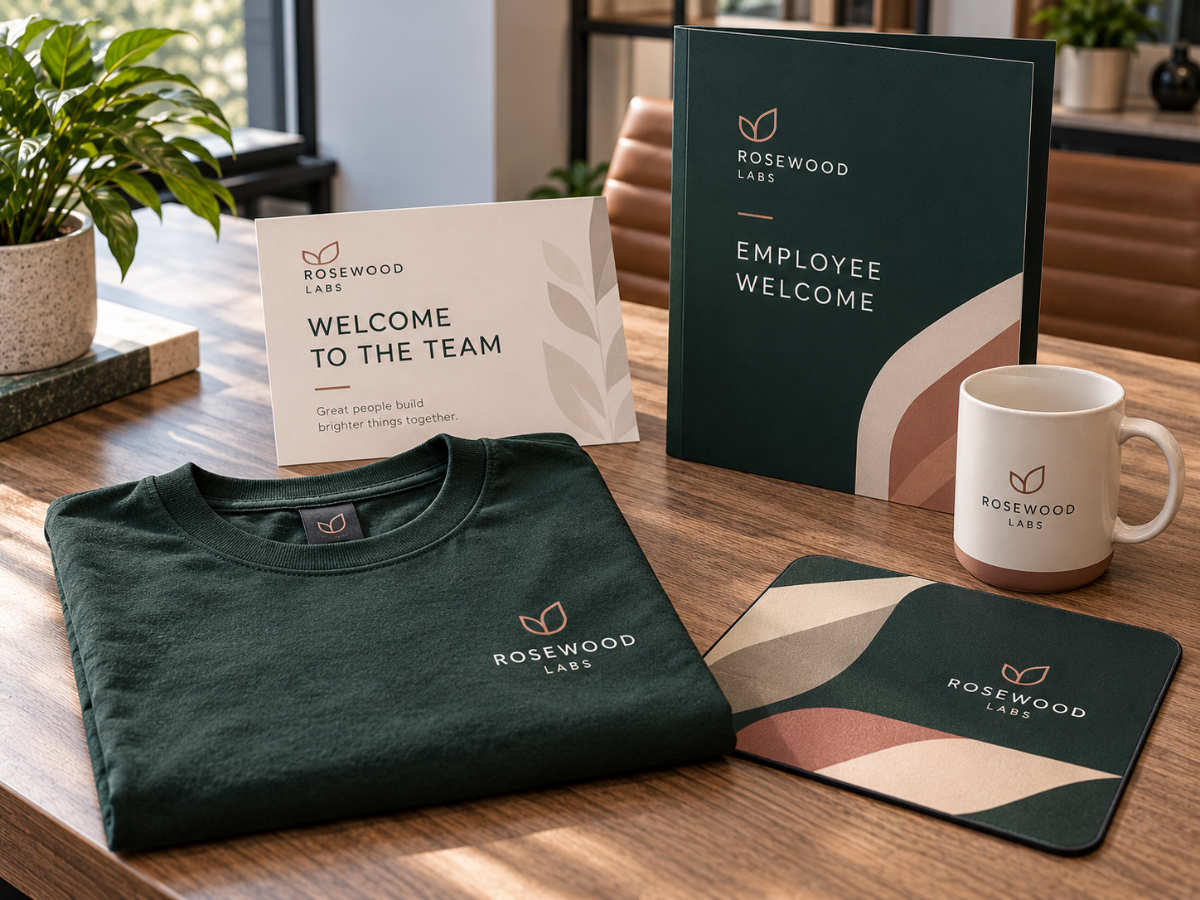
A useful employee welcome kit should help a new person feel prepared, not buried under branded merchandise. Start with the things they will actually use during the first weeks of work, then add one or two thoughtful branded items that fit the role and workplace.
Employee welcome kits are easy to overcomplicate.
A company decides it wants new hires to have a good first day.
Then the box starts filling up.
A shirt.
A mug.
A bottle.
A notebook.
A stack of company brochures.
A keychain.
Several cards.
Eventually the kit becomes more about proving the company has merchandise than helping the employee start work.
A better welcome kit is selective.
It combines practical onboarding information with a small number of branded items the employee has a realistic reason to use.
Pryntco’s current product range includes custom Apparel, Ceramic Mugs, Tumblers, Mouse Pads and printed stationery that can support a controlled onboarding kit.
1. What Is an Employee Welcome Kit?
An employee welcome kit is a group of materials provided to a new employee when they join the organization.
It may contain:
- Welcome message
- Branded apparel
- Useful desk or drinkware item
- Onboarding documents
- Quick-reference information
The kit should support the first days of work rather than function only as a gift box.
2. What Should the Welcome Kit Accomplish?
A good kit can help the employee understand:
- Who they joined
- What happens first
- What items belong to their role
- Where to find important resources
It can also give the employee one or two pieces of branded merchandise that feel genuinely useful.
3. Should Every Company Create a Large Welcome Box?
No.
A small business may only need:
- Welcome card
- Branded shirt
- Simple onboarding folder
A thoughtful three-piece kit can be stronger than a twelve-piece box filled with items the employee never uses.
4. What Should Be the First Item in the Kit?
A welcome card or short letter is a strong starting point.
It gives context to everything else.
The message can explain:
- Welcome to the team
- First-day schedule
- Main contact
- Where to begin
Keep the tone appropriate to the organization.
5. Should the Welcome Card Be Generic or Personal?
Personal is better when practical.
The printed card can carry the core company design while leaving room for:
- Employee name
- Short handwritten message
- Manager signature
Pryntco’s Greeting Card Guide includes employee recognition and welcome cards among business uses.
6. Should a Branded T-Shirt Be Included?
It can be one of the most useful welcome items when branded apparel is part of the workplace culture.
A T-shirt may be used for:
- Casual workdays
- Team events
- Company meetings
- Promotional events
Do not include one if employees have no practical reason to wear it.
7. Should the Shirt Match the Actual Staff Uniform?
Yes when the employee is expected to wear it at work.
Do not treat the welcome-kit shirt as unrelated merchandise if it is part of the uniform system.
Use the same approved:
- Garment
- Colour
- Logo
- Placement
8. Should a Hoodie or Crewneck Be Included Instead?
It can make sense for:
- Cooler workplaces
- Outdoor teams
- Casual company cultures
- Seasonal onboarding
The employee should receive the garment that fits their actual environment rather than the most expensive-looking piece.
9. Should Employees Be Asked for Their Size Before the Kit Is Prepared?
Yes.
Do not guess.
Collect the preferred size for the exact garment being ordered.
If several approved fits are available, let the employee select the appropriate option before the kit is assembled.
10. Should the Kit Include a Polo?
A polo can make more sense than a T-shirt for customer-facing staff or organizations with a more structured uniform.
The welcome kit should reflect the actual dress expectations of the role.
11. Does a Mug Make Sense?
Yes when employees regularly use:
- Office kitchen
- Break room
- Desk beverage
Pryntco’s current Ceramic Mugs support custom full-colour branding and can work as practical employee items rather than one-time promotional giveaways.
12. When Is a Tumbler Better Than a Mug?
A tumbler may fit employees who:
- Commute
- Travel between locations
- Work in vehicles
- Move around a large workplace
The role should decide.
13. Should a Water Bottle Be Included?
It can make sense when the employee spends significant time:
- On site
- Outdoors
- Travelling
- Moving between work areas
Pryntco currently carries a custom stainless-steel bottle for branded promotional use.
14. Is a Mouse Pad a Useful Welcome Item?
For desk-based staff, yes.
A branded mouse pad is useful when the employee actually works at a desktop workstation.
It may be less relevant for someone working entirely in the field.
This is a good example of choosing by role rather than by product availability.
15. Should the Kit Include a Business Card?
Only when the employee genuinely needs one.
Business cards make sense for:
- Sales staff
- Consultants
- Managers
- Client-facing professionals
- Business-development roles
Not every employee needs a box of cards on day one.
16. When Should Business Cards Be Ordered?
After the employee’s:
- Name
- Title
- Phone
- Location
are confirmed.
Do not print temporary information simply to complete the welcome kit before the first day.
17. Should the Kit Include an Onboarding Folder?
A folder can be useful when the employee receives several documents together.
It may organize:
- Welcome letter
- Role overview
- Training schedule
- Reference sheets
Keep sensitive HR documents within the organization’s approved process.
18. Should Employee Policies Be Printed Inside the Kit?
Only when the company intentionally uses physical copies.
Policies change.
A digital employee portal may be better for:
- Current handbook
- Benefits information
- Forms
- Policy updates
Print should not create outdated official information.
19. What Information Works Well on a Quick-Reference Card?
A simple card can contain stable information such as:
- Main office phone
- Internal help contact
- Building address
- Important public website
Do not print passwords, private access codes or sensitive security information on branded take-home cards.
20. Should the Welcome Kit Include a Company Brochure?
Only if it helps the employee understand the company.
A concise brochure can be useful for:
- Sales staff
- New customer-service employees
- Multi-service organizations
Do not add outdated marketing brochures simply because they are already in storage.
21. Should the Kit Include the Company’s Values?
It can, but keep them practical.
A small welcome card or onboarding sheet can explain the organization’s principles more naturally than a giant decorative poster inside the box.
The values should match the actual workplace culture.
22. How Much Branding Should Be on Each Item?
Less than many companies assume.
A mug does not need:
- Logo
- Website
- Phone
- Slogan
- Service list
A simple logo or restrained brand mark is usually enough.
23. Should Every Item Use the Exact Same Artwork?
No.
Use one brand system while adapting the artwork to the object.
For example:
- Shirt → small chest logo
- Mug → logo with controlled wrap
- Welcome card → warmer full layout
- Mouse pad → subtle pattern or larger graphic
24. Should an Employee Kit Feel Like Customer Merchandise?
Not necessarily.
Internal items can be more restrained and practical.
An employee should not feel like they have received a box of customer giveaways left over from a trade show.
25. Should Different Departments Receive Different Kits?
They can when the roles are genuinely different.
For example:
- Office employee → mug and mouse pad
- Field employee → shirt and bottle
- Sales employee → apparel and business cards
Keep the underlying brand consistent.
26. Should Remote Employees Receive a Welcome Kit?
They can, particularly when the kit helps create a physical connection to the company.
Choose compact items that ship reasonably and do not require unnecessary office-specific material.
Confirm the delivery address through the company’s approved onboarding process.
27. How Should New-Hire Addresses Be Handled?
Use personal shipping information only for the legitimate fulfilment purpose.
Limit access to the people who need it and follow the company’s privacy procedures.
Do not print an employee’s personal address onto general kit materials.
28. Should the Kit Include Safety or Compliance Information?
Only through the organization’s approved training and documentation process.
Do not replace required safety, legal or compliance training with a simplified promotional card.
The welcome kit can direct the employee to the proper resource.
29. When Should the Welcome Kit Be Given?
Common options include:
- Before the first day
- At the workstation
- During orientation
- After initial training
The best time is when the items actually help the employee begin the role.
30. Should Everything Be Packed in a Custom Box?
Not necessarily.
A plain shipping or presentation box can work when the contents already carry the brand.
Do not spend most of the budget decorating a box that is discarded immediately if the employee would benefit more from a better garment or useful item.
31. How Should Welcome-Kit Quantity Be Planned?
Base inventory on realistic hiring.
Keep evergreen items such as:
- Mugs
- Mouse pads
- Generic welcome cards
separate from employee-specific pieces such as apparel sizes and business cards.
32. Should Apparel Be Pre-Stocked?
A small controlled stock may be useful for frequently used sizes, but excessive inventory can create waste if:
- Branding changes
- Garments change
- Size demand differs from expectations
Collect actual employee sizes whenever possible.
33. How Should Reorders Stay Consistent?
Record:
- Product
- Colour
- Artwork
- Size or dimensions
- Approved vendor file
A welcome kit should not look completely different every three months because nobody recorded the original items.
34. Should the Kit Change Over Time?
Yes when the workplace changes.
Review whether employees actually use the items.
If every new hire leaves the same branded product untouched at their desk, replace it with something more useful.
35. How Should the Kit Be Tested?
Assemble one complete sample.
Check:
- Does everything fit?
- Does the kit feel excessive?
- Are instructions current?
- Does apparel sizing make sense?
- Does each item have a reason to be there?
36. What Are the Most Common Employee Welcome-Kit Mistakes?
Common problems include:
- Including too much branded merchandise.
- Guessing apparel sizes.
- Printing temporary employee details too early.
- Giving desk products to field staff.
- Including outdated onboarding documents.
- Putting confidential information on general printed cards.
37. What Should Be Left Out of a Welcome Kit?
Leave out items that:
- The employee has no realistic use for
- Contain obsolete information
- Duplicate digital systems
- Expose private information
- Exist only because the company already bought them
The kit should feel considered, not cleared from a storage room.
38. What Should Go in an Employee Welcome Kit?
Start with a welcome message.
Then add the items the employee will genuinely use.
For a typical office employee, that might be a branded shirt, mug or tumbler, mouse pad and a simple onboarding folder.
For a field employee, a shirt or hoodie and bottle may be more relevant than desk merchandise.
For sales or professional staff, business cards can be added once the personal information is confirmed.
Keep official policies and changing information in the company’s current system rather than filling the box with documents that may become outdated.
Most importantly, do not measure the quality of the welcome kit by the number of items inside it.
A useful shirt, thoughtful card and one practical product can create a better first impression than a box of ten items nobody asked for.
Businesses can explore current branded options through Pryntco’s Apparel, Ceramic Mugs, Tumblers and Mouse Pads.
For a coordinated employee onboarding kit, contact Pryntco or submit a custom quote request.

