
What Should an Ecommerce Brand Print Beyond the Shipping Box?
What Should an Ecommerce Brand Print Beyond the Shipping Box?
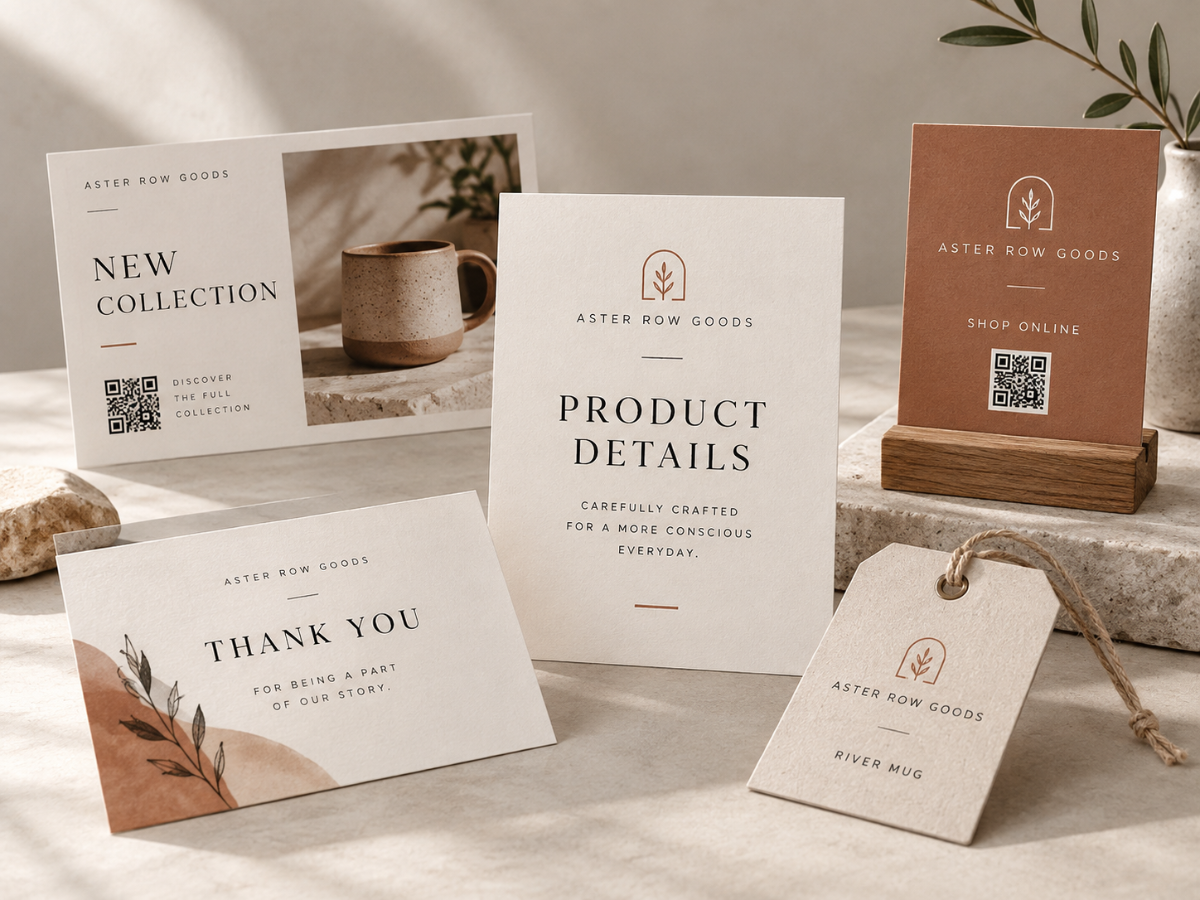
An ecommerce brand is not limited to what fits inside the parcel. Print can support the product before the sale, at pop-ups and wholesale meetings, during fulfilment and long after the order arrives. The useful pieces are the ones that connect a physical customer moment back to the brand clearly.
Ecommerce businesses often think about print almost entirely in terms of packaging.
Boxes.
Labels.
Thank-you cards.
Product-care inserts.
Those pieces matter, and Pryntco already has a dedicated Ecommerce Packaging Inserts Guide covering what belongs inside an order.
But an ecommerce brand may have many other physical touchpoints.
It might attend a pop-up market.
It might sell wholesale to retailers.
It might send samples to a buyer.
It might include printed information with a product launch, run a local event or create a referral card that continues working after the box has been recycled.
This guide looks at those broader opportunities.
1. What Print Does an Ecommerce Brand Need Beyond Packaging?
Depending on the business, useful pieces may include:
- Product information cards
- Hang tags
- Postcards
- Thank-you cards
- Review cards
- Referral cards
- Gift certificates
- Pop-up signage
- Wholesale sales materials
The business does not need all of them.
Choose print around actual physical customer moments.
2. Why Should an Online Brand Care About Offline Print?
Because the physical product creates moments the website cannot control by itself.
A customer may:
- Open a parcel
- Give the product as a gift
- See the brand at an event
- Pick up a product in a store
- Receive a sample
Print helps connect those physical moments back to the online brand.
3. Is a Packaging Insert Enough?
Sometimes.
A business that sells only online and has no retail, wholesale or event activity may need very little outside the package.
But as the brand grows, other print can support different channels without turning the shipping box into a stack of cards.
4. What Is the Difference Between a Package Insert and a Product Card?
A package insert describes where the piece is used.
A product information card describes what it does.
A product card may explain:
- Product name
- Key details
- Basic use
- Care
- Support
Pryntco’s Product Information Card Guide covers that function in detail.
5. When Does an Ecommerce Product Need a Hang Tag?
A hang tag makes sense when information needs to remain physically attached to the product rather than sitting loose in the package.
It may carry:
- Brand
- Product name
- Size
- Approved care information
- QR code
This can be particularly relevant to apparel, accessories and selected retail goods.
6. Should a Hang Tag Try to Tell the Whole Brand Story?
No.
A small tag needs a clear hierarchy.
The customer should first understand the product and brand.
A longer story can live on the website, product page or another larger printed piece.
7. When Does an Ecommerce Brand Need Labels or Stickers?
Labels and stickers can support:
- Product identity
- Packaging branding
- Variant identification
- Sealing
- Promotional branding
The material and adhesive should be selected for the actual surface and purpose.
8. Should Stickers Be Included as Freebies?
Only when the audience is likely to use them.
A sticker can work well for brands with:
- Strong visual identity
- Community following
- Lifestyle merchandise
Do not add one to every package simply because stickers are inexpensive.
9. When Is a Thank-You Card Worth Printing?
A thank-you card is useful when the business wants to acknowledge the purchase directly.
The first message should be appreciation.
Pryntco’s Thank-You Card Guide recommends keeping promotional actions secondary to the thank-you itself.
10. Should Every Order Receive the Same Thank-You Card?
Not necessarily.
A brand may have different cards for:
- First purchase
- Gift order
- Wholesale order
- VIP customer
Only create multiple versions if fulfilment can manage them reliably.
11. When Does an Ecommerce Brand Need a Care Card?
Use a care card when the customer genuinely needs help maintaining the product.
Examples may include:
- Apparel
- Jewellery
- Home décor
- Specialty goods
The manufacturer or responsible business should supply the actual care instructions.
12. Should Care Instructions Be Printed or Kept Online?
Use print for the information customers need immediately.
Move longer guidance online when the printed card would otherwise become difficult to read.
A clearly labelled QR code can connect the customer to a complete care page.
13. When Does a Product Need a Warranty or Registration Card?
Only when the business has a real warranty, registration or support process.
The card may help customers retain:
- Product identity
- Model
- Serial number
- Support destination
Never invent warranty terms to fill the design.
14. Should Ecommerce Brands Use Review Cards?
They can.
A review card is strongest when it has one neutral request and one clear QR destination.
For example:
WE’D VALUE YOUR FEEDBACK
Do not ask specifically for a positive rating.
15. Should a Review Request Be Combined With a Discount?
Be careful.
Review-platform rules can restrict incentives tied to reviews.
Keep customer appreciation offers separate from attempts to influence the rating or sentiment of a review.
16. When Should an Ecommerce Brand Use Referral Cards?
Referral cards make sense when the business has an actual referral program.
The card can explain:
- How referral works
- Referral code
- QR destination
- Any approved genuine benefit
Keep the program easy to understand.
17. Should a Referral Card Go in Every Order?
Not automatically.
It may be most relevant to:
- Repeat customers
- High-satisfaction products
- Community-driven brands
Test whether the card actually gets used before treating it as permanent package inventory.
18. When Should Ecommerce Brands Use Loyalty Cards?
Physical loyalty cards work best when there is a simple repeat-purchase system that customers can understand without needing a complicated account structure.
For many ecommerce businesses, a digital loyalty account may be easier.
Use print when it genuinely improves the program.
19. Can Ecommerce Brands Sell Printed Gift Certificates?
Yes when the business has a defined gift-certificate program.
A printed certificate can be useful for:
- Holiday gifting
- Events
- Corporate gifts
- Local pop-ups
The business should define redemption rules before the card is designed.
20. Should Online Brands Use Postcards?
They can be surprisingly useful because a postcard is not limited to direct mail.
It can support:
- New collection launch
- Event invitation
- Wholesale sample package
- Customer reactivation
- Local campaign
Keep the postcard focused on one reason to respond.
21. Can a Postcard Announce a New Product Drop?
Yes.
A simple launch postcard may include:
- Collection name
- Hero product image
- Launch date
- QR code
Do not fill it with the complete catalogue.
22. Should Ecommerce Brands Use Direct Mail?
They can when the business has an appropriate customer or prospect list and a clear campaign.
Possible uses include:
- Reactivation
- Product launch
- Seasonal campaign
- Customer appreciation
Mailing should be planned around real customer permission, list quality and applicable requirements.
23. What Print Does an Ecommerce Brand Need at a Pop-Up?
A simple pop-up setup may use:
- Table cover
- Small product signs
- Postcards
- Business cards
- One larger branded display
Do not turn a temporary booth into a wall of competing signs.
24. What Should a Pop-Up Sign Communicate?
From several steps away, customers need to know:
- Brand name
- What is sold
- Why they should stop
Detailed product information can remain closer to the merchandise.
25. Should a QR Code Be Used at a Pop-Up?
Yes when it provides a useful digital bridge.
It may lead to:
- Online store
- Product collection
- Email signup
- Event-specific page
Label the destination.
26. What Print Does an Ecommerce Brand Need for Wholesale?
Wholesale creates a different audience from the end customer.
A buyer may need:
- Brand overview
- Product line card
- Product sheets
- Ordering information
- Contact card
Keep retail-customer messaging separate from buyer information.
27. Should Wholesale Materials Use a Presentation Folder?
A folder can be useful when the buyer receives several separate documents.
It allows price sheets, product pages and brand information to be updated independently.
This is often more practical than reprinting one large catalogue whenever something changes.
28. When Does an Ecommerce Brand Need a Printed Catalogue?
A catalogue can make sense for:
- Wholesale buyers
- Trade shows
- Large collections
- Seasonal lines
It makes less sense when inventory, pricing or products change so rapidly that the catalogue becomes outdated almost immediately.
29. Should Prices Be Printed in Wholesale Materials?
Only when the pricing is stable and appropriate for the audience.
A separate price sheet is often easier to update than printing prices into a long-lived brand brochure or folder.
30. How Should Ecommerce Brands Use Business Cards?
They are still useful when the online business enters physical situations such as:
- Trade shows
- Wholesale meetings
- Pop-ups
- Partnership meetings
The card can connect an in-person conversation back to the digital business.
31. Should an Ecommerce Brand Print Return Instructions?
Only when a printed version improves the customer experience.
Because policies and procedures can change, a QR code or short URL to the current return process may be safer than printing several detailed policy paragraphs.
Any legal or policy wording should come from the business.
32. What Should Stay Printed and What Should Stay Online?
Print stable information.
Keep highly changeable information online.
For example:
| Better in Print | Often Better Online |
|---|---|
| Brand identity | Current inventory |
| Short care summary | Detailed changing instructions |
| Thank-you message | Current return policy |
33. How Should Print Match the Ecommerce Website?
The physical materials should feel like the same brand.
Coordinate:
- Logo
- Typography
- Colour palette
- Photography style
- Tone
The customer should not feel as though the package came from a different company than the website.
34. Should Every Printed Piece Use the Same Design?
No.
Consistency is not identical duplication.
A wholesale line sheet, thank-you card and pop-up sign should all look related while still being designed for their specific jobs.
35. How Should Ecommerce Print Quantities Be Planned?
Start with the operational use.
For example:
- Package cards → expected orders
- Pop-up cards → event attendance
- Wholesale sheets → buyer meetings
- Launch postcards → campaign list
Avoid large quantities when the artwork contains temporary products, dates or offers.
36. What Should Be Checked Before Ecommerce Print Is Approved?
Verify:
- Logo
- Product names
- Current URLs
- QR codes
- Care or warranty information
- Offer dates
- Wholesale information
- Physical fit inside packaging where relevant
37. What Are the Most Common Ecommerce Print Mistakes?
Common problems include:
- Putting five promotional cards into every shipment.
- Using the same message for first-time and wholesale customers.
- Printing return or warranty information that becomes outdated.
- Adding QR codes without explaining the destination.
- Designing pop-up signs like web pages.
- Printing large quantities of launch-specific material.
- Making every physical touchpoint another discount advertisement.
38. What Should an Ecommerce Brand Print Beyond the Shipping Box?
Start by mapping the physical moments that happen outside the website.
For the product itself, decide whether it needs a hang tag, label or simple information card.
Inside the order, use only the insert the customer genuinely needs—thank-you, care, registration or another clear post-purchase action.
For pop-ups, markets and trade shows, create a small set of materials designed for physical distance: one strong brand display, simple product information and an easy way to return to the online store.
For wholesale, build a different sales package with product sheets, line information and contact details rather than sending retailers consumer-facing package cards.
For retention, postcards, review cards or referral pieces can be useful when each has a specific purpose.
The ecommerce brand does not need to become a traditional print-heavy company.
It simply needs to recognize that some customer relationships now extend beyond the screen.
Pryntco’s existing resources cover Ecommerce Packaging Inserts, Thank-You Cards, Product Information Cards and Review Cards.
For a coordinated ecommerce, pop-up or wholesale print project, contact Pryntco or submit a custom quote request.

