Digital vs Offset Printing: Which Printing Method Is Better for Your Project?
Digital vs Offset Printing: Which Printing Method Is Better for Your Project?
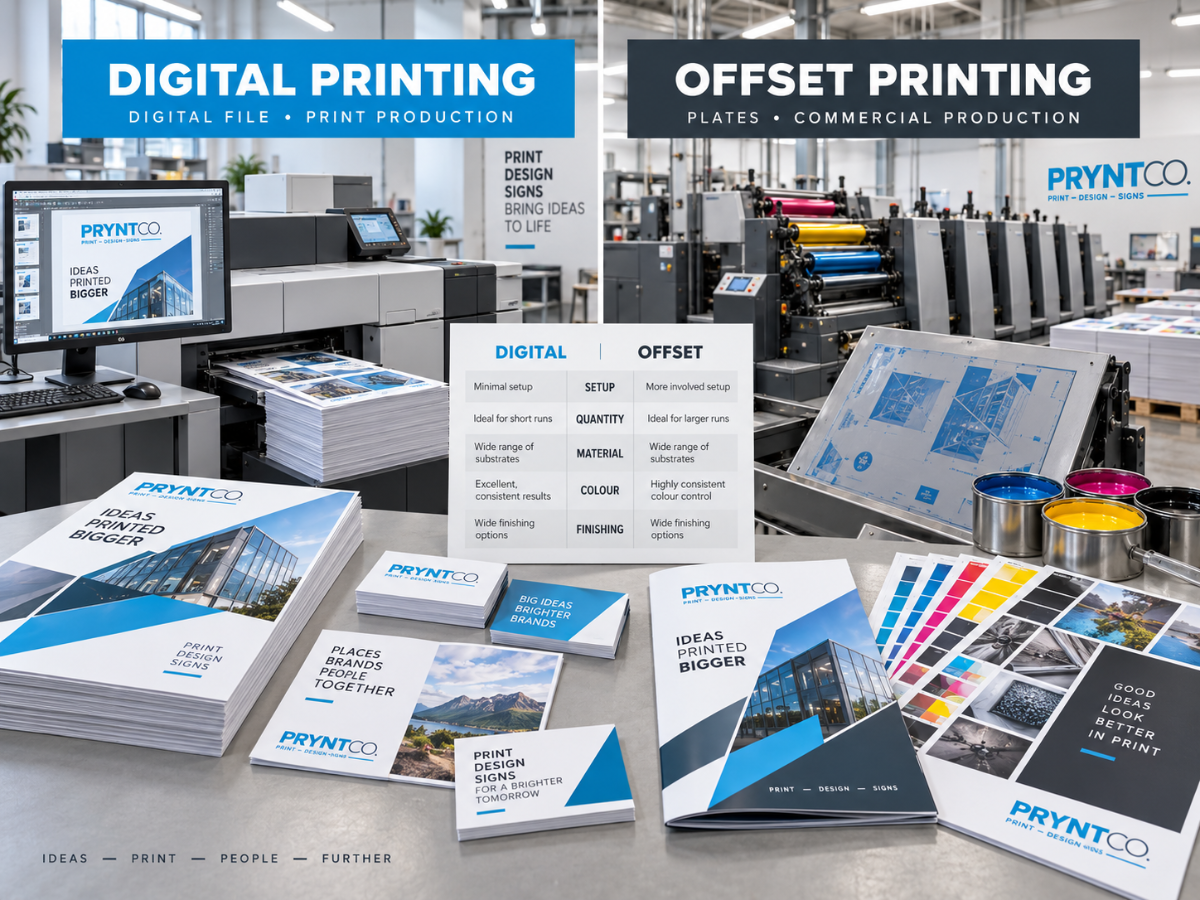
Digital and offset printing are not simply “good” and “better” versions of the same process. Each method has different setup, quantity, colour, material and production considerations. Pryntco selects the production method according to the product, quantity, material, turnaround and overall project requirements rather than expecting customers to choose a process in isolation.
Customers often ask whether digital printing or offset printing produces the better result.
The question sounds simple, but there is no universal winner.
A short run of marketing material may fit one production method efficiently. A larger repeat order may fit another. A product may only be compatible with a particular press, material or finishing workflow.
The decision can also depend on:
- Quantity
- Product
- Paper or material
- Colour requirements
- Turnaround
- Finishing
- Personalization
Pryntco’s current FAQ states that the company uses different printing methods depending on the product, quantity, material, turnaround time and project requirements. These methods may include digital, offset and large-format printing, with the most suitable production method selected for the order.
1. What Is Digital Printing?
Digital printing is a production method where artwork is sent from a digital file to compatible printing equipment without requiring the same traditional plate-making process used in offset printing.
This can make digital production well suited to many shorter or versioned print runs.
2. What Is Offset Printing?
Offset printing is a commercial printing method that commonly uses printing plates to transfer ink through an intermediate blanket before the image reaches the paper or other compatible substrate.
The method is widely used for commercial print production where its setup and run characteristics fit the project.
3. What Is Large-Format Printing?
Large-format printing is a separate production category used for oversized products such as:
- Banners
- Signs
- Window graphics
- Displays
Pryntco’s FAQ lists large-format printing alongside digital and offset methods because different products require different equipment and workflows.
4. What Is the Main Difference Between Digital and Offset Printing?
The main difference is how the image reaches the printed material and how much setup is required before production.
| Digital Printing | Offset Printing |
|---|---|
| Artwork moves through a digital production workflow | Traditional workflow commonly involves printing plates |
| Can reduce setup for suitable shorter runs | Setup may become efficient across suitable larger runs |
5. How Does Digital Printing Work?
At a high level:
- Artwork is prepared digitally.
- The production system interprets the file.
- The image is printed using the compatible digital process.
- The job moves to cutting, folding or other finishing where required.
The exact equipment and colourant system vary by product and press.
6. How Does Offset Printing Work?
In a conventional offset workflow:
- Artwork is prepared for production.
- Printing plates are created for the required image information.
- Ink is transferred through the press.
- The image is offset through a blanket before reaching the paper.
- The printed sheets move to finishing.
Specific press workflows vary, so customers do not normally need to engineer the production process themselves.
7. Why Does Setup Matter?
A production method with more physical setup can make less sense for an extremely short run while becoming more efficient when that setup is spread across a larger quantity.
This is one reason quantity influences the method selected.
8. Is Digital Printing Better for Small Quantities?
Digital production is often well suited to shorter runs because it can reduce some of the traditional setup associated with offset printing.
However, the correct method still depends on:
- Product
- Material
- Finish
- Equipment
Do not assume every small order is always produced digitally.
9. Is Offset Printing Better for Large Quantities?
Offset printing can become efficient for suitable larger runs because the initial setup is distributed across more pieces.
Again, there is no universal quantity where every job must switch methods.
Pryntco selects the production method according to the complete order.
10. Is There a Specific Quantity Where Offset Becomes Cheaper?
No universal threshold applies to every print job.
The break-even point depends on:
- Finished size
- Number of colours
- Paper
- Quantity
- Finishing
- Press configuration
Compare the actual quote rather than relying on a generic quantity from another product.
11. Is Digital Printing Faster?
Digital workflows can reduce certain setup stages, which may support faster production for suitable jobs.
But turnaround still depends on:
- Product
- Quantity
- Current production schedule
- Finishing
- Artwork approval
Do not assume “digital” automatically means same-day or next-day production.
12. Does Offset Printing Always Take Longer?
No.
Offset production can be efficient within scheduled commercial workflows, particularly for larger runs.
Actual turnaround depends on the complete production plan rather than the printing process alone.
13. Which Method Has Better Print Quality?
Both digital and offset printing can produce professional commercial results when the process is appropriate for the product.
Quality depends on:
- Press
- Artwork
- Paper
- Colour management
- Finish
- Production requirements
The process should be selected around the job rather than around the assumption that one method is automatically higher quality.
14. Does Digital Printing Look Different From Offset?
There can be visual differences depending on:
- Equipment
- Paper
- Ink or toner system
- Colour profile
- Finish
If a project must match a previous run closely, provide the earlier sample and discuss colour expectations before ordering.
15. Which Method Is Better for Colour?
Both methods can reproduce full-colour artwork professionally.
The more important question is whether the project has special colour requirements.
Pryntco recommends preparing print artwork in CMYK whenever possible.
16. Can RGB Files Be Printed Digitally?
RGB artwork can be submitted to Pryntco, but the FAQ notes that it may be converted to CMYK for production.
This conversion can change the appearance of some colours regardless of which compatible production method ultimately prints the job.
17. Does Offset Printing Use CMYK?
Full-colour offset printing commonly uses CMYK process inks, although offset printing can also support other ink configurations depending on the project and equipment.
Do not assume a special colour or spot-ink process is included unless it has been confirmed for the job.
18. What Are Spot Colours?
A spot colour is a specific ink formulation used separately from ordinary CMYK process combinations.
Spot-colour workflows can be useful for certain brand or specialty requirements.
Availability depends on the production method and project.
19. Does Offset Printing Handle Special Colours Better?
Traditional offset workflows can support dedicated spot inks on appropriate projects, but that does not mean every offset order includes spot colours.
If exact brand colour is critical, discuss the requirement before production.
20. Can Digital Printing Use Specialty Colours?
Some digital equipment can support specialty colour or enhancement capabilities, but availability varies significantly by press.
Do not assume a particular white, metallic or specialty colour is available unless Pryntco confirms it for the product.
21. Which Method Supports More Paper Types?
Compatibility depends on the specific equipment.
Paper characteristics that can influence production include:
- Thickness
- Coating
- Texture
- Sheet size
The printer should select a method that works with the chosen stock.
22. Does Paper Affect the Choice Between Digital and Offset?
Yes.
Not every press handles every paper equally.
The paper, product and finishing requirements all contribute to the final production decision.
23. Which Method Is Better for Business Cards?
Business cards can be produced through different workflows depending on:
- Quantity
- Stock
- Finish
- Turnaround
Customers normally choose the product configuration rather than needing to choose the press technology themselves.
24. Which Method Is Better for Flyers?
Flyers can also be produced through different production methods depending on quantity and product configuration.
Pryntco’s current Bulk Flyers, for example, are positioned around scheduled production runs for larger marketing quantities.
The production method is selected according to the job.
25. Which Method Is Better for Brochures?
Brochure production can depend on:
- Quantity
- Paper
- Fold
- Colour
- Finishing
The folding and finishing stages can be just as important as the printing method itself.
26. Which Method Is Better for Postcards?
Postcards can be suitable for different workflows depending on:
- Quantity
- Card stock
- Colour
- Coating
- Turnaround
Again, the printer should select the suitable process rather than expecting customers to guess.
27. Which Method Is Better for Books and Manuals?
Multi-page publications involve more than printing.
Production also needs to account for:
- Page count
- Interior stock
- Cover
- Binding
- Quantity
The complete publication workflow determines which printing process is appropriate.
28. Can Digital Printing Handle Variable Information?
Digital printing technology can support variable-data workflows where individual printed pieces contain different information.
Examples can include:
- Names
- Codes
- Versioned artwork
Do not assume Pryntco offers a specific variable-data configuration for every product; discuss the project before preparing personalized data.
29. Can Offset Printing Handle Personalized Pieces?
Traditional offset printing itself is designed around repeated plate-based image content.
Projects requiring personalization may use additional or combined workflows.
The appropriate method should be discussed with the printer rather than designed around assumptions.
30. Is Large-Format Printing Digital or Offset?
Many modern large-format systems use digital production technologies, but “large format” describes a category of printing equipment and products rather than simply being interchangeable with ordinary small-format digital printing.
Banners, signs and window graphics have different material and size requirements.
31. Does the Customer Need to Choose Digital or Offset?
Usually, the more useful customer decisions are:
- Product
- Size
- Quantity
- Paper or material
- Finish
- Turnaround
Pryntco’s FAQ states that its team selects the most suitable production method for the order.
32. Can the Same Artwork Be Used for Digital and Offset Printing?
A properly prepared print-ready file can often provide the basis for either workflow, but the printer may need to process the file according to the selected press and product.
Always prepare the artwork according to the product specifications rather than a generic printing-method assumption.
33. What Colour Mode Should the Artwork Use?
Pryntco recommends CMYK whenever possible for print artwork.
Pryntco’s CMYK vs RGB Guide explains why screen colours can change during print conversion.
34. What Image Resolution Should Be Used?
Pryntco generally recommends approximately 300 dpi at final printed size for many photographs and raster images.
Image resolution is an artwork-quality issue regardless of whether the suitable job is ultimately produced digitally or offset.
35. Do Digital and Offset Files Need Bleed?
Bleed depends on the product design and trimming requirements rather than simply on the printing method.
When artwork reaches the finished edge, follow the correct product template.
Pryntco’s Bleed, Trim and Safe Area Guide explains the concept in detail.
36. What Should You Ask Before Choosing a Printing Method?
Rather than asking only:
“Is this digital or offset?”
provide the printer with:
- Product
- Finished size
- Quantity
- Paper or material
- Colour requirements
- Finishing
- Deadline
- Whether pieces need personalization
Those details allow the production method to be chosen intelligently.
37. What Are the Most Common Digital vs Offset Printing Misconceptions?
Common misconceptions include:
- Digital printing is always lower quality.
- Offset printing is always better.
- Digital printing is always faster.
- Every large quantity must be offset.
- Every small quantity must be digital.
- The customer must choose the press.
- Artwork preparation no longer matters with digital printing.
- One universal quantity determines the cheapest method.
38. So, Should You Choose Digital or Offset Printing?
Choose the print product and specifications first.
The production method should follow the needs of the job.
Digital printing is often well suited to shorter runs, quick version changes and certain personalized workflows because it avoids some traditional plate-making setup.
Offset printing can become highly efficient for suitable larger commercial runs and supports established process-ink and specialty production workflows.
Neither method is automatically superior.
A 250-piece job and a 25,000-piece job may have very different production economics. A coated flyer, textured card, book interior and large-format banner may each need different equipment regardless of quantity.
Colour matters too, but not in the simplistic sense that one method has “better colour.” The paper, press, ink or toner system, colour management, finish and artwork all influence the result.
Pryntco’s current FAQ says the company uses digital, offset and large-format printing depending on the product, quantity, material, turnaround and project requirements and selects the most suitable production method for the order.
That means customers can focus on defining what they need rather than trying to act as production engineers.
Prepare the artwork correctly, choose the product, quantity and finish, explain any colour or personalization requirements and let the printer determine the most appropriate workflow.
For broader artwork preparation, review Pryntco’s How to Prepare Artwork for Professional Printing.
For a custom project where the production method or specifications need to be discussed, use Pryntco’s custom quote request or contact Pryntco.