Customer Reactivation Direct Mail: How to Bring Past Customers Back With Postcards, Offers and QR Codes
Customer Reactivation Direct Mail: How to Bring Past Customers Back With Postcards, Offers and QR Codes
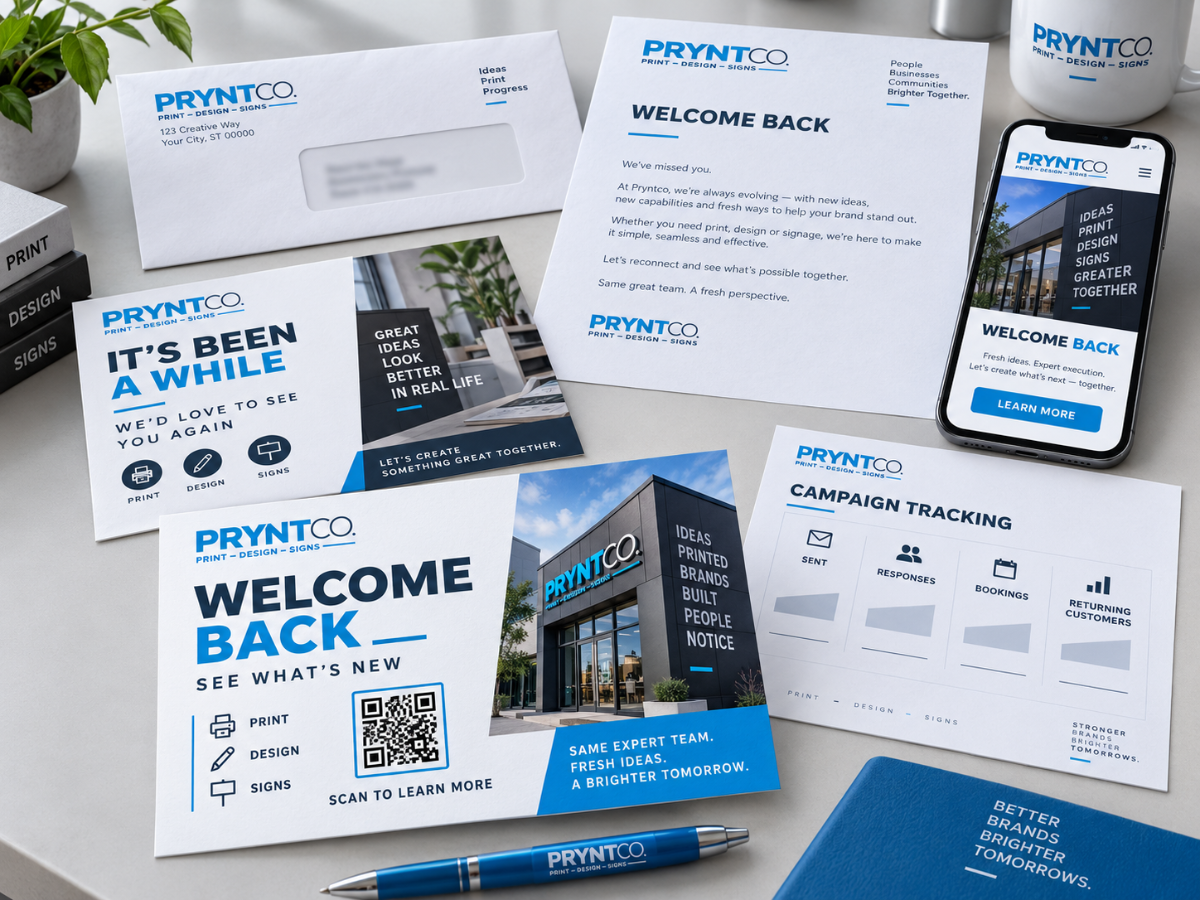
A customer reactivation campaign should give past customers a relevant reason to return without pretending the relationship is more recent than it is. Start with clean customer data, choose one reason to reconnect and build a measurable response path so the business can distinguish real returning customers from general campaign activity.
Businesses spend a great deal of marketing effort trying to reach people who have never purchased from them.
Meanwhile, thousands of previous customers may already know the company, understand the product or service and simply have not returned recently.
Some no longer need the service.
Others may have:
- Forgotten the business
- Delayed a repeat purchase
- Changed buying habits
- Never received another reason to come back
A customer reactivation direct mail campaign is designed specifically for these inactive or lapsed customers.
Instead of sending a generic prospecting postcard, the business uses the previous relationship as the starting point.
Pryntco currently offers postcard artwork in 4" × 6" and 5" × 7" formats and custom printed envelopes for business correspondence and direct-mail applications. These formats can support customer win-back campaigns where a physical reminder is useful.
1. What Is Customer Reactivation Marketing?
Customer reactivation marketing targets people or businesses that purchased previously but have not returned within the period the company normally expects.
The objective is to restart the relationship.
2. What Is a Lapsed Customer?
A lapsed customer is a previous customer who has become inactive.
The definition depends on the business.
For example:
- A restaurant may notice inactivity relatively quickly.
- A dental office may have a longer normal cycle.
- A contractor may naturally work with customers only occasionally.
Use the company’s normal buying cycle rather than one arbitrary inactivity period.
3. Why Use Direct Mail for Customer Reactivation?
Direct mail provides a physical reminder outside email and social media.
It can deliver:
- Personal message
- Offer
- QR code
- Service reminder
- New product announcement
The success of the campaign depends heavily on the quality of the customer list and message.
4. Which Customers Should Receive a Reactivation Campaign?
Start with a defined customer segment.
Examples include:
- No purchase within the normal repeat period
- Past high-value customers
- Previous seasonal customers
- Customers who used one service but not another relevant service
The business should use customer information lawfully and appropriately.
5. Should Every Past Customer Be Mailed?
No.
Remove or review records that are:
- Duplicated
- Outdated
- Invalid
- Known to be inappropriate for marketing
A smaller clean list can be more useful than a much larger inaccurate one.
6. How Long Should a Customer Be Inactive?
There is no universal number.
Ask how often an active customer normally buys or books.
Then define inactivity relative to that cycle.
7. What Should a Reactivation Postcard Say?
A useful structure is:
- Recognize the existing relationship.
- Explain why the business is reaching out.
- Give a relevant reason to return.
- Provide one clear next action.
Keep the message warm but concise.
8. Is “We Miss You” a Good Headline?
It can work for friendly consumer brands.
Other options include:
- WELCOME BACK
- IT’S BEEN A WHILE
- SEE WHAT’S NEW
- READY WHEN YOU ARE
The wording should sound natural for the brand.
9. Should a Reactivation Campaign Include an Offer?
An offer can create a specific reason to return.
Possible offers include:
- Discount
- Bonus
- Upgrade
- Consultation
- Seasonal promotion
Only print promotions the business is prepared to honour.
10. Does Every Win-Back Campaign Need a Discount?
No.
A customer may return because the business has:
- New product
- New service
- New location
- Seasonal availability
- Updated experience
Discounting should be intentional rather than automatic.
11. What Is a Win-Back Offer?
A win-back offer is a promotion intended specifically to encourage an inactive customer to return.
It should have:
- Clear value
- Clear conditions
- Clear redemption method
12. Should the Offer Have an Expiry Date?
It can when there is a genuine end date.
An expiry creates urgency but also makes leftover print unusable after that date.
Proof the date carefully before production.
13. Should Reactivation Mail Be Personalized?
Personalization can make a campaign feel more relevant when the data is accurate.
Possible personalization includes:
- Customer name
- Business name
- Location
Do not use personal information unnecessarily.
14. Should You Mention a Previous Purchase?
Only when it is useful, appropriate and accurate.
For example, a business might reference a broad service category.
Avoid placing sensitive purchasing history on an exposed postcard.
15. Postcard vs Letter for Reactivation: Which Is Better?
| Postcard | Letter |
|---|---|
| Message visible immediately | More room for explanation |
| Useful for concise offers | Useful for personal or higher-value communication |
16. When Should You Use a Branded Envelope?
A branded envelope can work when:
- The message needs privacy.
- The campaign includes a personalized letter.
- Several materials are included.
- The relationship is more formal.
Pryntco’s Custom Envelope Printing Guide covers business-mail design in more detail.
17. What Postcard Sizes Can Pryntco Support?
Pryntco’s current postcard artwork supports:
- 4" × 6"
- 5" × 7"
Use the format that gives the campaign enough space without overcrowding the message.
18. What Should Go on the Front of a Reactivation Postcard?
The front should communicate the reason to pay attention.
Possible elements include:
- WELCOME BACK
- Main benefit
- Relevant photograph
- Short offer
19. What Should Go on the Back?
The back can include:
- Short explanation
- Offer conditions
- Contact information
- QR code
- Website
Leave appropriate space for the mailing method.
20. Should Customer Reactivation Mail Include a QR Code?
Yes when the QR code connects directly to the next step.
Possible destinations include:
- Booking page
- Offer landing page
- Quote request
- Product page
- Location information
21. Should the QR Code Go to the Homepage?
Usually, a campaign-specific destination is stronger.
If the postcard says:
SEE WHAT’S NEW
the QR code should take the customer directly to the relevant new information rather than forcing them to search the website.
22. How Should the QR Code Be Labelled?
Tell customers what happens after scanning.
Examples include:
- SCAN TO BOOK
- SCAN TO VIEW THE OFFER
- SCAN TO SEE WHAT’S NEW
23. Can Promo Codes Track Customer Reactivation?
Yes.
A unique campaign code can help identify purchases or bookings connected with the mailing.
Keep the code short and easy to enter.
24. Should Different Customer Groups Use Different Codes?
They can when the business wants to compare campaign segments.
For example:
- PAST RETAIL CUSTOMERS
- PAST SERVICE CUSTOMERS
- VIP CUSTOMERS
Only create separate tracking where the business can realistically analyze the results.
25. Can Phone Calls Be Tracked?
Yes.
Businesses can use:
- Campaign-specific extensions
- Staff lead-source questions
- CRM campaign fields
Choose the method before the mailing begins.
26. How Should a Reactivation Campaign Be Measured?
Useful metrics include:
- QR scans
- Landing-page visits
- Calls
- Bookings
- Promo-code redemptions
- Repeat purchases
27. What Is the Most Important Reactivation Metric?
The most useful metric is usually the final business outcome.
For example:
- Customer returned
- Appointment booked
- Purchase completed
- Quote requested
A QR scan alone does not necessarily represent a successful reactivation.
28. Should You Send More Than One Reactivation Mailing?
A sequence can work when each mailing remains relevant.
For example:
- Reconnect
- Show what is new
- Send final seasonal reminder
Do not repeatedly send the same card without learning from previous results.
29. Should the Second Mailing Look Different?
It can remain visually connected while changing the message.
Keep:
- Brand colours
- Logo
- Typography
while changing the headline or call to action.
30. How Should a Customer List Be Cleaned?
Review for:
- Duplicate records
- Returned addresses
- Incomplete addresses
- Former companies
- Records that should not be contacted
List quality directly affects print efficiency.
31. Should Reactivation Campaigns Be Segmented by Location?
Yes when:
- Different branches serve different customers.
- Offers vary by location.
- Contact information changes.
Use the correct location information on each version.
32. Should High-Value Customers Receive a Different Version?
Potentially.
High-value or long-term customers may justify:
- More personalized letter
- Different offer
- Higher-touch follow-up
The campaign should reflect the real customer relationship.
33. Should Direct Mail Match Email and Digital Advertising?
Yes.
Coordinate:
- Headline
- Offer
- Landing page
- Branding
- Timing
The customer should encounter one consistent reactivation message across channels.
34. How Many Reactivation Postcards Should Be Printed?
Use the cleaned customer list as the starting quantity.
Calculate:
- Eligible inactive customers
- Duplicates removed
- Invalid addresses removed
- Small reserve if required
Do not order around a rough database total without reviewing it first.
35. How Should Reactivation Artwork Be Prepared?
Before production:
- Use the correct final dimensions.
- Extend backgrounds into bleed.
- Keep important information inside safe areas.
- Use high-resolution images.
- Prepare CMYK colour where appropriate.
- Leave mailing space.
- Test QR codes.
- Confirm offer dates and conditions.
Pryntco’s Artwork Preparation Guide covers general print-file setup.
36. What Should Be Proofed Before Mailing?
Check:
- Customer segment
- Business name
- Location
- Offer
- Expiry date where applicable
- Promo code
- Phone number
- QR destination
Test the complete customer journey before printing.
37. What Are the Most Common Customer Reactivation Direct Mail Mistakes?
Common mistakes include:
- Mailing the complete customer database without segmentation.
- Using outdated addresses.
- Sending a generic message with no reason to return.
- Using incorrect personalization.
- Exposing unnecessary purchase information.
- Using a QR code without tracking.
- Failing to measure actual returning customers.
- Printing before the offer is approved.
38. How Should a Business Run a Customer Reactivation Direct Mail Campaign?
Start by defining what an inactive customer means for the business.
Do not use one universal timeframe. A customer buying weekly behaves differently from a customer using a professional service once every year or two.
Clean the list before printing. Remove duplicates, invalid addresses and records that should not be included in marketing.
Choose one reason to reconnect. That reason may be a new service, new location, seasonal need, updated product or genuine offer.
Select the format according to the message. Pryntco’s current postcard artwork supports 4" × 6" and 5" × 7" layouts. A postcard works well for a concise visible message, while a letter inside a custom envelope provides more room and privacy.
Create one clear response path. Send the QR code to a relevant landing page, provide a campaign code or use another trackable method.
Measure the outcome that matters. The campaign is not successful simply because people scanned a code. Look at bookings, repeat purchases, quotes or whatever business action the campaign was designed to create.
Use the results to improve the next customer segment, offer and mailing rather than simply repeating the same campaign.
For the broader fundamentals of campaign planning, review Pryntco’s Direct Mail Marketing Guide.
For custom direct-mail printing, use Pryntco’s custom quote request or contact Pryntco.