
Cotton, CVC or Triblend? Choosing a T-Shirt That Fits Your Team
Cotton, CVC or Triblend? Choosing a T-Shirt That Fits Your Team
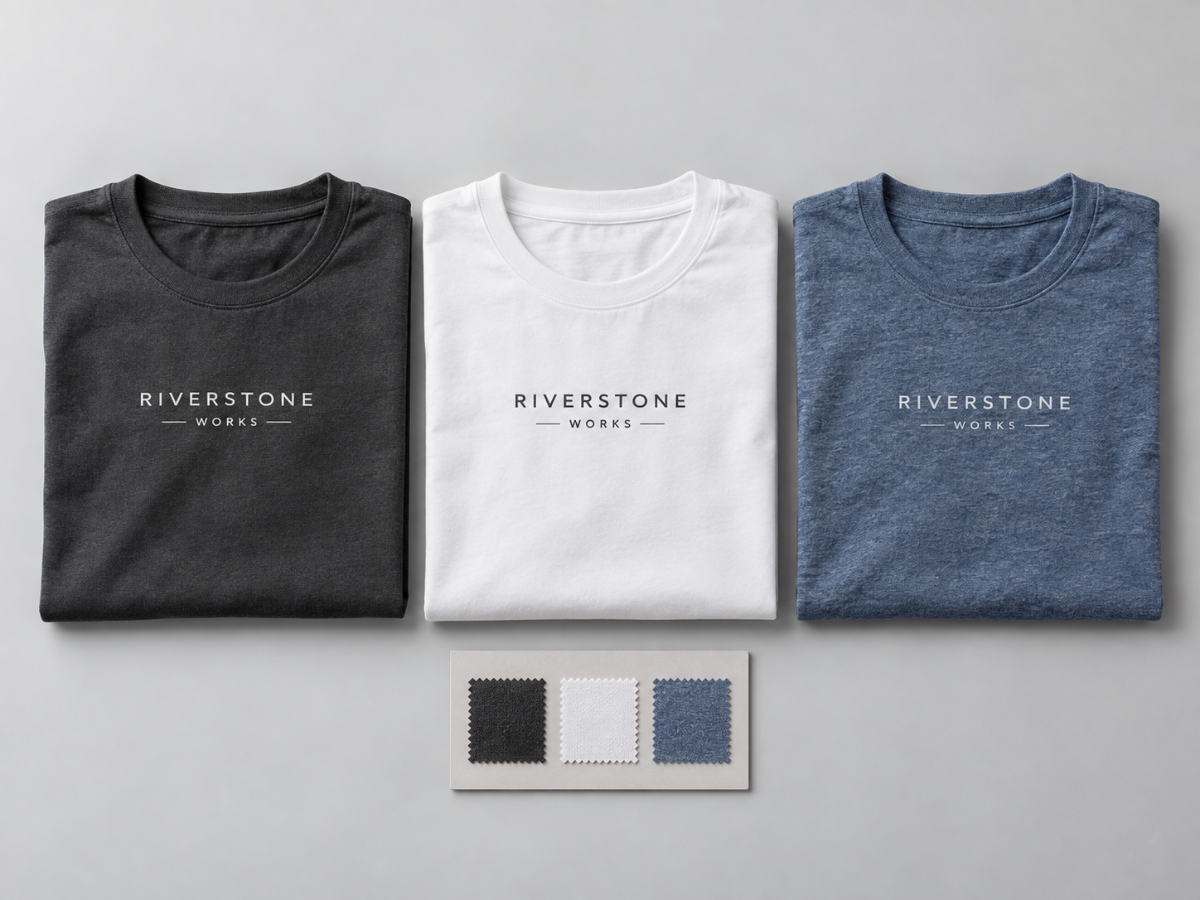
The right branded T-shirt is not just about the logo. Fabric blend affects how the shirt feels, hangs, layers and fits into everyday work, event or merchandise use. Start with how people will wear the shirt, then choose the fabric that supports that job.
Businesses ordering custom T-shirts often spend most of their time thinking about the logo, colour and quantity.
The shirt itself gets treated like a blank surface.
But two shirts with similar colours and similar artwork can feel very different once someone actually wears them.
A straightforward cotton tee can give a familiar everyday feel. A CVC shirt combines cotton with another fibre to create a blended garment. A triblend introduces a third fibre and often creates a lighter, softer presentation.
Pryntco’s current apparel catalogue includes cotton, CVC, triblend and sueded T-shirt styles across men’s, women’s and unisex categories, which gives businesses several different starting points rather than one generic company shirt.
The useful question is not:
“Which fabric is best?”
It is:
“Which shirt makes the most sense for the people who will actually wear it?”
1. What Is a Cotton T-Shirt?
A cotton T-shirt uses cotton as the main garment fibre and creates the familiar feel many people associate with a standard tee.
It can be a practical option for:
- Staff shirts
- Event crews
- Teams
- Promotions
- Branded merchandise
The exact feel still depends on the individual garment rather than the word “cotton” alone.
2. What Is a CVC T-Shirt?
CVC refers to a cotton-rich blended fabric rather than a single-fibre shirt.
The blend changes the feel and drape compared with a conventional cotton tee.
Pryntco’s current men’s T-shirt catalogue includes CVC styles alongside cotton and triblend options.
3. What Is a Triblend T-Shirt?
A triblend combines three fibres in one fabric.
Triblend garments are commonly chosen when a business wants a softer, lighter-feeling shirt for:
- Staff apparel
- Event crews
- Team orders
- Retail-style merchandise
Pryntco currently carries several triblend T-shirt styles within its apparel catalogue.
4. Why Does T-Shirt Fabric Matter for Branded Apparel?
Because the shirt has to work after the artwork is printed.
Fabric influences how the garment:
- Feels against the body
- Drapes
- Layers
- Fits into a uniform
- Feels as merchandise
If employees dislike the shirt, excellent artwork will not make them want to wear it.
5. Which Fabric Feels the Most Familiar?
A conventional cotton T-shirt usually gives the most familiar classic-tee experience.
That can be a strength.
For staff uniforms, community events and straightforward company shirts, familiarity can be more valuable than choosing a garment simply because the fabric description sounds more premium.
6. Which Fabric Feels Softer or Lighter?
Many CVC and triblend styles are designed around a softer or lighter presentation than a traditional heavier cotton tee.
However, fabric blend is only one factor.
The exact garment construction, weight and cut also matter, so the individual product should be evaluated rather than assuming every triblend or CVC shirt feels identical.
7. Which T-Shirt Works Best for Everyday Staff Uniforms?
Start with durability of use, comfort and fit rather than fabric terminology.
Ask:
- How many days per week will staff wear it?
- Will they work indoors or outdoors?
- Will the shirt be worn by itself or under another layer?
- How much movement does the job require?
A simple cotton shirt may be perfectly appropriate. A softer blended tee may make more sense when comfort and presentation are higher priorities.
8. Which T-Shirt Works Best for Event Crews?
Event teams often benefit from shirts that are comfortable for several hours and easy to identify from a distance.
The artwork, garment colour and fit may matter as much as the exact blend.
A company can therefore choose cotton, CVC or triblend depending on the event environment and the intended appearance.
9. Which Fabric Makes Sense for Branded Merchandise?
Merchandise should feel like something a customer would choose to wear voluntarily.
That raises the importance of:
- Fit
- Softness
- Garment style
- Colour
- Artwork
A retail-style CVC or triblend tee may fit that goal, but a well-chosen cotton garment can work just as well when it matches the audience.
10. Which Fabric Is Better for Warm-Weather Use?
Do not choose solely from the fibre name.
Look at the actual garment weight, construction and fit.
A lighter shirt may feel more appropriate in warm conditions than a heavier one, regardless of whether the product is cotton or blended.
11. Which T-Shirt Is Better for Layering?
A shirt worn under a hoodie, sweatshirt or jacket often benefits from a comfortable fit that does not feel unnecessarily bulky.
Businesses planning uniforms as a complete system should evaluate the T-shirt together with the outer layer rather than selecting each piece in isolation.
12. What Does T-Shirt Fabric Weight Mean?
Fabric weight describes how substantial the textile is, but it should not be treated as a simple quality score.
A lighter shirt may be intentionally designed for a softer, more relaxed feel.
A heavier garment may suit another use.
The best choice depends on the purpose.
13. Does a Heavier T-Shirt Automatically Mean Better Quality?
No.
Weight and quality are not the same thing.
A business may prefer a lighter shirt for:
- Events
- Summer use
- Merchandise
while choosing a more substantial tee for another staff program.
14. How Does Fabric Blend Affect the Way a Shirt Hangs?
Different blends can create different drape and softness.
This matters when the business wants the shirt to feel:
- Structured
- Relaxed
- Soft
- Retail-oriented
Compare the actual garment style rather than relying on a single fibre percentage.
15. Should Shrinkage Be Considered?
Yes, but use the care and product information supplied for the specific garment.
Do not make broad promises that a particular fabric will never shrink or change.
When sizing matters for a staff program, follow the garment’s actual care guidance and consider testing the selected style before a large order.
16. Does Artwork Look Different on Cotton and Blended Shirts?
It can.
The garment surface, colour and production process can all influence the finished appearance.
Artwork that looks excellent on one shirt should still be reviewed on the exact garment being ordered.
17. Should the Design Change for a Triblend or CVC Shirt?
Not necessarily, but the design should be checked against the actual shirt colour and surface.
Important considerations include:
- Contrast
- Logo size
- Fine detail
- Artwork placement
18. Do Garment Colours Look the Same Across Different Fabrics?
No assumption should be made that the same colour name will look identical across every garment.
Different fibres, manufacturers and fabric constructions can produce slightly different visual results.
If the uniform requires several garment types, review how the colours coordinate as a group.
19. How Should a Dark T-Shirt Affect the Artwork?
The logo needs enough contrast to remain recognizable.
A dark garment may work well with:
- White artwork
- Bright brand colours
- Simplified logo treatments
The final colour combination should be reviewed as one composition.
20. How Should a Light T-Shirt Affect the Artwork?
Light garments can create a clean background for darker or more colourful branding.
Avoid colours that disappear into the fabric.
The shirt colour is part of the design, not simply the surface underneath it.
21. How Should Businesses Choose a T-Shirt Colour?
Consider:
- Brand palette
- Logo contrast
- Work environment
- Uniform requirements
- Available garment colours
Neutral shirts can often provide more flexibility than trying to match a specific brand colour exactly.
22. Does Fit Matter More Than Fabric?
In many cases, yes.
A soft shirt that fits poorly may be less useful than a more straightforward garment that fits the wearer properly.
Fabric, cut and sizing should be evaluated together.
23. Should a Business Offer Men’s, Women’s and Unisex Options?
Where appropriate, giving staff multiple garment cuts can improve the chances that people receive something they are comfortable wearing.
Pryntco’s current catalogue includes separate men’s, women’s and unisex T-shirt categories.
That allows businesses to build a coordinated program without requiring one cut for every person.
24. Should Every Employee Wear the Exact Same T-Shirt?
Not necessarily.
A company can maintain consistency through:
- Logo
- Colour family
- Artwork placement
while allowing different approved fits or cuts.
25. Can Cotton, CVC and Triblend Shirts Be Mixed in One Staff Program?
They can, but the visual result should remain intentional.
If the garments vary too much in:
- Colour
- Fit
- Logo scale
the uniform may begin to look inconsistent.
Use a controlled set of approved garments rather than allowing unlimited substitutions.
26. Can the Same Logo Be Used Across Different Shirt Fabrics?
Yes.
Keep one approved master logo, then adapt the production file where necessary for the selected garment and decoration process.
Do not create a different logo simply because the shirt fabric changes.
27. How Large Should a T-Shirt Logo Be?
The size should fit the role of the shirt.
A staff uniform may use restrained branding.
An event shirt or merchandise piece may use a larger graphic.
Do not make the logo large merely because the front of the shirt provides space.
28. What Artwork Works Best on Branded T-Shirts?
Start with clean source artwork.
Useful files include:
- Vector logos
- High-resolution graphics
- Properly prepared illustrations
A small logo copied from a website should not become the master apparel artwork.
29. Why Are Vector Logos Useful for T-Shirts?
Vector artwork can be resized without relying on a fixed number of pixels.
This makes it easier to adapt the same logo to different garments and final decoration sizes.
Pryntco’s Vector vs Raster Guide explains the difference in more detail.
30. Should a Business Test One Shirt Before a Large Staff Order?
When practical, checking the actual selected garment can help confirm:
- Fit
- Feel
- Colour
- Logo scale
This is particularly useful when the shirt will become a recurring uniform.
31. How Should T-Shirt Sizes Be Collected?
Ask people for their preferred size in the exact garment being ordered.
Do not assume:
- One brand fits like another
- A unisex size matches a fitted style
- Everyone wants the same cut
32. How Many Branded T-Shirts Should a Business Order?
Base the quantity on real use.
Consider:
- Number of staff
- Frequency of wear
- Events
- Replacement needs
- Reasonable reserve
A full-time uniform program may need more rotation than an occasional event shirt.
33. How Should Reorders Be Kept Consistent?
Record the approved:
- Garment
- Fabric style
- Colour
- Artwork
- Placement
This reduces the chance of a staff uniform slowly changing with every reorder.
34. Should Care Instructions Be Considered Before Ordering?
Yes.
A staff uniform should fit realistically into how employees wash and use their clothing.
Use the actual garment care information rather than making assumptions based only on fibre type.
35. Should Businesses Make Sustainability Claims Based on Fabric Alone?
No.
Do not describe a garment as environmentally friendly, sustainable or ethical unless those claims are supported by verified product information.
Fabric names alone are not enough to support broad environmental claims.
36. What Should Be Checked Before Approving a T-Shirt Order?
Confirm:
- Exact garment
- Fabric or blend
- Colour
- Sizes
- Artwork
- Logo placement
- Quantity
Review the complete product configuration, not only the logo proof.
37. What Are the Most Common T-Shirt Selection Mistakes?
Common problems include:
- Choosing the fabric name instead of the actual garment.
- Ignoring fit.
- Guessing employee sizes.
- Assuming every garment colour with the same name is identical.
- Choosing a soft merchandise tee for a role where another shirt would work better.
- Using low-quality logo artwork.
- Failing to record the exact product for future reorders.
38. Should You Choose Cotton, CVC or Triblend T-Shirts?
Choose according to the people wearing the shirt and the situation they will wear it in.
Start with cotton when you want a familiar, straightforward T-shirt for staff, events, teams or promotions.
Consider a CVC garment when you want a cotton-rich blended shirt with a different feel and drape from a conventional cotton tee.
Consider triblend when a softer, lighter or more retail-oriented presentation fits the program.
Then look beyond the fabric name.
Compare the actual fit, available colours, sizes, artwork and everyday use.
The best branded T-shirt is the one that supports the logo while still being something the wearer is comfortable putting on repeatedly.
Businesses can compare current options through Pryntco’s custom apparel catalogue.
For a staff, team, event or merchandise order, contact Pryntco or submit a custom quote request.

