
What Should a Commercial Cleaning Company Print? Proposals, Work Orders and Site Materials
What Should a Commercial Cleaning Company Print? Proposals, Work Orders and Site Materials
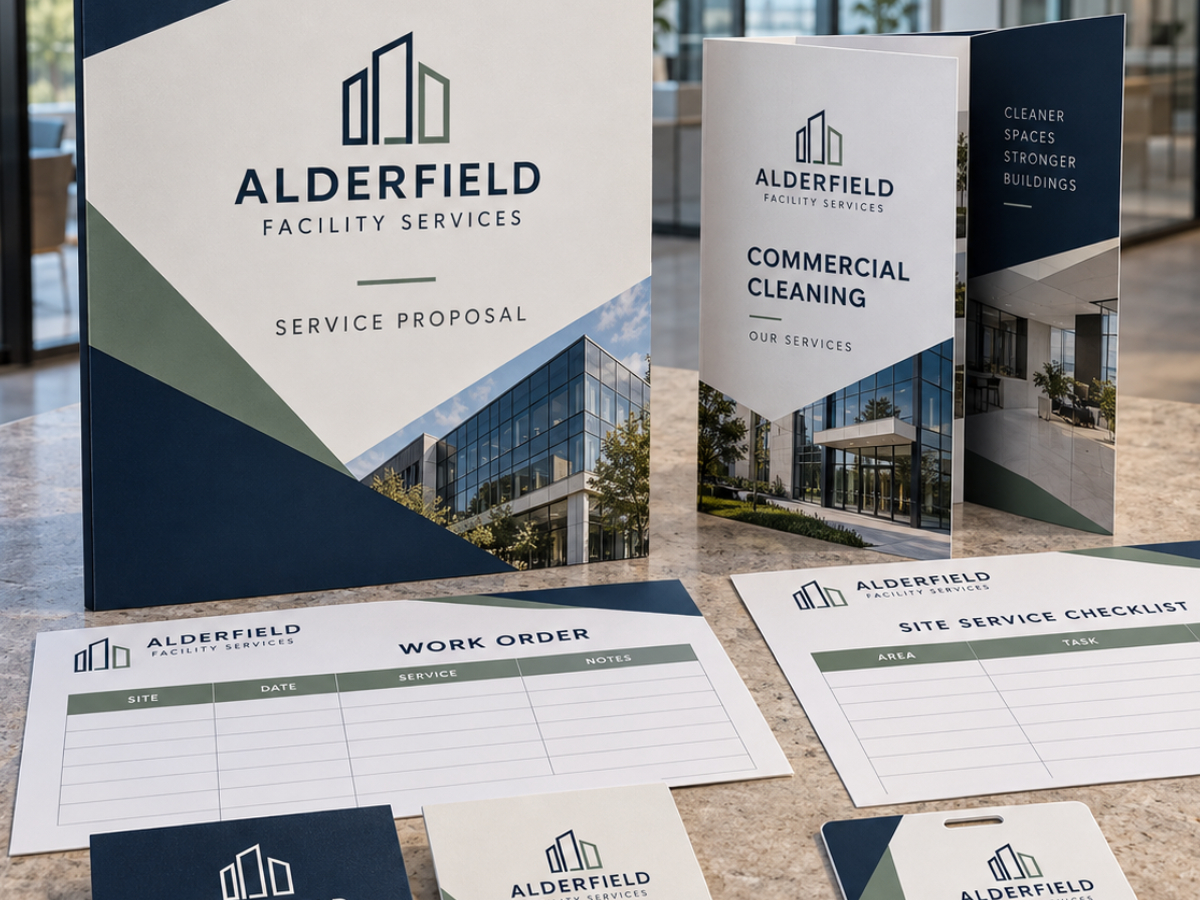
Commercial cleaning companies need printed materials that support client communication and work performed at individual properties. Service brochures and proposal folders help explain the business, while approved site checklists, work orders and inspection records help staff carry out the agreed scope. Keep reusable company branding separate from documents that change with each building, contract or service visit.
A commercial cleaning company may serve an office building, a medical practice, a retail store and a condominium property during the same week. The company name and general service offering stay the same, but the work at each location can be quite different.
One client may require evening office cleaning. Another has an approved schedule for common areas. A third requests an additional service outside the regular agreement.
The people responsible for delivering the work need accurate instructions. The client needs a clear explanation of what has been agreed. Management needs a dependable way to record changes, address concerns and keep documents current.
Printed materials can support those tasks, particularly when staff work at different customer locations or need paper records on site.
That does not mean every cleaning company should print large quantities of brochures or complicated forms. The useful materials are the ones that fit the company's actual workflow and reduce uncertainty between the office, employees and clients.
1. Start With the Type of Cleaning Business
A business offering occasional residential cleaning has different documentation needs from a commercial contractor responsible for several managed properties.
For commercial cleaning, printed materials commonly fall into four groups:
- Business development: Business cards, service brochures and sales presentation materials.
- Client agreements: Approved proposals, scope-of-work summaries and related documents.
- Site operations: Cleaning schedules, task checklists, work orders and inspection records.
- Staff and property communication: Name tags, approved notices and customer contact information.
The first purchasing decision is not paper size or finish. It is identifying which documents staff and clients actually use.
2. Business Cards Still Have a Practical Role
Commercial cleaning contracts often begin through property managers, office administrators, facility managers or direct business referrals.
A business card gives those contacts an easy way to retain the company's information after a site visit, meeting or introduction.
Keep the design straightforward. The company name, relevant contact, telephone number, email address and website should be easy to read.
If the company operates in several cities, decide whether the card should contain one central contact or location-specific details.
A QR code can link to an appropriate service or inquiry page, but it should not replace the information someone needs to contact the company directly.
Pryntco offers Standard Business Cards suitable for everyday business networking and client meetings.
3. A Service Brochure Should Explain What the Company Actually Does
Commercial cleaning covers a wide range of work. A short brochure can help a prospective client understand which services the company offers and which types of properties it serves.
The document might describe approved services such as routine office cleaning, common-area cleaning or scheduled maintenance work, depending on the company's capabilities.
It should also make the next step clear. Does the business require a property walkthrough before preparing a quotation? Is there a designated contact for commercial inquiries?
A brochure is not the right place to publish every possible contract variation.
Instead, use it to establish the company's services, operating area and general approach to client communication. Detailed requirements can be handled later through a site-specific proposal.
Pryntco's Brochure Printing options can accommodate a concise business introduction without turning it into a large catalogue.
4. What Should Go Into a Client Proposal Folder?
A proposal prepared for a commercial property usually contains more information than a general promotional brochure.
The company may need to address the proposed work, visit frequency, property areas, staffing arrangements and commercial terms.
Those details depend on the individual client and must be supplied by the business.
A presentation folder provides a consistent physical package while allowing the contents to change from one proposal to another.
For example, a fictional cleaning company could prepare a folder containing:
- A short company introduction.
- The approved property-specific scope of work.
- The proposed service schedule.
- Relevant quotation documents.
- Any required supporting information approved for the client.
- A business contact card.
These documents should not be permanently combined into one brochure if the contents are likely to change during negotiations.
A custom presentation folder can remain useful across many proposals while the inserted documents reflect each property.
5. Keep the Scope of Work Separate From Marketing Copy
A common problem in service businesses is confusing a general list of capabilities with the work the customer has actually purchased.
A brochure may state that the company offers several cleaning services. That does not mean all those services are included in every contract.
The agreed scope should be maintained in an approved operational or contractual document, not inferred from promotional wording.
If employees use a printed service sheet, its instructions should correspond to that approved scope.
For example, a site might require certain tasks on every visit and others only on a scheduled basis. Combining both into one undifferentiated checklist can lead to misunderstandings.
Organize the sheet by the company's real procedures, with clear responsibility for approving changes.
6. How Should a Site Cleaning Checklist Be Designed?
A good checklist is meant to be used during work, not admired in a presentation.
It should be readable at the size in which it will actually be printed, with enough room for any required marks or notes.
Depending on the service arrangement, the company may organize tasks by area, work period or approved service frequency.
For a multi-floor office, a checklist might identify separate areas such as reception, meeting rooms, washrooms and common spaces. The actual tasks must come from the company's established cleaning specifications.
Consider whether the form needs:
- Property or site reference.
- Approved work areas.
- Relevant task descriptions.
- Service date.
- Employee or team identification.
- Space for exceptions or follow-up.
- Supervisor review where required.
Do not add signature or confirmation fields simply to make the document look official. Every field should have a defined purpose within the company's workflow.
7. One Checklist for Every Site, or Separate Site Versions?
A common template is useful, but individual properties may require different instructions.
The company can standardize the layout while keeping each site's approved content separate.
For example, two offices might use the same checklist structure, but one has a scheduled service area that the other does not.
Maintaining separate site versions prevents employees from relying on a generic document that does not match the agreement.
Each version should identify the property and carry a revision reference when updates are important.
Older copies should be withdrawn when they no longer reflect the current requirements.
8. When Are Carbonless Work Orders Useful?
Some companies still need a physical record when additional work is requested or a service is completed at a client location.
Where the business has an established paper process, carbonless NCR forms may allow the same handwritten information to be retained in multiple copies.
A work order may identify the service location, authorized work, relevant notes and any approvals required by the company's procedures.
However, printed work orders should not introduce new contractual terms or approval requirements without management review.
Pryntco currently lists 3-Part NCR Forms for invoices, work orders, receipts and other business documents.
If another copy arrangement, numbering method or custom configuration is required, confirm its availability before ordering.
9. What About Quality Inspection Forms?
A cleaning company may perform periodic internal quality reviews or inspections with a client's representative.
An inspection form should record the observations actually relevant to that process. It should not make unsupported claims about cleanliness, hygiene or compliance.
For example, a company might use an approved review system that identifies the property, the areas inspected, observations, required follow-up and responsible person.
The layout should give reviewers enough room to record useful findings rather than forcing everything into tiny checkboxes.
Where a digital quality-management system is already in place, printing the same information may not be necessary.
The aim is to support a consistent review process, whether the final record is maintained on paper or digitally.
10. Site-Specific Instructions Should Be Easy to Replace
Cleaning staff sometimes receive updated instructions when a building changes its operating arrangements or when the client's approved service requirements change.
Printing those instructions permanently on a large wall sign may be impractical.
A replaceable printed sheet in a suitable holder can make more sense for certain internal areas, subject to the property's rules.
Use a clear title and relevant version information so staff can identify the active instructions.
Do not place private access information, customer details or confidential building procedures on signs visible to the public.
Permanent property identification and temporary operating instructions should be managed as different types of communication.
11. When Would a Printed Site Notice Be Appropriate?
Some work may require a temporary notice approved by the building operator.
For example, occupants might need to know that a particular shared area is temporarily unavailable during scheduled work.
The content, location and display period should be determined by the property's responsible management team.
Do not improvise official hazard symbols, safety warnings or regulatory signs using an ordinary promotional template.
Where a simple non-regulatory information notice is suitable, a printed sheet or appropriate rigid display may be sufficient. Pryntco provides Rigid Sign Printing for selected commercial applications.
Check material suitability and installation requirements before placing signs in working areas.
12. Staff Identification and Customer-Facing Work
Cleaning employees may work in buildings where tenants or visitors are unfamiliar with the service provider.
Appropriate staff identification can help distinguish authorized company personnel from other visitors.
A name tag may display the company identity, employee name or approved role description, depending on the employer's policies.
In some facilities, the property has its own identification or access requirements. Those take precedence over ordinary promotional branding.
Staff identification should not expose unnecessary personal information.
For customer-facing roles, Pryntco's Name Tags are one printed identification option.
13. Should the Company Print Flyers for Local Businesses?
Printed flyers can support a targeted commercial prospecting campaign, but the content should reflect the type of customer the company wants to reach.
A property manager may be interested in recurring building services. A small office owner may need a different arrangement.
Rather than listing every service in small type, the flyer can introduce a specific relevant offering and explain how to request a quotation.
A useful commercial flyer normally needs:
- The company name and service category.
- A clear explanation of the intended service.
- Relevant service area.
- Accurate business contact information.
- An appropriate inquiry destination.
Pryntco's Flyers can support this type of business outreach.
Be selective about distribution. A commercial cleaning proposal is more likely to be relevant to the appropriate building decision-maker than to an arbitrary passerby.
14. How Many Forms and Checklists Should Be Printed?
Order quantities should reflect how often the actual document is used.
A company serving several properties may need one checklist per service visit, while another location may use one document for a longer reporting period.
For example, if a fictional contract calls for a paper checklist on every scheduled visit, management can forecast the required quantity from the approved service calendar.
Add an appropriate reserve for damaged or incorrectly completed copies, but avoid ordering a full year's supply when the process may change.
Site-specific forms are particularly vulnerable to becoming outdated when contracts, property layouts or work schedules are revised.
Business cards and general brochures may have a longer useful life than operational documents tied to one client.
15. Protect Client and Employee Information
Cleaning businesses can work in environments where privacy matters, including offices, healthcare-related facilities and managed residential properties.
Printed documents should contain only the information needed for their approved purpose.
Do not leave customer contact details, building access instructions, employee records or confidential service information in publicly accessible areas.
Establish who may use each form, where completed copies are stored and when outdated documents are withdrawn.
A well-designed form cannot replace appropriate information-handling procedures.
For regulated environments, the company should also follow the requirements established by the responsible client and relevant authorities.
16. Avoid These Print and Documentation Problems
Many issues can be prevented during the document planning stage.
- Using one generic checklist that does not match individual properties.
- Printing marketing claims that imply unverified certifications or results.
- Giving staff an outdated version of a service scope.
- Designing forms without enough space for useful notes.
- Ordering large quantities before the workflow is finalized.
- Mixing public promotional materials with confidential property information.
- Creating unofficial safety or compliance signage.
- Using unclear version names such as "final-new-revised."
- Failing to define who approves operational documents.
- Including service options in a proposal as though they are already part of the contract.
17. Building a Practical Print System for a Commercial Cleaning Business
A cleaning company does not need dozens of different printed products to operate professionally.
It needs business materials that accurately introduce its services and operational documents that employees can use without confusion.
Start with a consistent business card and service overview. Use presentation folders for client proposals when several documents need to stay together.
For ongoing work, develop approved checklists and forms around the company's actual agreements, with clear site identifiers and version control.
Keep changing instructions separate from permanent branding, and avoid printing confidential or regulated information without the necessary review.
Pryntco supplies business cards, brochures, presentation folders, NCR forms and related printed materials for commercial service companies.
For a coordinated order involving several document types, request a quote from Pryntco with the approved designs, product requirements and quantities.

