How to Choose Promotional Products for Your Business
How to Choose Promotional Products for Your Business
The best promotional product is not necessarily the most unusual or expensive item. It is the one that makes sense for the audience, fits the way the business wants to be remembered and gives the recipient a realistic reason to keep or use it.
Promotional products can put a company’s name, logo or message onto something people can actually use.
That sounds simple, but choosing the right item is more important than simply adding a logo to whatever product happens to be available.
A mug used in an office has a different purpose from a giveaway handed out at a trade show. A client thank-you gift should feel different from an item distributed to hundreds of event attendees. A product intended for employees may need to support internal culture rather than customer acquisition.
The starting question should therefore not be:
“What promotional products are popular?”
It should be:
“Who is receiving this, and what do we want the item to accomplish?”
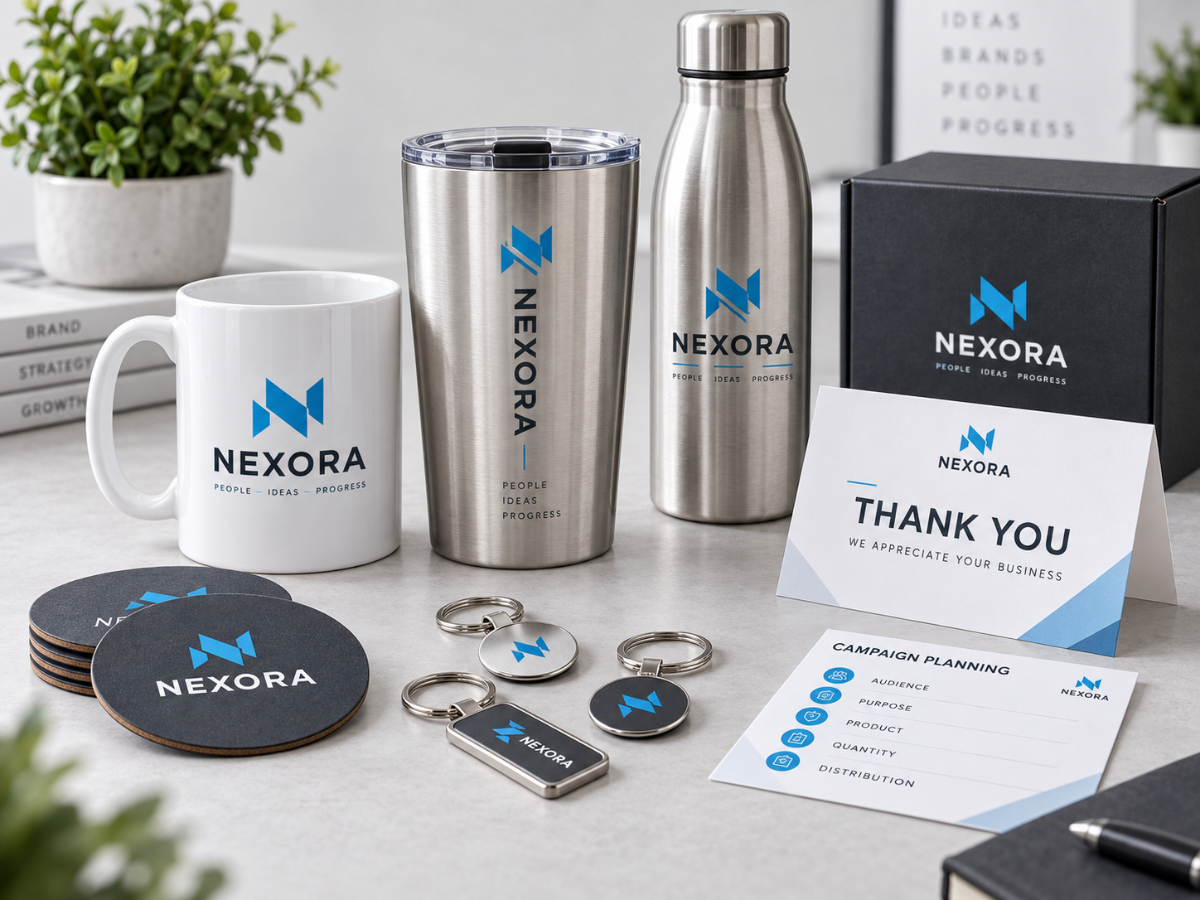
Pryntco’s current product catalogue includes promotional and branded products across categories such as drinkware, promotional gifts and photo or décor products. Examples include custom ceramic mugs, custom tumblers, stainless-steel bottles, coasters, keychains and other customizable products.
This guide explains how to choose among those types of items based on the audience, campaign and intended use rather than treating every promotional product as interchangeable.
1. What Is a Promotional Product?
A promotional product is a physical item customized with business branding, artwork, photography or another approved design.
Businesses may use promotional products for:
- Customer gifts
- Event giveaways
- Trade shows
- Employee programs
- Client appreciation
- Brand awareness
- Retail merchandise
The item becomes part of the brand experience rather than simply another printed advertisement.
2. Why Do Businesses Use Promotional Products?
Unlike a flyer or postcard, a useful promotional item may remain with the recipient after the original interaction is over.
The item can support:
- Brand recognition
- Customer appreciation
- Event engagement
- Employee identity
- Business gifting
The value comes from the combination of the object and the branding, not the logo by itself.
3. What Should You Decide Before Choosing a Promotional Product?
Define the purpose first.
Ask:
- Who will receive it?
- Where will it be distributed?
- How long should it remain useful?
- What budget is available?
- How much branding is appropriate?
Those answers narrow the product choices considerably.
4. Who Is the Audience?
A promotional item should suit the recipient.
Potential audiences include:
- Existing customers
- Prospective customers
- Employees
- Event visitors
- Business partners
- Retail shoppers
A product chosen for office professionals may not be the same item selected for a community event.
5. Should Promotional Products Be Useful?
Usually, usefulness is a strong advantage.
An item that fits naturally into someone’s routine has a better chance of being retained.
Useful categories may include:
- Drinkware
- Desk accessories
- Keychains
- Coasters
- Reusable everyday items
Usefulness should still be evaluated for the actual recipient rather than assumed.
6. Is a More Expensive Promotional Product Always Better?
No.
A higher-cost item can be appropriate for an important client, employee recognition or a limited premium campaign.
For broad distribution, a simpler item may make more sense.
The appropriate choice depends on:
- Number of recipients
- Relationship value
- Campaign goal
- Distribution method
7. What Is the Difference Between a Giveaway and a Business Gift?
| Giveaway | Business Gift |
|---|---|
| Usually distributed to a larger audience | Usually intended for a smaller, more defined audience |
| Brand visibility is often central | Relationship and presentation may matter more |
| Quantity may be higher | Quantity may be lower |
8. When Are Custom Mugs a Good Promotional Product?
Mugs can work well for businesses whose recipients spend time in:
- Offices
- Staff rooms
- Home workspaces
- Customer-service environments
They are also suitable for client gifts, staff items and branded merchandise.
Pryntco’s current Ceramic Mugs support custom branding and artwork for promotional use.
9. When Is a Tumbler a Better Choice?
Tumblers can suit recipients who regularly carry beverages between locations, commute or work away from a desk.
They can be useful for:
- Employee gifts
- Client appreciation
- Corporate events
- Branded merchandise
The product should fit the audience rather than being chosen only because drinkware is popular.
10. When Should You Choose a Branded Bottle?
A branded bottle can make sense for:
- Fitness-related businesses
- Outdoor events
- Employee programs
- Conferences
- Customer gifts
Pryntco’s current Stainless Steel Bottle provides another drinkware option for branded business use.
11. When Do Custom Coasters Make Sense?
Coasters work naturally in environments such as:
- Offices
- Restaurants
- Hospitality
- Meeting rooms
- Client gift packages
They can also work as a compact branded item when a mug or bottle would be more than the campaign requires.
Pryntco currently offers custom coasters as part of its promotional-gift catalogue.
12. When Are Keychains a Useful Promotional Product?
Keychains can work for businesses where compact everyday visibility is useful.
Potential applications include:
- Property services
- Automotive businesses
- Real estate
- Customer appreciation
- Event giveaways
Because the printable area is relatively small, the artwork should remain simple.
13. What About Photo and Décor Products?
Photo-oriented products can serve a different purpose from conventional giveaways.
They can be used for:
- Corporate gifts
- Recognition
- Branded interior décor
- Retail merchandise
Pryntco’s current Stretched Canvas Prints demonstrate how artwork or photography can extend into display-oriented products.
14. Should a Promotional Product Be Connected to the Business?
It helps when the product feels natural for the company.
For example:
- A café may choose drinkware.
- A property business may choose keychains.
- A creative company may choose art or décor products.
- An office-focused service may choose desk-oriented items.
The connection does not need to be literal, but it should feel intentional.
15. What Makes a Good Trade Show Giveaway?
A trade show item should be easy to distribute and relevant enough that attendees want to keep it.
Consider:
- Size
- Weight
- How attendees will carry it
- Quantity required
- How visible the branding should be
A large gift may be appropriate for selected prospects but impractical for every visitor.
16. Should Every Trade Show Visitor Receive the Same Item?
Not necessarily.
A company can separate:
- General event giveaways
- Qualified-prospect gifts
- Customer gifts
This allows the business to match the promotional value to the relationship.
17. What Makes a Good Client Appreciation Gift?
A client gift should feel like an acknowledgement of the relationship rather than a piece of advertising disguised as a gift.
Keep branding tasteful.
The item can still include the company logo, but the recipient should feel comfortable actually using it.
18. What Promotional Products Work for Employees?
Employee items may support:
- Onboarding
- Recognition
- Company events
- Internal culture
The goal may be different from customer-facing promotion, so the design can emphasize team identity instead of sales messaging.
19. Can Promotional Products Be Sold as Merchandise?
Yes when the product and brand are suitable.
A company with a strong audience may use customized products as retail merchandise rather than giving them away.
Before doing this, consider:
- Product appeal without a promotion
- Packaging
- Retail presentation
- Inventory planning
20. How Much Branding Should Go on a Promotional Product?
Usually less than businesses expect.
A product does not need:
- Logo
- Phone number
- Street address
- Five services
- Long slogan
all printed together.
Often a strong logo or short message is enough.
21. Should You Put a Website on the Product?
It can be useful when the web address is short and the item provides enough space.
However, forcing a URL into a small imprint area can weaken the design.
Use it only when it remains readable.
22. Should You Put a QR Code on a Promotional Product?
Sometimes.
A QR code may work on a product with enough flat printable area and appropriate contrast.
But it should not be added automatically.
Before using one:
- Confirm the printable area.
- Keep sufficient contrast.
- Test the final production size.
- Use a useful destination.
23. Should the Logo Be Large?
The logo should be large enough to reproduce clearly, but not so large that the product becomes uncomfortable or visually unbalanced.
Consider how the recipient will actually see the item during normal use.
24. What Artwork Is Best for Promotional Products?
Use the cleanest original artwork available.
Preferred source material often includes:
- Original vector logos
- High-resolution photography
- Approved brand artwork
A small logo copied from a website should not be treated as the master branding file.
25. Why Are Vector Logos Useful?
Vector artwork can be resized without depending on a fixed number of pixels.
This is especially useful when the same logo needs to appear on several products with different imprint areas.
Pryntco’s Vector vs Raster Guide explains this difference in more detail.
26. Should Promotional Product Artwork Be Complicated?
Usually not.
Complex detail may disappear when the printable area is relatively small.
A strong product design often uses:
- One logo
- One short phrase
- One clear visual
rather than a miniature version of a brochure.
27. Should Every Promotional Product Use the Same Artwork?
Not necessarily.
The brand should remain consistent, but artwork may need to adapt to:
- Product shape
- Orientation
- Printable area
- Audience
A horizontal tumbler design and a small keychain design may require different layouts.
28. How Should Brand Colours Be Used?
Use approved brand colours where they reproduce appropriately, but remember that product material and printing processes can affect appearance.
Do not assume a screen colour will look identical on every physical product.
29. How Many Promotional Products Should You Order?
Start with the distribution plan.
Calculate:
- Number of recipients
- Expected event attendance
- Employee count
- Client list
- Reserve quantity
Avoid choosing quantity simply because a larger number feels more impressive.
30. Should You Order Extra Promotional Products?
A reasonable reserve may help with:
- Late event registrations
- New employees
- Replacement gifts
- Future customer meetings
But items with dated or campaign-specific artwork can become obsolete.
31. How Should Promotional Products Be Distributed?
Distribution should be planned before ordering.
Possible methods include:
- Handed out at events
- Added to customer orders
- Given after meetings
- Included in welcome kits
- Used as employee gifts
A product sitting in storage has no marketing value.
32. Should Promotional Products Be Combined With Printed Materials?
Yes when the pieces support the same campaign.
A client package might combine:
- Branded gift
- Thank-you card
- Product information
- Business card
Keep the visual identity consistent across the package.
33. Can Promotional Products Support Customer Retention?
They can.
A useful thank-you item may strengthen a customer relationship after:
- Large project
- Repeat purchase
- Milestone
- Long-term partnership
The item should feel appropriate to the value and nature of the relationship.
34. Can Promotional Products Support Lead Generation?
Yes, particularly at events or in-person campaigns.
But the product itself should not be mistaken for the entire lead strategy.
The business still needs a clear next step such as:
- Conversation
- Contact exchange
- Quote request
- Website visit
35. How Can Promotional Product Results Be Evaluated?
Not every item can be measured directly.
For campaigns where measurement matters, businesses can track:
- Distribution quantity
- Event leads
- QR responses where appropriate
- Promo-code use
- Customer feedback
Use the measurement method that fits the campaign rather than forcing digital attribution onto every gift.
36. What Should Be Checked Before Approving Promotional Product Artwork?
Confirm:
- Correct product
- Correct artwork version
- Logo spelling and orientation
- Image quality
- Readable text
- Approved brand colours
- Correct quantity
- Any campaign-specific information
Review the artwork against the product template or current production requirements.
37. What Are the Most Common Promotional Product Mistakes?
Common mistakes include:
- Choosing an item only because it is trendy.
- Ignoring the actual audience.
- Putting too much information into a small imprint area.
- Using a low-resolution logo.
- Ordering before planning distribution.
- Using the same artwork unchanged across very different products.
- Over-ordering dated items.
- Making branding so aggressive that recipients do not want to use the item.
38. How Should You Choose Promotional Products for Your Business?
Start with the recipient, not the catalogue.
Identify who will receive the product, why they are receiving it and what you want the item to accomplish.
A broad event giveaway should be easy to distribute. A client gift can be more selective. An employee item should support the team experience. Branded merchandise needs enough appeal that someone would genuinely want the product itself.
Then choose a category that fits how the recipient lives or works.
Drinkware such as ceramic mugs, tumblers and bottles can suit offices, employee programs, events and customer gifting. Compact products such as custom keychains can suit campaigns where portability matters. Coasters and décor-oriented products can work when the campaign has a stronger hospitality, office or gifting focus.
Keep the artwork simple enough for the product. Use original logo files, high-quality photography and a layout built around the real printable area rather than shrinking a flyer design onto a small object.
Order according to a distribution plan. Know where the products will go before they arrive.
Most importantly, choose something people have a reason to keep.
A promotional item that stays useful can continue representing the business long after the original event, order or meeting is finished.
Businesses can explore Pryntco’s current promotional categories through the Pryntco product catalogue.
For a custom promotional project or help choosing a suitable product, contact Pryntco or submit a custom quote request.