What Should a Recruitment Team Print for a Career Fair?
What Should a Recruitment Team Print for a Career Fair?
A useful career fair print package helps candidates recognize the employer, understand the opportunities available and know what to do after the conversation. Start with clear employer branding, practical role information and an accurate application destination. Add supporting handouts, name tags and event signage according to the way the recruiting team plans to engage visitors.
A recruitment booth has a different job from a typical trade show display.
At a commercial exhibition, the team may be introducing products, qualifying buyers or arranging sales appointments.
At a career fair, the person approaching the booth is considering something more personal: whether the organization could be a suitable place to work.
They may want to know which roles are available, where the jobs are located, what experience is required and how to apply. They may also be comparing several employers over the course of the event.
That changes what the printed materials need to accomplish.
A striking banner might attract attention, but it cannot carry a complete job description. A detailed role sheet can answer practical questions, but it is not suitable for displaying across the top of a booth. A business card may provide a contact, but it does not replace clear application instructions.
Good recruitment print gives each format a defined role and helps candidates leave with useful information rather than another generic promotional brochure.
1. What Printed Materials Does a Career Fair Booth Need?
A practical recruitment display may include:
- Employer branding banner.
- Career opportunities overview.
- Role-specific information sheets.
- Candidate application cards.
- Recruiter name tags.
- Business cards for appropriate staff.
- Table cover with company branding.
- Relevant QR codes.
- Event schedules or information signs.
- Takeaway material about the organization.
The correct collection depends on the event, available space and number of positions being recruited.
A business hiring two employees at a local job fair may need only a modest display and concise handout.
A larger organization attending several university recruitment events may benefit from reusable branding and a more structured set of role-specific materials.
2. Start With the Candidates, Not the Display Products
Before ordering print, identify who the team is hoping to meet.
A university career fair may attract students exploring internships and entry-level opportunities.
A specialized industry event may bring experienced professionals looking for particular technical roles.
A local hiring event could attract candidates interested in immediate openings, specific shift patterns or nearby workplaces.
The information each group needs will be different.
Design the print around the actual recruiting objective rather than using the same corporate marketing package at every event.
3. What Should Be on a Recruitment Banner?
The primary purpose of the banner is to help visitors recognize the employer and understand why they might approach.
It normally needs:
- Company name and recognizable logo.
- Clear recruitment-related headline.
- Short description of the employment area or opportunity.
- One relevant call to action.
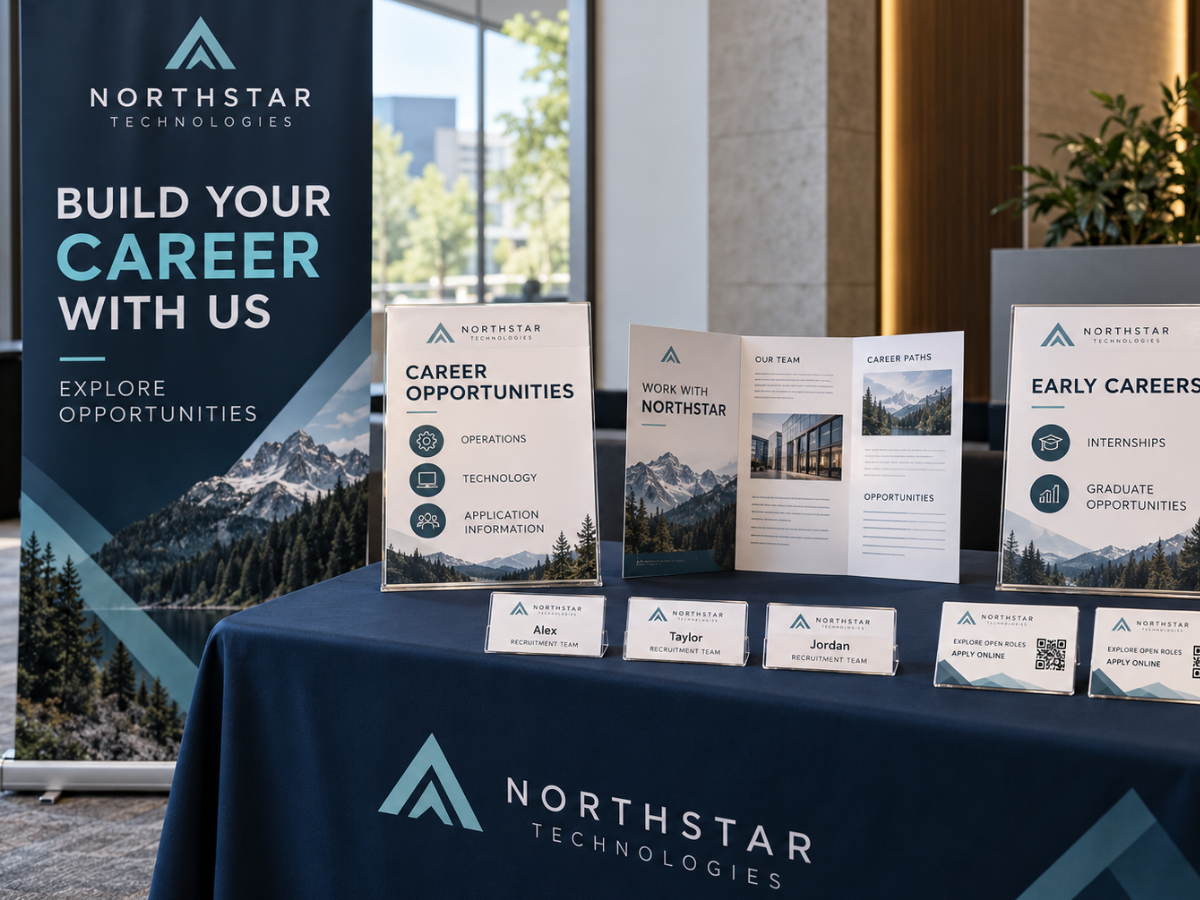
A simple fictional example might read:
NORTHSTAR TECHNOLOGIES
Build Your Career With Us
Explore Current Opportunities
That provides a clear introduction without attempting to reproduce the company's complete careers page.
The banner should be readable from the aisle. Detailed employment information belongs on more suitable printed materials or a dedicated careers webpage.
4. Retractable Banner or Larger Booth Backdrop?
A retractable banner is a practical consideration for smaller recruiting teams attending multiple events.
It creates a vertical branded presence while providing a portable display format.
A larger backdrop may be more suitable when the organization has a substantial booth space or wants a complete branded presentation area.
Neither option should be selected without reviewing the venue's space and display restrictions.
Pryntco offers Retractable Banner Stands for professional promotional and event displays.
For a recruiting program attending different venues, reusable employer branding is usually more practical than printing a new complete banner for every event.
5. Should Recruitment Banners List Individual Jobs?
Only when the job information is sufficiently stable and there is a good reason for including it.
Specific positions may be filled, renamed or revised between events.
A permanent branded banner that lists temporary vacancies could become inaccurate after one recruiting campaign.
A better approach is often to keep the main display focused on the employer while using separate replaceable materials for current roles.
This allows the company to maintain consistent presentation without repeatedly replacing expensive display graphics.
6. Why Are Job Information Sheets Useful?
A printed role sheet can help candidates understand an opportunity without relying entirely on a short conversation at a busy booth.
It may also give them a useful reference when they review employers afterward.
The sheet should answer the questions candidates commonly ask.
Depending on the position, relevant information may include:
- Approved job title.
- Department or team.
- Work location.
- General responsibilities.
- Required qualifications or experience.
- Employment arrangement.
- Approved compensation information where appropriate or required.
- Application instructions.
Human resources should approve all employment information before it is printed.
7. One General Career Flyer or Several Role-Specific Sheets?
The decision depends on the number and type of vacancies.
A general career flyer can introduce the organization, its work and the categories of opportunities available.
It is useful when candidates are exploring the employer rather than applying for one particular job.
Role-specific sheets provide more detail and work better when the team is recruiting for clearly defined positions.
For an organization hiring across several departments, a combined approach may be more effective.
Give visitors a concise employer overview and provide individual sheets only for roles relevant to their interests.
8. How Should a Role Sheet Be Designed?
Use a layout that makes the important information easy to locate.
A candidate should be able to identify the job title, work location, relevant requirements and application method without reading several paragraphs first.
For example, a fictional information sheet could use this structure:
OPERATIONS COORDINATOR
Position Overview
Key Responsibilities
Qualifications
Location and Employment Details
How to Apply
Short paragraphs and carefully organized lists are generally easier to scan than dense promotional writing.
Pryntco's Flyers can support individual job information sheets and broader recruitment materials.
9. Should Salary Information Be Printed?
Where compensation information is required or appropriate, it should be accurate and approved.
Employment posting requirements vary by jurisdiction and circumstances. The recruiting team should confirm any applicable obligations before finalizing the wording.
A printed sheet should not contain estimated salary ranges invented by a designer or marketing department.
If the approved information changes frequently, consider whether the print should direct candidates to the current official listing while still providing the information that must appear in the printed communication.
Job content should be treated as operational information, not simply advertising copy.
10. When Does a Recruitment Brochure Make Sense?
A brochure can be useful when candidates need to understand the employer beyond one vacancy.
It might explain the organization's work, operating locations, professional development opportunities and approved information about its teams.
A brochure is particularly suitable when the same material will be used across several recruitment events.
However, it should not become a lengthy corporate history that fails to answer what candidates want to know.
Focus on information that helps someone assess whether the organization and its opportunities suit their goals.
Pryntco offers Brochure Printing with multiple folding formats for organizing more detailed content.
11. What Should a Career Fair QR Code Link To?
A QR code should lead to a destination connected directly to the conversation taking place at the booth.
Useful destinations include:
- Current careers page.
- Specific approved job posting.
- Internship opportunities.
- Recruitment event registration.
- Official application instructions.
A generic corporate homepage may be less helpful if candidates need to search again to find the jobs.
Test the code on a mobile device and confirm that the destination is active.
If different codes are used for different programs, label them clearly so visitors know which one to scan.
12. Should Printed Handouts Include the Application Link?
Yes, when the candidate is expected to continue online.
A visible website address or short approved application URL provides an alternative to scanning a QR code.
This is important because not everyone will scan a code while standing at the booth.
Some candidates may prefer to review the details later on a larger screen.
The printed application destination should remain accurate for the expected life of the handout. Avoid printing temporary campaign links on materials intended for repeated use unless the destination is managed accordingly.
13. Are Recruiter Business Cards Worth Printing?
They can be useful for recruiters who regularly maintain professional relationships with candidates, educational institutions and industry contacts.
A business card may include the recruiter's name, role, organization and appropriate professional contact information.
However, giving every visitor a personal recruiter's card is not necessary if the official hiring process requires applications through a centralized system.
The card should not create confusion about how candidates are expected to apply.
General recruiting contact cards may be more appropriate when several employees staff the same event.
14. Do Recruiters Need Name Tags?
Name tags help candidates identify the people representing the organization.
They are particularly useful when several recruiters, department managers and employees attend the same event.
A straightforward name tag should prioritize:
- Staff member's name.
- Company identity.
- Role or department when useful.
A readable tag makes conversations more comfortable and can help visitors identify the correct person to ask about a position.
Pryntco offers Name Tags for business and event use.
15. Should the Booth Have a Branded Table Cover?
A table cover can help the recruitment area look coordinated, particularly when the event supplies a basic table without branded presentation materials.
It can show the company identity without consuming space on the tabletop.
However, the table cover should not compete visually with the banner or handouts.
Keep branding simple and make sure it remains visible once chairs, boxes and promotional materials are positioned around the booth.
For a professional event setup, Pryntco offers Trade Show & Display Products, including table covers and portable branding systems.
16. How Should Career Fair Materials Be Arranged?
The physical layout should follow how visitors approach the team.
The banner identifies the employer from a distance. A short overview introduces the opportunities. Role sheets provide more specific information once the candidate's interests become clear.
Application cards or QR codes should be easy to access before the visitor leaves.
Do not cover the table with several large piles of nearly identical documents.
Organize handouts by job category or candidate type, and provide clear labels when necessary.
Employees should be able to find the correct information quickly without interrupting the conversation.
17. Should Every Visitor Receive Every Handout?
No.
A visitor interested in a technical internship does not necessarily need printed information about senior management vacancies.
Giving everyone the entire recruitment package creates unnecessary printing costs and makes the information harder to navigate.
A better process is to identify the candidate's area of interest and provide the relevant material.
The team can keep general employer information available for visitors who are still exploring their options.
18. Should Candidates Complete Paper Application Forms?
Only if paper applications are part of the organization's approved recruiting process.
Many employers use dedicated online application systems that support documentation, internal review and consistent candidate records.
Introducing an improvised paper form at a career fair can create administrative and privacy problems.
If the organization requires printed applications, the forms should be established and approved by the responsible human resources team.
A print provider should not invent employment screening questions, consent wording or data-collection procedures.
19. How Should Candidate Information Be Handled?
Candidate information may include personal contact details, employment history and other sensitive information.
Printed forms containing such details should not be left openly on the table or placed where other visitors can read them.
The recruiting team should establish how information is collected, stored, accessed and transferred according to its policies and applicable obligations.
When an approved digital application process is available, it may be preferable to collecting additional paper records simply because candidates are physically present at the booth.
Keep public promotional materials separate from confidential recruiting documents.
20. Should Recruiters Bring Printed Interview or Screening Sheets?
That depends on whether the organization conducts formal screening during the event.
Some career fairs focus on introducing employers. Others include scheduled interviews or designated assessment sessions.
Any printed interview materials should match the organization's established recruiting procedures.
They may need structured fields and enough space for authorized notes, but the content must be controlled by the employer.
Do not turn a casual introductory conversation into an unapproved screening exercise because a printed form is available.
21. What Should Be Printed for On-Site Interviews?
When formal interviews are scheduled during an event, printed materials may support coordination.
Examples include internal schedules, interviewer identification, authorized evaluation documents and room directions.
Separate documents intended for candidates from confidential materials intended for the recruiting team.
Be careful with displays containing candidate names or interview details.
Scheduling information should be communicated through the organization's approved process and shared only with the people who need it.
22. Are Career Fair Giveaways Worth the Cost?
A giveaway can create a positive interaction, but it should not consume the budget needed for essential recruitment materials.
A branded pen, notebook or other practical item may be appropriate for certain audiences.
However, a giveaway does little to support recruitment if visitors cannot understand the jobs or find the application process.
For a smaller employer, a clear recruitment sheet and professional display may provide more value than a large collection of promotional merchandise.
Choose giveaways based on the intended audience and event objective rather than handing out products simply because other booths do.
23. How Can Universities and Employers Coordinate Printed Materials?
University recruiting often involves career services teams, student organizations and employer representatives.
Before the event, confirm the expected audience, booth dimensions, permitted promotional materials and any artwork requirements established by the organizer.
An employer recruiting for internships may prepare a different information sheet from the one used for experienced professionals.
Where appropriate, include approved information about program eligibility and the application process.
Any references to educational qualifications or work authorization requirements should be accurate and reviewed by the responsible team.
24. What Changes for a Local Hiring Event?
A local hiring event may focus on people seeking opportunities within a particular community.
Location, commuting considerations, available roles and application steps may become especially important.
Printed information should explain the actual employment opportunity rather than relying entirely on broad employer-branding statements.
If a business is hiring for several local sites, separate the information by location so candidates know where each position is based.
Do not promote employment conditions or benefits that have not been approved.
25. How Should Multi-Location Employers Handle Career Fair Print?
A company operating in several cities may attend events with different recruiting priorities.
Its banner and general employer branding can remain consistent, while individual job sheets and application destinations may change by location.
For example, one event may focus on Toronto positions while another promotes opportunities in Hamilton.
Before distribution, confirm that the printed information matches the vacancies and application process for that location.
Using a controlled template can help prevent the wrong branch, department or application link from appearing on a local handout.
26. How Many Recruitment Flyers Should You Print?
Start with expected booth traffic and the proportion of visitors likely to need each piece.
Suppose a fictional employer expects 180 meaningful conversations over two recruiting events.
If the team estimates that 100 visitors will benefit from a general careers overview and 60 will request a role-specific sheet, those two products have different quantity requirements.
The business should then allow for a reasonable reserve and review the available order quantities.
These figures are planning examples, not typical attendance claims.
Do not multiply total event attendance by the number of different flyers. Many visitors will not need every printed piece.
27. Should Employers Print Extra Copies for Future Events?
That makes sense for stable content.
A general employer overview may remain useful across several events if the company information and branding stay accurate.
Individual job descriptions, salary information and application instructions can change more frequently.
Separate evergreen materials from vacancy-specific documents when calculating quantities.
That allows the company to reuse suitable materials without distributing outdated role information.
28. How Can Recruiters Keep Print Consistent With the Careers Website?
Printed information and online job listings should agree.
A candidate should not leave with a handout describing one role and arrive at a webpage containing contradictory requirements or location details.
Before the event, compare printed job titles, departments, employment details and application instructions with the approved online listings.
Test every QR code and short URL.
If the official posting changes, establish whether the existing handout can still be used or needs to be replaced.
The website should remain the authoritative source for current application information where that is the organization's established process.
29. What Should Be Checked Before Printing?
Career fair artwork should be reviewed by both the communications team and the people responsible for recruitment.
- Correct employer name and logo.
- Approved recruitment headline.
- Current job titles.
- Accurate locations and departments.
- Approved role requirements.
- Correct compensation details where included or required.
- Current application links.
- Working QR codes.
- Correct event information.
- Readable fonts and sufficient contrast.
- Suitable booth display dimensions.
- Correct artwork templates and bleed.
- Clear separation of general and role-specific materials.
- Any required review of employment-related wording.
Have the final exported files approved rather than relying only on the editable design.
30. Common Career Fair Printing Mistakes
Some mistakes affect appearance, while others can make the recruiting process more confusing for candidates.
- Using a generic corporate sales banner with no recruitment message.
- Filling the banner with lengthy job descriptions.
- Printing temporary vacancies on expensive reusable displays.
- Giving every candidate irrelevant role information.
- Using QR codes that lead to an unrelated homepage.
- Printing outdated application requirements.
- Preparing role sheets without HR approval.
- Using text that is too small to read comfortably.
- Ignoring the event organizer's booth restrictions.
- Collecting personal information without an approved process.
- Ordering giveaways before planning useful candidate materials.
- Failing to separate materials intended for different locations.
- Printing excessive quantities of time-sensitive job information.
31. How Should a Recruitment Team Prepare for Multiple Career Fairs?
Organizations attending several recruitment events benefit from a small reusable print system.
Keep the employer branding consistent across all events. A general-purpose banner and coordinated table cover can provide the visual foundation where suitable.
Maintain flexible role information sheets that can be updated when vacancies change.
Prepare a current application card or QR-code handout that takes visitors directly to the appropriate careers destination.
Before each event, review the expected audience and select the materials that fit its interests.
Finally, record how much of each printed product was actually distributed. That information makes future quantity planning more accurate.
32. What Should a Small Business Print for Its First Hiring Event?
A small employer does not need to imitate the display of a national corporation.
Start with a recognizable banner or suitable sign, a concise introduction to the business and clear information about the available positions.
Give candidates an approved method of applying after the event.
If several employees attend, simple name tags can help visitors identify who they are speaking with.
Keep the table organized and avoid covering it with unnecessary promotional products.
Professionalism comes from clear communication and preparation, not the number of printed pieces on display.
33. Building a Career Fair Print Package That Supports Recruitment
A good career fair display should make the next step obvious.
From across the aisle, candidates should recognize the employer. Once they approach, they should be able to understand the types of opportunities available.
During the conversation, the recruiting team should have access to accurate role information without searching through a disorganized pile of papers.
Before leaving, the visitor should know where to find current job listings and how to apply.
That is the real purpose of recruitment printing.
A banner attracts attention. A flyer explains the opportunity. A name tag identifies the recruiter. A carefully prepared application card helps the candidate continue the process.
Each printed piece supports a different part of the interaction.
Pryntco provides Trade Show & Display Products, Flyers, Brochures and Name Tags for business and event use.
For custom recruiting displays, coordinated multi-product orders or special event requirements, request a quote from Pryntco with the intended products, quantities, artwork and venue specifications.