
How Thick Should a Business Card Be? Understanding 14pt, 16pt, 18pt and 19pt Cards
How Thick Should a Business Card Be? Understanding 14pt, 16pt, 18pt and 19pt Cards
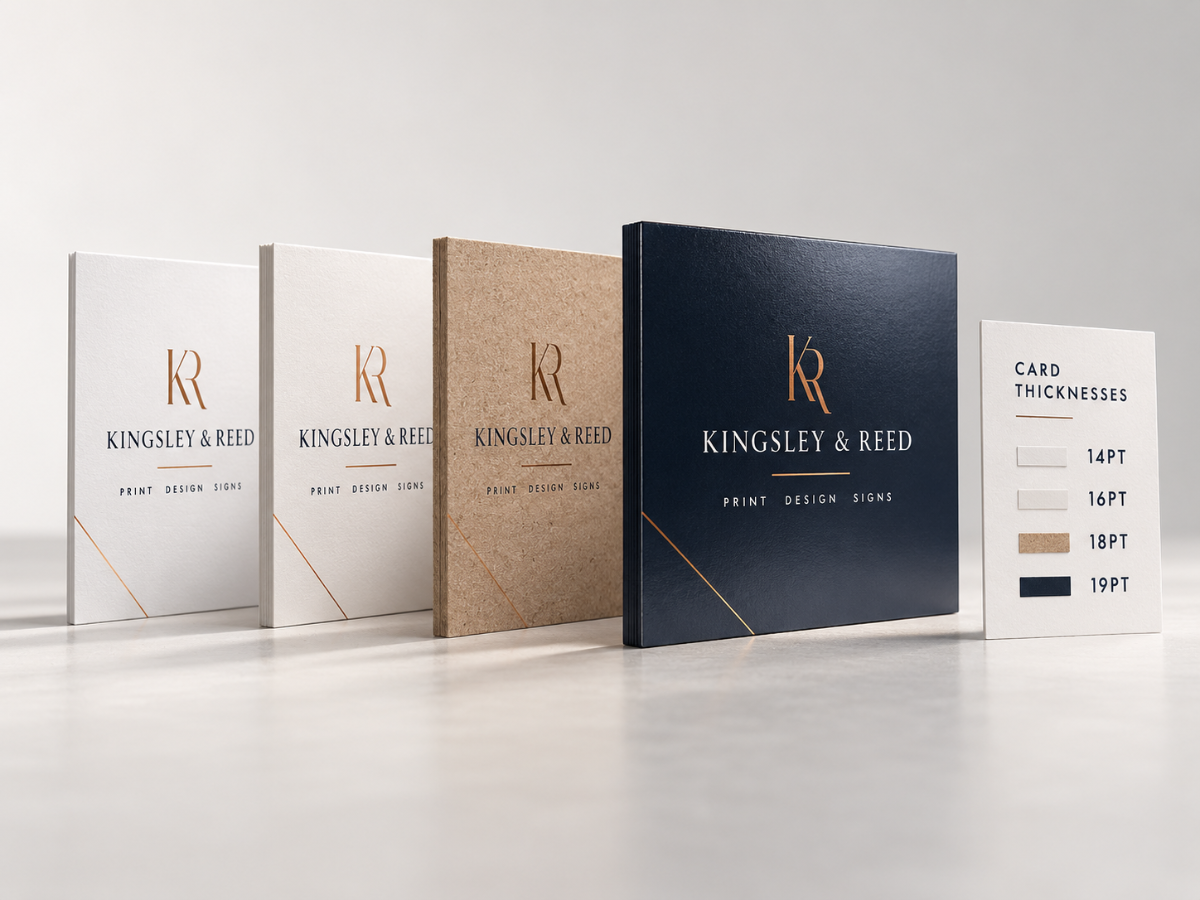
A thicker business card can feel more substantial, but thickness is only one part of the finished card. A 14pt uncoated card, an 18pt Kraft card and a 19pt laminated card have different surfaces, artwork considerations and uses. Choose the complete card, not just the biggest number.
Business-card thickness is one of those specifications that sounds simple until you start comparing actual products.
One card is 14pt.
Another is 16pt.
A specialty card is 18pt.
A laminated premium card is 19pt.
It is tempting to assume that the largest number must automatically be the best card.
That is not how business-card selection works.
Thickness affects stiffness and physical feel, but the finish, stock surface, colour, writing requirements and intended use can matter just as much.
Pryntco’s current Standard Business Cards include 14pt and 16pt options, while the Premium Business Cards collection includes 18pt Kraft and several 19pt laminated products.
1. What Does “pt” Mean on a Business Card?
“Pt” refers to point thickness.
In this context, the number is used to describe the physical thickness of the card stock.
A higher point number generally indicates a thicker card within a comparable product type.
It should not be confused with:
- Paper weight in pounds
- Font point size
- GSM
2. What Is a 14pt Business Card?
A 14pt card is a common business-card thickness that provides a traditional card feel without being unusually heavy.
Pryntco currently uses 14pt across several products, including:
- Semi-gloss business cards
- Uncoated business cards
- Silk business cards
- Folded business cards
The same thickness can therefore feel very different depending on the surface and finish.
3. What Is a 16pt Business Card?
A 16pt card is thicker and more rigid than a comparable 14pt card.
Pryntco currently offers 16pt options in its semi-gloss and uncoated standard business-card products.
It can be a useful step up when the customer wants a more substantial card without moving into a specialty laminated product.
4. What Is an 18pt Business Card?
Pryntco’s current 18pt business-card option is its Kraft card.
That means the thickness cannot be separated from the material itself.
Kraft has a natural brown surface and visible fibre character, so the design behaves differently from artwork printed on smooth white cardstock.
The card should be chosen because the material suits the brand, not simply because it is 18pt.
5. What Is a 19pt Business Card?
Pryntco currently uses 19pt stock for several premium laminated card products, including:
- Soft Touch
- Flat Matte Laminated
- Ultra Gloss Laminated
These cards combine a thicker physical construction with a specific surface finish.
The lamination is part of the finished experience.
6. Is a Thicker Business Card Always Better?
No.
A thicker card may feel more substantial, but it may not be the best fit for every application.
A 14pt uncoated card can be more useful than a laminated 19pt card when:
- Staff need to write on it
- It doubles as an appointment card
- Stamps or notes are added
Function comes before thickness.
7. Can You Feel the Difference Between 14pt and 16pt?
Yes, especially when the cards use the same general stock and finish.
A 16pt card feels slightly stiffer and more substantial than a comparable 14pt version.
The difference is noticeable without transforming the card into a specialty product.
8. When Does 14pt Make Sense?
14pt can be a practical choice for:
- General business cards
- Staff cards
- High-volume distribution
- Appointment-style cards
- Folded cards where the product uses 14pt stock
The specific finish matters more than treating 14pt as one universal card.
9. When Does 16pt Make Sense?
16pt works well when the business wants a slightly more substantial version of a standard card.
It can be especially useful for:
- Client-facing professionals
- Sales teams
- Consultants
- Retail owners
- Businesses wanting a firmer standard card
10. When Does 18pt Kraft Make Sense?
Choose 18pt Kraft when the natural material itself supports the visual identity.
It may suit brands associated with:
- Craft
- Food
- Independent retail
- Natural aesthetics
- Rustic design
The artwork needs to work on the brown stock rather than expecting a white-card result.
11. When Does 19pt Make Sense?
19pt premium cards make sense when the business wants the physical card to feel noticeably substantial and the selected lamination supports the design.
This may suit:
- Professional services
- Luxury brands
- Design studios
- Real estate professionals
- Client-facing sales roles
12. Does Finish Change How Thick a Card Feels?
Yes.
A smooth laminate, soft-touch surface or natural uncoated stock changes the way the card feels in the hand.
Two cards can have similar physical thickness while creating very different impressions because of surface texture.
13. Does Lamination Affect the Finished Card?
Yes.
Laminated cards add another finished surface over the printed stock.
Pryntco’s current Soft Touch, Flat Matte and Ultra Gloss premium cards all use 19pt laminated constructions.
The choice between them should be based on the desired surface appearance as well as thickness.
14. How Does Uncoated Stock Feel Compared With Coated Stock?
Uncoated stock has a more paper-like surface.
Pryntco’s current Uncoated Business Cards are offered in 14pt and 16pt and are specifically positioned as writable surfaces.
That makes them useful when the card needs to accept notes, dates or stamps.
15. How Does Semi-Gloss Affect the Card?
Semi-gloss creates a coated surface with stronger colour presentation than an uncoated card.
Pryntco currently offers both 14pt and 16pt Semi-Gloss Business Cards.
This makes it one of the easiest product families for directly comparing the feel of 14pt and 16pt.
16. What Is Different About 14pt Silk Cards?
Silk cards use a smoother specialty finish while remaining in the 14pt thickness category.
This is a useful reminder that thickness does not determine whether a card feels standard or premium.
The surface can change the experience significantly.
17. What Is Different About 19pt Soft Touch?
Soft Touch adds a smooth, velvet-like laminated surface to an extra-thick card.
The appeal is therefore both tactile and structural.
The card should be chosen when that finish fits the brand rather than simply because 19pt sounds more impressive.
18. What Is Different About 19pt Flat Matte?
Flat Matte Laminated cards combine the thicker 19pt construction with a low-shine laminated surface.
This can suit designs that rely on:
- Clean typography
- Minimal branding
- Controlled colour
19. What Is Different About 19pt Ultra Gloss?
Ultra Gloss uses a high-shine laminated surface.
The same 19pt thickness therefore produces a very different visual result from Flat Matte or Soft Touch.
Artwork with strong colour and contrast may suit the reflective surface better than muted designs.
20. Why Should 18pt Kraft Not Be Compared Only by Thickness?
Because Kraft is a specialty material.
The brown paper surface influences:
- Colour
- Contrast
- Photography
- Fine detail
Pryntco’s Kraft product specifically notes that it is not recommended for full-colour photography and that white ink is not available.
21. What About Magnet Business Cards?
Magnet cards are a different functional product.
Pryntco currently lists its Magnet Business Cards at 14pt thickness, but their purpose is to remain attached to a suitable metal surface rather than behave exactly like a pocket card.
Choose them for utility, not because of their point number.
22. Which Thickness Is Best If Customers Need to Write on the Card?
Surface matters more than thickness.
A 14pt or 16pt uncoated card is generally more appropriate than a highly laminated card when handwriting is central to the design.
This applies to:
- Appointment cards
- Service reminders
- Notes
- Stamp cards
23. Which Thickness Fits Easily in a Wallet?
Standard business-card products in the normal 14pt to 19pt range are still designed around conventional business-card use.
However, a thicker card feels more substantial when several are stacked together.
If staff carry large quantities daily, practical handling may matter.
24. Which Thickness Works for Appointment Cards?
A writable 14pt or 16pt uncoated product is usually the more relevant question than choosing the thickest stock.
The card needs to accept the date, time and other handwritten information reliably.
Surface usability should lead the decision.
25. Does a Folded Business Card Need Extra Thickness?
Not necessarily.
Pryntco’s current Folded Business Cards use 14pt stock.
Because the card folds, the product construction itself creates more physical presence.
Adding thickness simply for the sake of thickness is not automatically useful.
26. Does Thickness Affect QR Codes?
Not directly.
A QR code depends more on:
- Printed size
- Contrast
- Clear space
- Accurate artwork
Do not choose a premium thick card because you expect the QR code itself to work better.
27. Does Thickness Allow Smaller Text?
No.
A 19pt card does not make tiny typography easier to read.
Text size should still be chosen according to:
- Typeface
- Contrast
- Viewing conditions
Pryntco’s Fine Detail in Print Guide covers that issue separately.
28. Does Thickness Affect Rounded Corners?
The available corner options depend on the actual product configuration.
Do not assume every thickness or specialty card supports every finishing combination.
Select the product first, then check its current customization options.
29. Should a Double-Sided Card Be Thicker?
No.
Printing on both sides does not require a thicker stock simply because more information is present.
The front and back should be designed as one card with a clear hierarchy.
30. How Should Brand Positioning Influence Thickness?
Think about the intended experience.
A simple local service business may be perfectly served by a clean 14pt or 16pt card.
A premium design studio may prefer a thicker laminated product.
A natural-products brand may choose 18pt Kraft because the material suits the visual identity.
The card should feel like the company.
31. Should Budget Determine Thickness?
Budget is part of the decision, but compare the complete product rather than thickness alone.
A thicker specialty card may cost more because of:
- Stock
- Lamination
- Finish
- Production requirements
Use current product pricing when comparing actual order configurations.
32. Which Thickness Makes Sense for Large Staff Teams?
A standard 14pt or 16pt card may be practical when a business orders cards for many employees and replaces them regularly.
Premium cards can still make sense for selected client-facing roles.
The business does not need the same card for every internal job.
33. Should Executives and Staff Use Different Thicknesses?
Usually, brand consistency matters more than creating a hierarchy through card thickness.
If different products are used, keep:
- Logo
- Colours
- Typography
- Contact structure
consistent enough that the cards still belong to one organization.
34. How Should Reorders Stay Consistent?
Record the exact:
- Product
- Thickness
- Finish
- Size
- Corner option
- Artwork version
Do not reorder from memory using only the phrase “the thick card we used last time.”
35. Can You Match an Existing Business Card by Measuring It?
Measuring can help, but surface, stock and finish also matter.
If the original order information is available, use that.
If not, provide the physical card or clear specifications rather than assuming a similar thickness guarantees the same result.
36. What Are Common Mistakes With Thinner Cards?
Common mistakes include:
- Assuming 14pt means low quality.
- Ignoring finish.
- Choosing coated stock when handwriting is required.
- Using a thicker alternative when the standard product already suits the job.
37. What Are Common Mistakes With Thicker Cards?
Common mistakes include:
- Assuming the thickest card is automatically the most professional.
- Ignoring whether lamination suits the artwork.
- Choosing 18pt Kraft for a design that depends on white or photographic colour.
- Paying for a premium stock while using weak or outdated artwork.
38. How Thick Should Your Business Card Be?
Choose 14pt when you want a practical standard card and the selected finish already supports the job.
Choose 16pt when you want a firmer version of a standard semi-gloss or uncoated card.
Choose 18pt Kraft when the natural brown material itself fits the brand.
Choose a 19pt laminated product when the thicker premium feel and specific Soft Touch, Flat Matte or Ultra Gloss surface support the intended presentation.
Then consider how the card will actually be used.
If people need to write on it, uncoated stock may matter more than extra thickness.
If the artwork depends on strong colour, the finish matters.
If the card needs a distinctive tactile experience, a specialty product may make sense.
Thickness should support the card.
It should not become the only reason the product was chosen.
Businesses can compare current choices through Pryntco’s Standard Business Cards and Premium Business Cards.
For a custom size, shape or specialty card, request a custom quote or contact Pryntco.

