
Brochure or Rack Card? Choosing the Right Format for Your Message
Brochure or Rack Card? Choosing the Right Format for Your Message
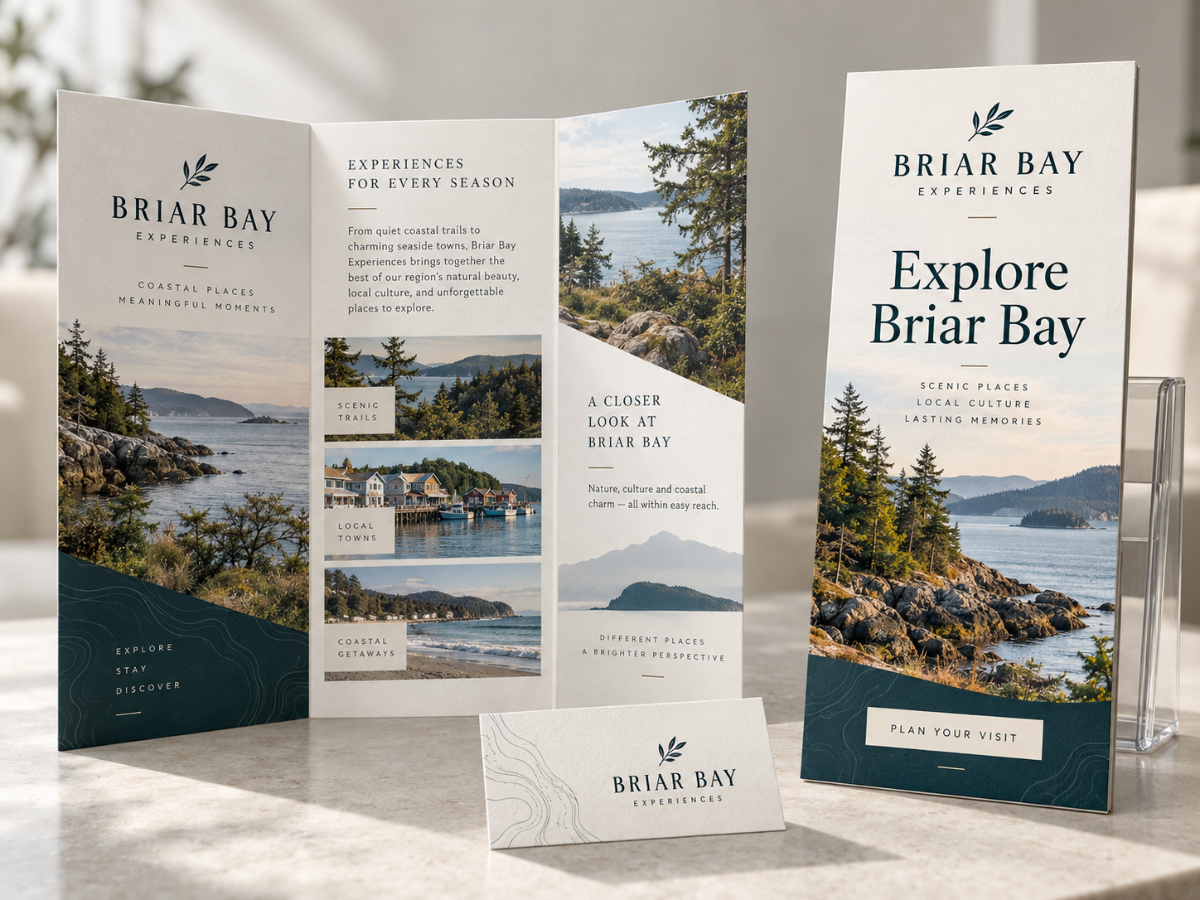
Choose a brochure when the customer needs a structured explanation with several sections. Choose a rack card when the message needs to be understood quickly from a compact display. The right format depends less on how much information you have and more on how much information the customer actually needs at that moment.
Brochures and rack cards are both designed to help businesses explain what they offer.
That can make them look interchangeable at first.
They are not.
A brochure is designed around unfolding and reading through several sections.
A rack card is narrow, compact and often viewed while standing inside a holder where only part of the card is visible initially.
Those different physical formats create different jobs.
Pryntco’s current Brochure Printing includes half-fold, tri-fold, Z-fold and accordion options, while its current Rack Cards use a compact 3.5" × 8.5" display-ready format.
The format should follow the communication problem.
1. What Is the Main Difference Between a Brochure and a Rack Card?
A brochure unfolds to reveal multiple panels of information.
A rack card stays flat.
That means a brochure is naturally suited to:
- Several services
- Processes
- Programs
- Detailed introductions
A rack card works best when one focused message can be communicated in a compact vertical format.
2. What Is a Brochure Best At?
A brochure is strongest when the reader needs to move through information in stages.
For example:
- Who the business is
- What it offers
- How the process works
- Why it may be relevant
- What to do next
The fold creates a natural information sequence.
3. What Is a Rack Card Best At?
A rack card is strongest when the customer needs to understand one subject quickly.
It may promote:
- One attraction
- One service category
- One restaurant offering
- One event
- One location
The card should make sense before the reader commits to a longer read.
4. Which Format Holds More Information?
A brochure normally provides more usable content space because the sheet is divided into several panels.
That does not mean every available panel should be filled.
Use the extra space to improve hierarchy rather than to add unnecessary paragraphs.
5. Which Format Is Faster to Read?
A rack card should generally be faster.
Its compact format encourages:
- One headline
- One main image
- A few short sections
- One clear call to action
If a rack card requires several minutes to understand, the message may be too large for the format.
6. Which Format Works Better in a Brochure Holder?
Both can work when the holder is designed for the finished dimensions.
However, rack cards are specifically built around narrow vertical display.
Pryntco’s Rack Card Design Guide explains why the upper section is especially important when the lower portion sits inside a holder.
7. Why Is the Top of a Rack Card So Important?
Because the customer may only see the upper portion at first.
The visible area should quickly show:
- Brand
- Subject
- Main image or benefit
Do not place the most important headline near the bottom where the display rack can hide it.
8. Does a Brochure Need the Same Kind of Top-Heavy Design?
No.
A brochure has a defined front cover.
The front cover needs to create interest, but the internal sections can carry the deeper explanation once the reader opens it.
The design should account for the reading sequence created by the folds.
9. Which Is Better for Several Services?
A brochure usually handles several related services more comfortably.
Each panel can focus on:
- Service category
- Process
- Benefit
- Supporting information
A rack card should normally feature a smaller selection.
10. Which Is Better for One Featured Service?
A rack card can be excellent when the business wants to highlight one service without explaining the entire company.
For example:
WEDDING PACKAGES
is a more natural rack-card subject than:
EVERY SERVICE OUR HOTEL OFFERS
11. Which Is Better for a Company Overview?
A brochure generally provides the stronger structure.
It can combine:
- Company introduction
- Services
- Process
- Examples
- Contact information
without forcing everything into one narrow column.
12. Which Is Better for Tourism?
Both can work, but for different purposes.
A rack card can promote one attraction, tour or experience from a visitor-information display.
A brochure can explain:
- Several attractions
- A destination
- A multi-stop itinerary
- Detailed visitor information
13. Which Is Better for Hotels?
A hotel might use both.
Rack cards can promote:
- Spa service
- Dining
- Nearby attraction
- Meeting service
A brochure can present the property, meetings, weddings or several guest services in more depth.
14. Which Is Better for Restaurants?
A rack card can promote one restaurant service such as:
- Catering
- Private events
- Takeout
A brochure can make more sense when the restaurant needs several sections or a broader presentation.
Neither should be used to squeeze a complete detailed menu into unreadably small type.
15. Which Is Better for Real Estate?
A rack card can introduce an agent, service or property-related campaign in a compact display.
A brochure can work better for:
- Development presentation
- Agent service overview
- Community information
- Multi-property marketing
Choose according to how much the prospective client needs to understand.
16. Which Is Better for Professional Services?
If the business needs to explain several services or a process, start with a brochure.
If the goal is one consultation or one service category, a rack card may be more focused.
Examples include:
- One legal service
- One accounting consultation
- One clinic program
17. Which Is Better for Trade Shows?
It depends on what the attendee should take away.
A brochure can provide a broader company or product presentation.
A rack card can give visitors one concise offer or featured service.
Do not automatically hand every visitor the longest piece available.
18. Which Is Easier for Customers to Carry?
A rack card is compact and easy to pick up from a counter or display.
A folded brochure is also portable, but its final size depends on the selected fold and starting sheet.
Consider:
- Folder
- Event bag
- Envelope
when choosing the final format.
19. Which Format Is Better for Mailing?
Either may be included in a mailing package depending on size and configuration.
The complete mail piece should be planned together with the:
- Envelope
- Other inserts
- Final weight
- Mailing requirements
Do not design the print piece first and discover later that it does not fit the intended package.
20. Which Format Is Better for Reception Areas?
A rack card works especially naturally in:
- Reception racks
- Countertop holders
- Visitor-information areas
A brochure is useful when visitors have more time and need a deeper explanation.
The two can even share the same display when each has a different purpose.
21. Can a Rack Card Replace a Flyer?
Sometimes, but the formats behave differently.
A flyer is more flexible in shape and distribution.
A rack card is designed around a narrow vertical display.
If the card will never be used in that kind of environment, ask whether a flyer would actually be the more practical format.
22. Can a Rack Card Replace a Brochure?
Only when the message can be reduced without losing important information.
If the customer genuinely needs:
- Several service explanations
- Detailed process
- Multiple product categories
a brochure will usually be more comfortable to read.
23. Can a Brochure Replace a Rack Card?
Not always.
A brochure may be too large or detailed for a compact self-service display where customers are choosing among several pieces.
A focused rack card can perform better in that situation because the subject is visible immediately.
24. Which Format Handles Photography Better?
Both can use strong photography.
A brochure gives the designer more panel options and can support larger images in selected fold structures.
A rack card needs one or two images to work within a much narrower layout.
Do not shrink several photographs just to include them all.
25. Which Format Handles Tables or Comparisons Better?
A brochure generally provides more room for:
- Packages
- Service comparisons
- Timelines
- Processes
A rack card should keep comparisons short and simple.
26. Which Format Is Better for a Map?
A brochure may be stronger when the map needs meaningful space or several directions.
A rack card can work for a very simple visitor map or location cue.
Do not make map labels so small that they become unusable.
27. How Should QR Codes Be Used?
Both formats can use a QR code.
Give it a clear purpose.
For example:
- BOOK YOUR TOUR
- VIEW THE FULL MENU
- SEE CURRENT PACKAGES
Do not place an unexplained code on the page and expect the customer to guess.
28. Should Pricing Go on a Brochure?
Only when the prices are stable enough to remain accurate for the life of the brochure.
If prices change regularly, consider:
- Separate price insert
- QR code
- Website
This can keep the main brochure useful longer.
29. Should Pricing Go on a Rack Card?
It can when price is central to the offer and unlikely to become outdated immediately.
Keep the relationship between product and price obvious.
A rack card should not contain a dense price list requiring tiny type.
30. Which Brochure Fold Should You Use?
The content should determine the fold.
Pryntco’s current brochure product includes:
- Half-fold
- Tri-fold
- Z-fold
- Accordion fold
The Brochure Folding Guide explains how each structure changes the reading experience.
31. Does a Rack Card Need a Fold?
No.
The format stays flat, which is part of its strength.
The reader can:
- See the front immediately
- Pick it up
- Turn it over
without unfolding the piece.
32. Which Format Is Easier to Update?
A simple rack card may be easier to revise because there are fewer sections.
A brochure can involve several connected panels, so one changed service or price may affect the surrounding layout.
Keep frequently changing details online or on replaceable pieces when appropriate.
33. How Much Copy Should a Brochure Have?
Enough to explain the subject without replacing the website.
Use:
- Short sections
- Descriptive headings
- Bullets
- Supporting photography
Each panel should have a reason to exist.
34. How Much Copy Should a Rack Card Have?
Less.
A useful structure can be:
- Headline
- Short explanation
- Three to five key points
- Call to action
The customer should not need to study the piece.
35. What Should Be Checked Before Ordering Either Format?
Confirm:
- Primary goal
- Amount of content
- Distribution method
- Display holder dimensions where relevant
- Paper and finish
- Artwork size
- QR code
36. What Are the Most Common Brochure Mistakes?
Common brochure problems include:
- Choosing the fold after the design is finished.
- Putting important text across a fold.
- Filling every panel with copy.
- Ignoring the closed front and back covers.
- Using outdated pricing.
37. What Are the Most Common Rack Card Mistakes?
Common rack-card problems include:
- Putting the main headline too low.
- Trying to show every service.
- Using several small images instead of one strong image.
- Making contact information difficult to find.
- Forgetting how the card will sit inside the display holder.
38. Should You Choose a Brochure or a Rack Card?
Choose a brochure when the reader genuinely needs a structured explanation.
It is the stronger format for company overviews, several related services, processes, programs and content that benefits from several organized panels.
Choose a rack card when the message should work quickly from a compact display.
It is particularly useful for attractions, hospitality, one featured service, local offers and information that customers may pick up from a reception area or brochure rack.
The key question is not:
“Which product gives me more space?”
Ask:
“How much does the customer need to know before taking the next step?”
If the answer is several connected sections, use a brochure.
If the answer is one focused message, a rack card may be stronger.
Businesses can compare Pryntco’s current Brochure Printing and Rack Cards before preparing artwork.
For help choosing the format for a custom project, contact Pryntco or submit a custom quote request.

